The subjective objective. One needs no German to parse Michael's four graphs. The first shows amplitude variations with toe-in, the second with seating height. At 22° which the designer finds ideal, the response beyond 1kHz gradually shelves down to be -5dB at 20kHz regardless of chair/stand height. This tilt accomplishes the subjective objective of a preferred in-room response which on paper isn't flat but ramps up at 1kHz to be +3dB to +6dB at 20Hz. Because of the MusikBoxx's bass limits from its sealed compactness, shelving the treble response down instead has the same effect as an LF lift would.
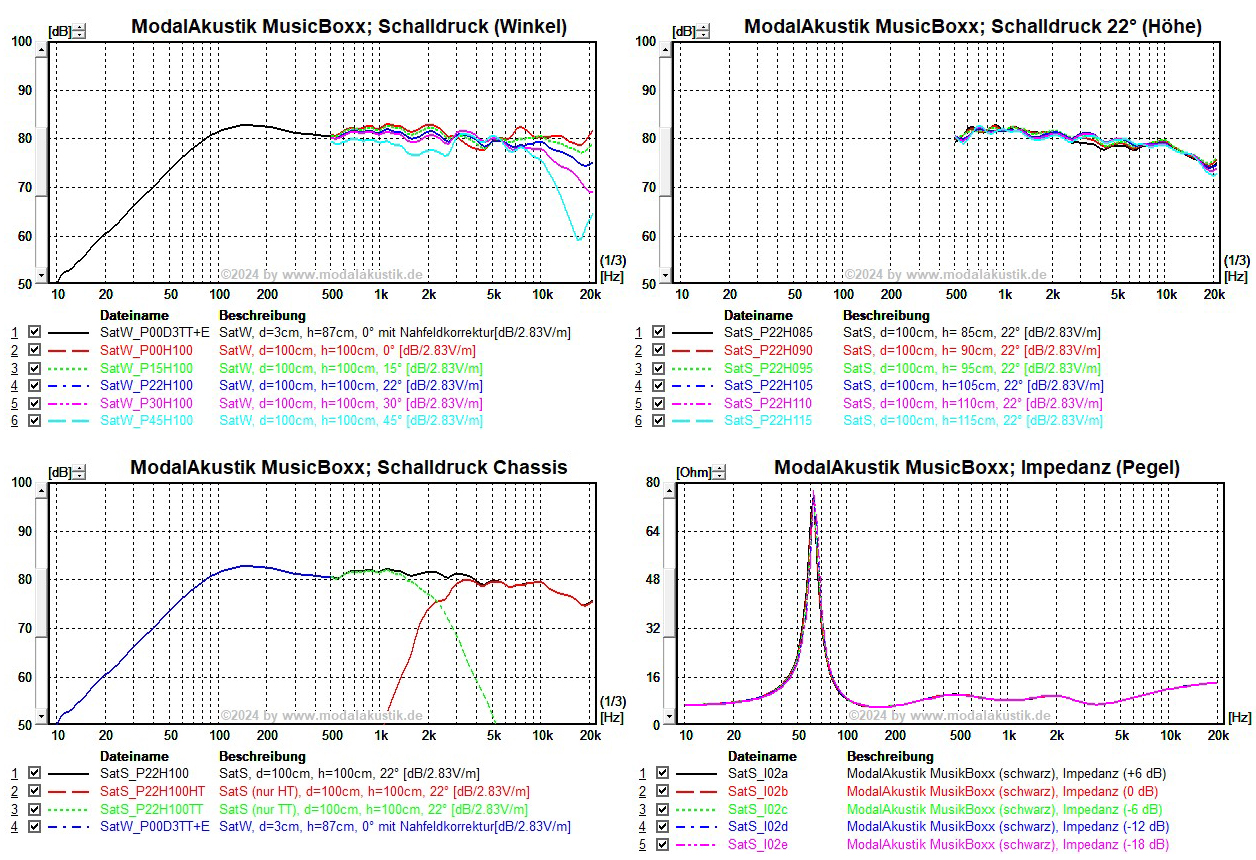
With my preferred 4th-order subwoofer entry having the mains already down 6dB at 100Hz, I'd downplay the steep single impedance spike where any amplifier delivers far less power and damping. As to the amount of HF attenuation, I had a lot of wiggle room between face-on positioning as my usual starting point and a more classic straight-out aim which puts our ears off axis. As the first graph shows with individual lines for 0°, 15°, 22°, 30° and 45°, toe-in becomes a passive tone control in the HF. The more toe-in we use, the flatter of a treble we get. Season to taste. Also, this tweeter is a dipole. It puts twice as much energy into a room than a tweeter whose rear wave absorbs in a sealed chamber. On top of that, the operational principle of an air-motion transformer based on an expired Oskar Heil patent is said to enjoy a 4:1 even 5:1 velocity advantage over classic dome tweeters. It gives them more dynamic expression. On energetic material and against less dynamically aspirated mid/woofers, this can suggest occasional brightness when charged treble events like cymbal hits peak higher than usual. With the Boxx's carefully modelled off-axis behaviour, we're in control of treble energetics. As the third graph shows, at 22° the anechoic response from 20kHz to 150Hz follows a linear up-tilt into the LF. What happens below 150Hz is up to the usual room gain and whether/how we add a sub.











The stands deliver assembled. With the flat footers fully inserted, they elevate the Boxx at 73cm. The swivelling threaded footer posts—check out the exposed one on top of the white stand—are long enough to still increase the standard height should we sit taller as I do downstairs. For my upstairs meanwhile, screwing the footers in to their stops was ideal. The included banana-terminated biwire cables are clearly marked and connect the crossovers to the monitors with length to spare. We supply the speaker cables between amp and filters.
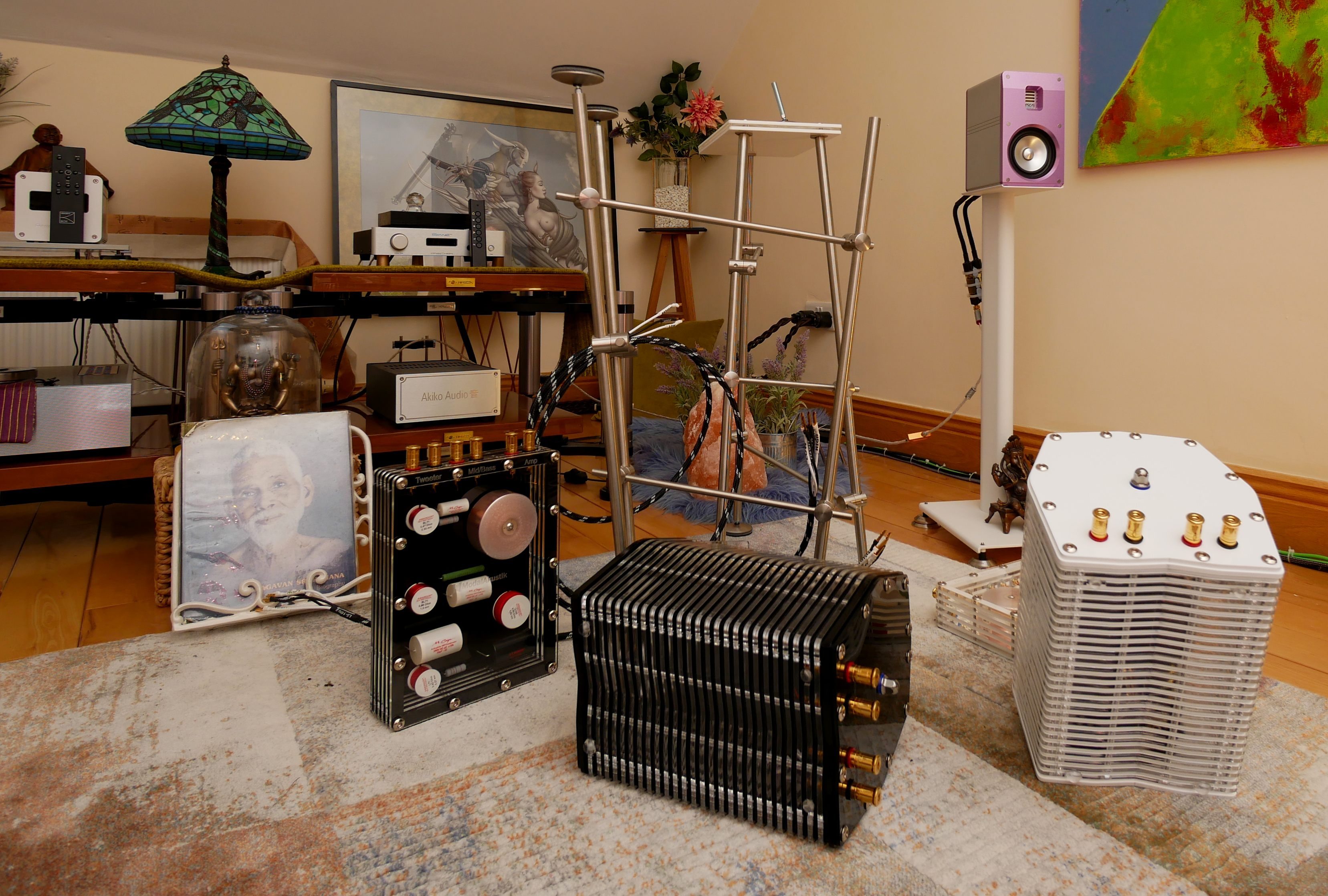
Clever mounting conceals the hookup wiring on the pleated dipole tweeters for an exceptionally clean modern look. The subtle inverted wing motif of the lower baffle edge is another example of fine attention to detail. Like equivalent piano gloss, the black acrylic is obviously very reflective. If you dislike speaker mirrors, go white. Whilst the minimalist stands are spindly, the attached large floor discs render them perfectly stable. Especially in white, I rather liked the full-frontal look of my default toe-in showing no sidewalls in the seated position. In that orientation, the MusikBoxx doesn't let on that its depth rather exceeds its attractively faceted profile. By sending me one colour each, Michael could show both and short-circuit any 'bought the samples' self indulgence which can follow particularly happy review dates. My wallet was safe. And whilst on mismatched colours still, I could see some buyers opting for white speakers on black stands to pick up on the black Accuton rings and AMT plates and maximize a two-tone scheme. I'll show that downstairs. But I won't be able to speak to acrylic's scratch resistance even if Google claims that the weight required to break an acrylic sheet is 30 times greater than a glass pane of identical thickness; and that acrylic has roughly 17 more impact resistance than even tempered glass. Pacecourt's acrylic flooring for tennis, basketball, skating rinks and other sports certainly speaks to its hard-wearing durability even though athletes aren't bothered by scratching or scuffing a court's surface. Suffice it to say that keeping particularly the black acrylic clean will take diligence.

However, there's rather more to acrylic than looks and shiny finishing. "Under alternating current conditions like the intricate workings of a hifi amplifier, apparently non-magnetic alloys of aluminium and magnesium prove to be extremely magnetic, creating eddy currents which interfere with the all-important audio signal." Hence the author of this quote, Denis Morecroft of the UK's DNM Design, pioneered the use of still very rare acrylic casings in serious hifi electronics. "The only significant amount of conducting material remaining in any of our products is the aluminium heatsink in our power amplifiers. To reduce the influence of magnetic interaction caused by such a large expanse of metal, we space the output transistors and regulators away from the heatsink with aluminium oxide blocks. This material has no magnetic properties but good thermal conductivity. This 5mm non-magnetic spacer gives a big increase in clarity and resolution. Imagine the loss of quality suffered by large all-metal amplifiers. Would you choose to make a camera out of glass and then fail to notice that the film kept fogging up?"