 Shifts. With sub 100Hz coverage identical except for adjusting output to speaker sensitivity offsets, the IQ and Boxx performed 'on the level' but different. With its 3rd driver reaching up to 600Hz, the IQ felt more grounded and rhythmically charged, the Boxx more lithe, nimble and aerated. The IQ's far broader dipole bandwidth added tonal effulgence or 'wetness' whilst the slightly drier monopole Accuton focused sharper to image even spookier. Without the IQ's crafty sidewall cancellation from its figure-8 radiation pattern, the Boxx could ride my room's lateral mode.
In the treble, the same Mundorf AMT run far more broadly had the advantage on resolution and capturing the sympathetic string glitter of Jasdeep Singh Desgun's sitar on the breakout album Anomaly in fuller glory. Ditto the right-handed piano harmonics of Vassilis Tsabropoulos on the ECM album Melos. They were more filigreed like spiderwebs glistening in the sun. Whilst I've long admired Raal's ribbon and Raidho's planarmagnetic tweeters as top HF transducers, I now nominate Mundorf's dipole AMT as implemented by the MusikBoxx as my favourite tweeter. "Get a room" and all that. [At right, the footer bolts extended by about two fingers' width.]
Whilst on Zimmer-scale soundtracks the IQ had the dynamic advantage, I tend not to play that loud and massive. I focus more on microdynamic flickers and expressive emphasis than enormous crescendos and Taiko drums. Here the Boxx's deeper insight into musical structures from more separation held the subjective edge. Back on tone and how gifted players modulate it to alter the overtone spectrum, Michael's tweeter had still more to say. Where the IQ plays more of the room's ambient field to inject subliminal playback-venue reverb, the Boxx felt more astute about recorded tone. In a perfect world, I might prefer twin 2×12" Ripole subs on the Boxx for a less drastic jump from its 6.2" Accuton to my 15" AudioTechnology woofers. But that's picking nits with a fine needle.
 Proper single-leg-forward orientation, face-on toe-in given my +3dB/20Hz shelving filter in the active crossover's low pass.
For triggering even less room by mostly overlooking the sidewalls as reflectors, the IQ is my perfect loudspeaker for this space. Just so, in my stereo 2.1 scheme it's obviously rather too much speaker. Here the Boxx makes a smart counter proposal. We're not paying for bass only to bypass it. We're not looking at two freezer-sized LF bins but barely-there stands. We're upping the stakes in the rez game and bolt on three spectacular top octaves. To top it off, cosmetics gain gold stars. That's my contrast assessment against our domestics. But as all buyers (should!) know, once we bring anything home, it's time to stop the comparison shopping. Now we segue into living with our acquisition to enjoy it on its very own terms. As your punter by proxy, that's our final destination.








Time doesn't matter? From Vandersteen to Wilson, speaker designers object to this very question. Vandersteen insist on physical time alignment (sloped or stepped baffles) and minimum-phase 1st-order filters. So did Thiel and the original Meadowlark. Wilson Audio combine steeper filters with physical time alignment adjustments. Reviews describing how Wilson experts dial in their samples routinely comment on the absolute audibility of these very fine incremental changes of the relative distances between multiple drivers and the listening seat. Descriptors thereof tend to be variations on "the sound snapped into focus" like a camera lens perfectly locked onto a target. Other brands combine 1st-order filters with vertical baffles; or use dual-concentric even tri-concentric drivers. Whilst the vast speaker majority denies the audibility of miniscule time delays from filter-induced phase rotation and voice coils not vertically aligned, exceptions certainly do exist. The Boxx's set-back tweeter is such a one.
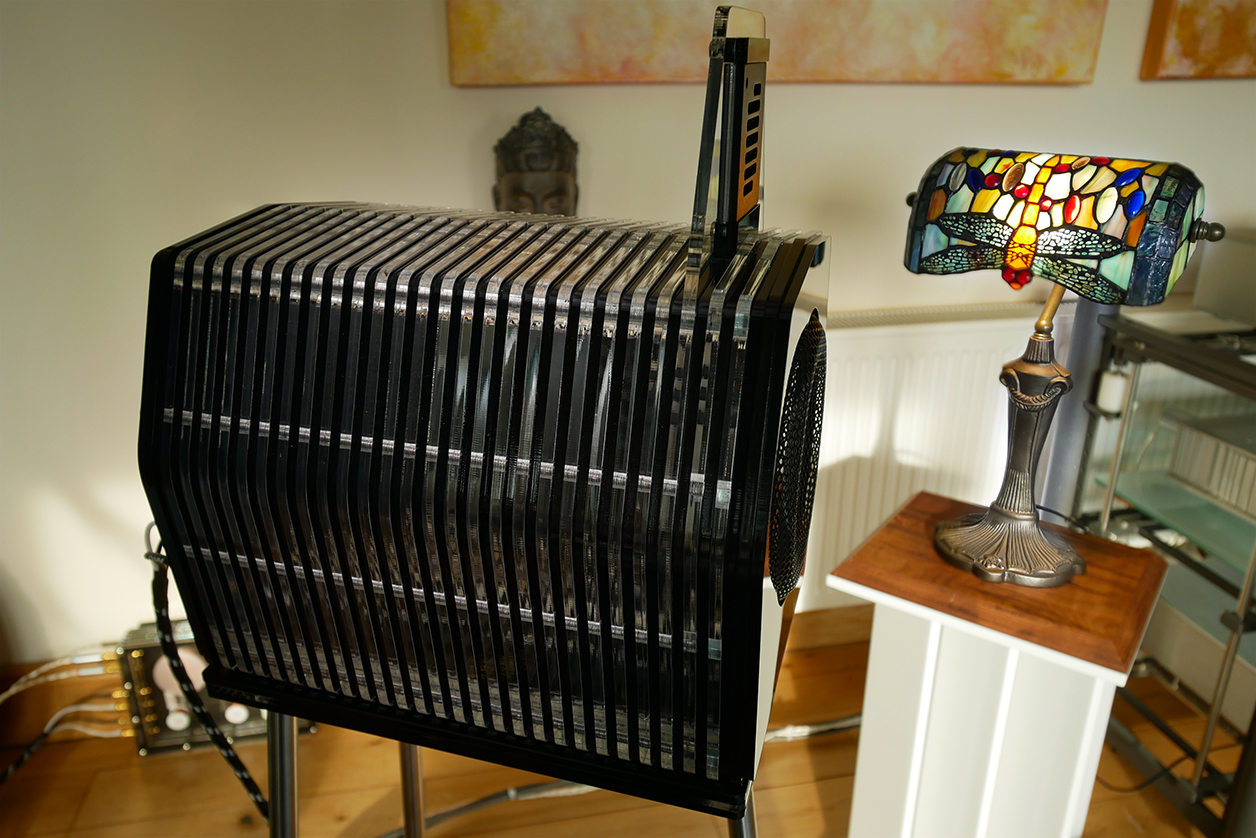 Time-aligned tweeter.
Inert cabinetry addresses the time domain in its own way. It minimizes or eliminates so-called box talk whereby the micro flex of cabinet panels exposed to high internal pressure causes distortion. Single-driver speakers without filter parts avoid the smear of capacitors as another address to the matter of time. Likewise for sealed bass which avoids the resonant MO of ports. Whilst these connections to physical time alignment, sealed loading and multi-lam cabs under tension revive the reviewer's curse of wanting explanations, there's good reason to list them. Be it Zakir Hussain table trills or madly splattering darbuka drums in quartet formation, the Boxx absolutely excelled at separating very fast tightly spaced beats. Most speakers don't return to zero between rapid hits. Envision a classic comb from the side. Each inner tooth is surrounded by an air gap all the way down to the base. Compare that to a debris-matted comb whose individual teeth no longer separate cleanly. That's what many speakers do not with hairs but a kind of haze. Unlike a dirty comb, temporal haze may not be obvious per se but it certainly telegraphs against a speaker that doesn't do that at all; or to a far lesser extent.