
The same applies when Aries Cerat enter this comparison. Their Protos costs half the hARt pre/power pairing, offers no digital or pre-out so operates as basic integrated amplifier. It's also relatively picky about its source, needing a high input voltage and lowest-possible output impedance to work best, both of which are guaranteed with an Aries Cerat source. That said, its sonic performance was up with the best I ever had in my system, just with a different perspective on the music. Its transparency, speed and purity balanced remarkably well against the organic side. Detail retrieval and low-level contrast were first-rate without making the amplifier feel analytical. With hARt the sound thickens and gains gravitas. Treble extension and finesse subdue a touch but dramatic scale, saturation and warmth are more apparent. The SPEC RSA-EX1000 makes for a classic "horses for courses" scenario. The Japanese integrated runs cool, requires no maintenance whatsoever, occupies less real estate in the rack though that argument can reverse by considering that the Tune 4 can act as the only source you need. Most importantly, it sounds very different than the hARt combo. SPEC's flagship integrated seems to intentionally research invisibility and neutrality. It is gentle but of a sobriety which a southern Mediterranean temperament could at first misread for coldness where the longer run reveals respect. Openness becomes an allowance of personal space to feel accepted and at ease. Although the EX-1000's abundant power reserves allow it to dominate a pair of loudspeakers with a firm first, it never became bossy or vulgar. Its delicate, feline, elegant inner nature shone through regardless. The hARt Lab Tunes are more muscular, sanguine and explicitly embodied. Their visible tube vocabulary is allowed to trespass into some editorializing to inject a stronger sense of harmonic character.
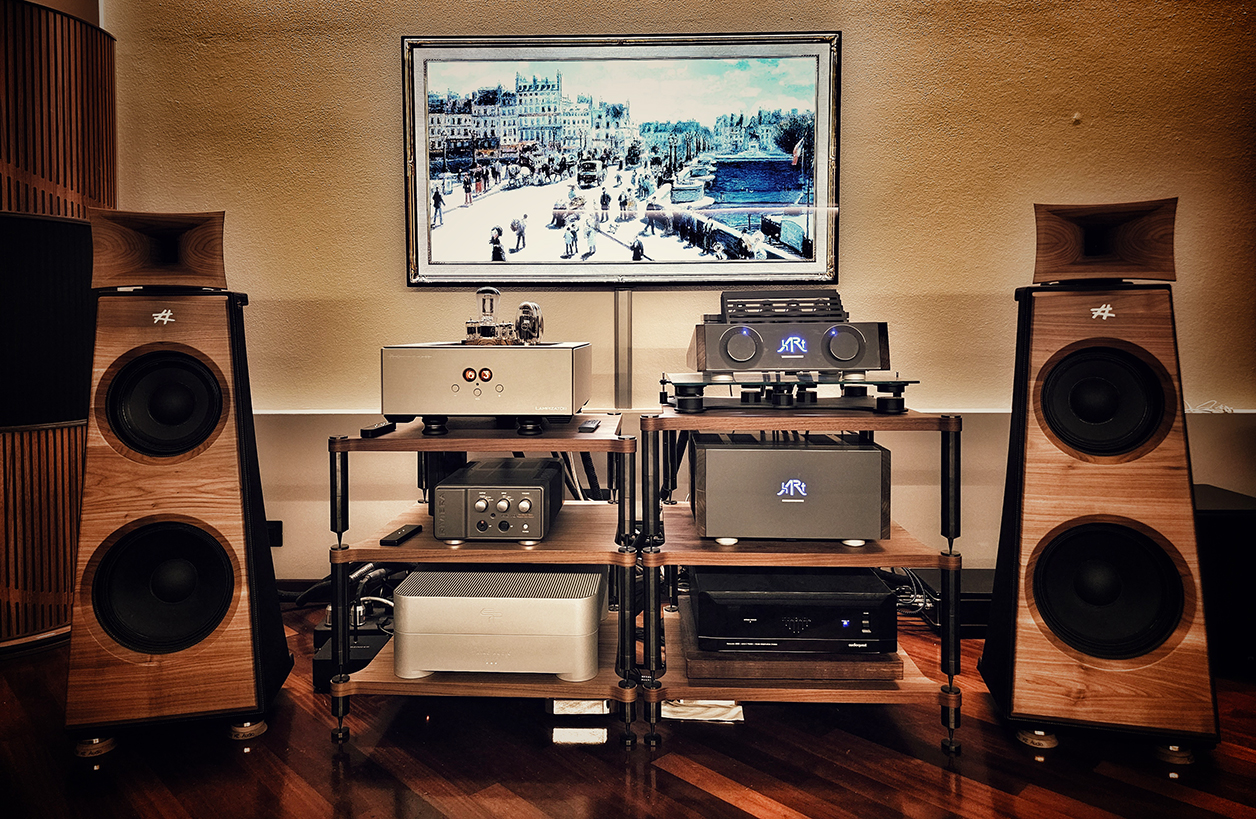
Ultimately the hARt Lab Tune 3+4 pairing is a union of saturation and scale. They offer more colour and dimensionality than the stereotypical high-power transistor amplifier; broader speaker control than purist tube amplifiers; and more functional completeness than most separates. The Tunes are not for measurement absolutists who want distortion figures to vanish into decimal dust; nor for separates minimalists who distrust digital boards inside analogue boxes. But for listeners who respond to outstanding sound supported by design conviction, hARt Lab's choices are refreshing. These electronics come at a steep price even by today's gentrified hifi standards hence meet formidable competition. My strongest praise is that the Tune 4+3 system seems to know what it wants to be. It blends minimalistic principles inherited from an era where thermionic valves dominated signal amplification with the versatility, scalability and integration needs of the modern age. The result is curated complexity. The Tune 4⇒3 is a system that makes even more sense than either component in isolation. The preamp explains the power amp; the power amp justifies the preamp. Visual and circuit originality reinforce each other. One merely looks at the pair and already expects more than standard audiophile black-tie obedience. Together they form an answer to a very real question: can hifi be beautiful, technically individual, modern in use and still emotionally persuasive?











In my opinion, the answer is yes.
