On the Tune 4 front panel, the right knob is source selector, the left volume control. LED show their settings. This is eye-pleasingly minimalist but not terribly practical for the input switch without extra identifiers. Beneath the front panel hide two buttons to control the colour and brightness of the backlighting whose settings go to memory. Beside the physical touch interface, all preamp functions duplicate on the substantial brushed aluminium remote and web-based interface. On the top panel's front corners sit a 6.3mm headphone jack on the left; and a USB input for external storage on the right. Given the Tune 4's multifunctional talents, its back panel populates densely with i/o. "The rear panel is acrylic composite to provide electrical insulation, reduce eddy-current interactions and decouple the connectors from the chassis. It features backplane source switching whereby the input relays sit directly behind the input connectors. Thus the signal path between input connector and relay is extremely short." There are 5 analogue RCA inputs, the first dedicated to phono if this €2'500 option is ordered; and a range of digital inputs via twin USB, coax, optical, LAN and WLAN. There's also a ground post for phono. Two sets of RCA outputs label "main" and "direct". "Main" inserts a class A output buffer, "direct" couples to the CV181 tubes. I appreciated the paralleled outputs whereby to connect both Tune 3 power amplifier and my subwoofer. I was also curious how they affect the sound. "Direct: maximum purity, texture, dimensionality and harmonic richness. This is the most organic and emotionally engaging presentation. Hybrid: slightly firmer control, higher current, a more incisive dynamically authoritative character. Due to lower output Ω, "main" is best suited for long cables of higher capacitance to distant monoblocks, active speakers and subwoofers. Given your experience with ultra-high-end systems, I suspect that you may prefer the direct output for its naturalness but the choice will ultimately depend on system synergy. That's why we offer both." The Tune 4 dimensions including the tube cage are 20x43x39cm, weight is 12kg.
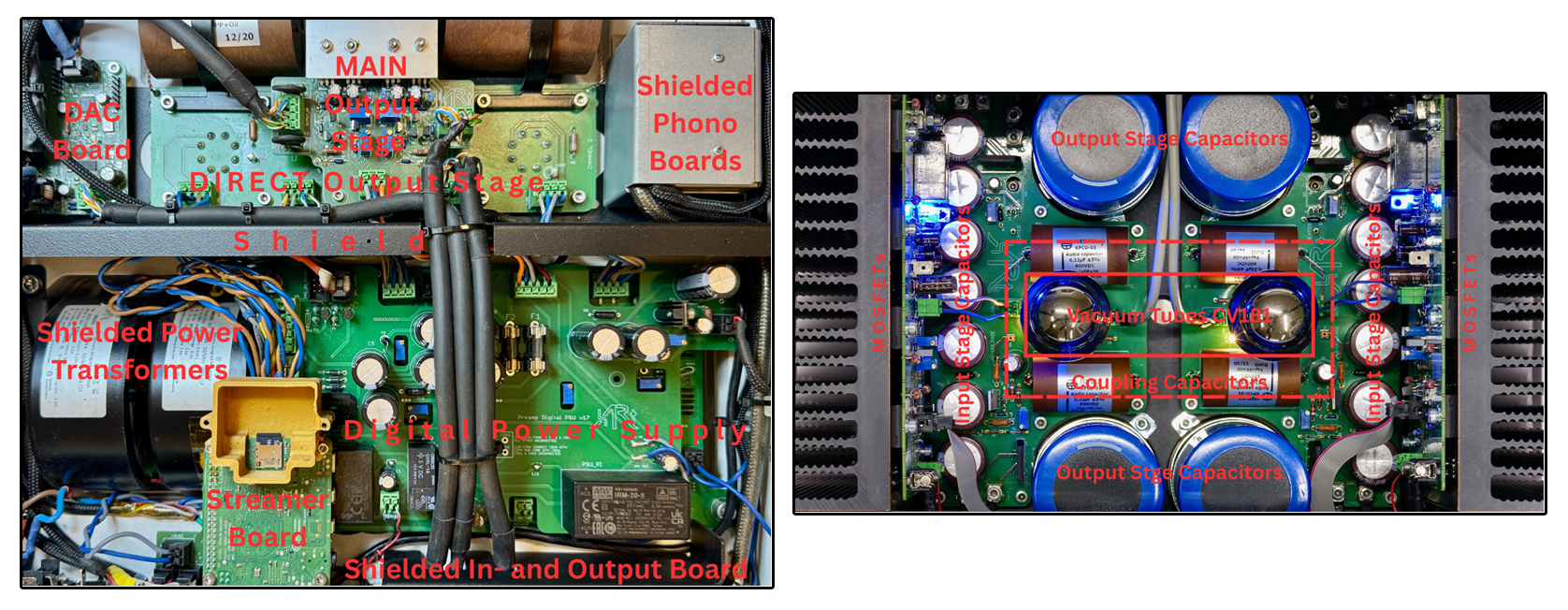
About its topology, more Mr. Gaveras: "A single class-A tube stage feeds the direct output. Following this is a class-A solid-state buffer of zero voltage gain to feed the headphone and main outputs. What the photo doesn't show is the analog power supply on the upper side of the chassis, by the grilles behind the tubes. You see only the two dual-mono power transformers. Everything shields to prevent EMI for remarkably quiet performance especially with a tube device." Fully separated power supplies for digital/analog audio/control circuits add up to a full dozen. Dual mono and star grounding aim at reducing and/or rejecting noise. As volume control is a main preamp task, I asked how the Tune 4 implements it. "As a true relay-switched stepped resistor ladder with 64x1dB steps. We use matched precision resistors, ultra-durable signal relays, constant input impedance, a minimal signal path, zero digital, carbon track or IC-based attenuation so can guarantee stable behaviour over time without any deterioration from mechanical friction. The relays seal hermetically for a long lifecycle. This ensures transparency, microdynamic resolution and stable channel balance even at very low listening levels." The digital streamer and DAC cards plus headphone circuit are no mere conveniences. They are fully formed custom solutions each with its own dedicated power supply and high drive aiming at compelling performance compared to dedicated external units. "The single-board computer used as streamer also has other functions and therefore is a standard feature. The €1'500 DAC board is optional, however. But even without it, the digital streamer signal can be routed USB-out to an external DAC then fed back into an analog line input. The main advantage of the internal DAC is the I²S connection and absence of a digital interconnect. We've chosen a Burr-Brown DAC chip whose implementation is far more important than its model number. As you can see from the photo, we invested heavily into the digital power supply. The incoming signal is re-clocked to reduce jitter then upsampled to 192kHz as the DAC's optimal rate to push quantization noise to higher frequencies where it can be filtered more effectively. One advantage of having streamer and DAC in a single chassis is the short I²S connection."











The Tune 4 has no internal storage so our music library data will access via NAS/USB. As for the streaming user interface, "we use no proprietary app to ensure long-term compatibility and platform stability. Our streaming implementation is the renowned Volumio music player OS. Designed to be transparent, stable, sonically invisible and fully compatible with Qobuz Connect, in our view it is one of the most elegant musically convincing control ecosystems available today." I used Qobuz Connect which worked like a charm. Being a hardcore headphone enthusiast, I was more than intrigued by the Tune 4 given Epaminondas' comment: "This is no auxiliary add-on. It is a fully discrete high-voltage design derived from our linestage topology. It combines tube voltage gain with a dedicated current buffer, high voltage-swing capability and support for both high-Ω and demanding planar loads." Just so it wasn't designed as a measurement champion but to operate at a musically complete, emotionally engaging level. Before protection kicks in, maximum output is 16Vrms from 30-600Ω. Output power tracks from 8.53wpc/30Ω to ~0.43wpc/600Ω. There is no lower impedance limit, only that protection kicks in at 10V/22Ω. As my preferred scheme was to connect my LampizatOr Horizon 360's relatively hot voltage—allegedly ~5V RCA though not officially confirmed—directly to the Tune 4 without engaging the DAC's own attenuator then given the relatively high 300Ω output impedance of the Horizon, I asked hARt Lab about potential input overload or mismatched drive. "A 5V input signal is absolutely fine and gives excellent headroom. The 300Ω output impedance is no issue either since the Tune 4's input impedance is sufficiently high to eliminate load concerns. You should experience no dynamic compression or tonal imbalance." What makes the Tune 4 unique is no single checkbox. Streamers exist. So do DAC preamps, tube linestages, relay attenuators, hybrid headphone amplifiers. The Tune 4's distinction is the density of choices around a single aesthetic and circuit philosophy. It is no feature-loaded transistor preamp with a decorative tube buffer. It is a tube preamplifier whose makers decided that modern functionality needn't be sacrificed to external boxes. The risk is obvious. Complexity can pollute purity. The ambition is equally obvious: one chassis, one visual language, one grounding scheme, one control interface, one gain-stage philosophy.
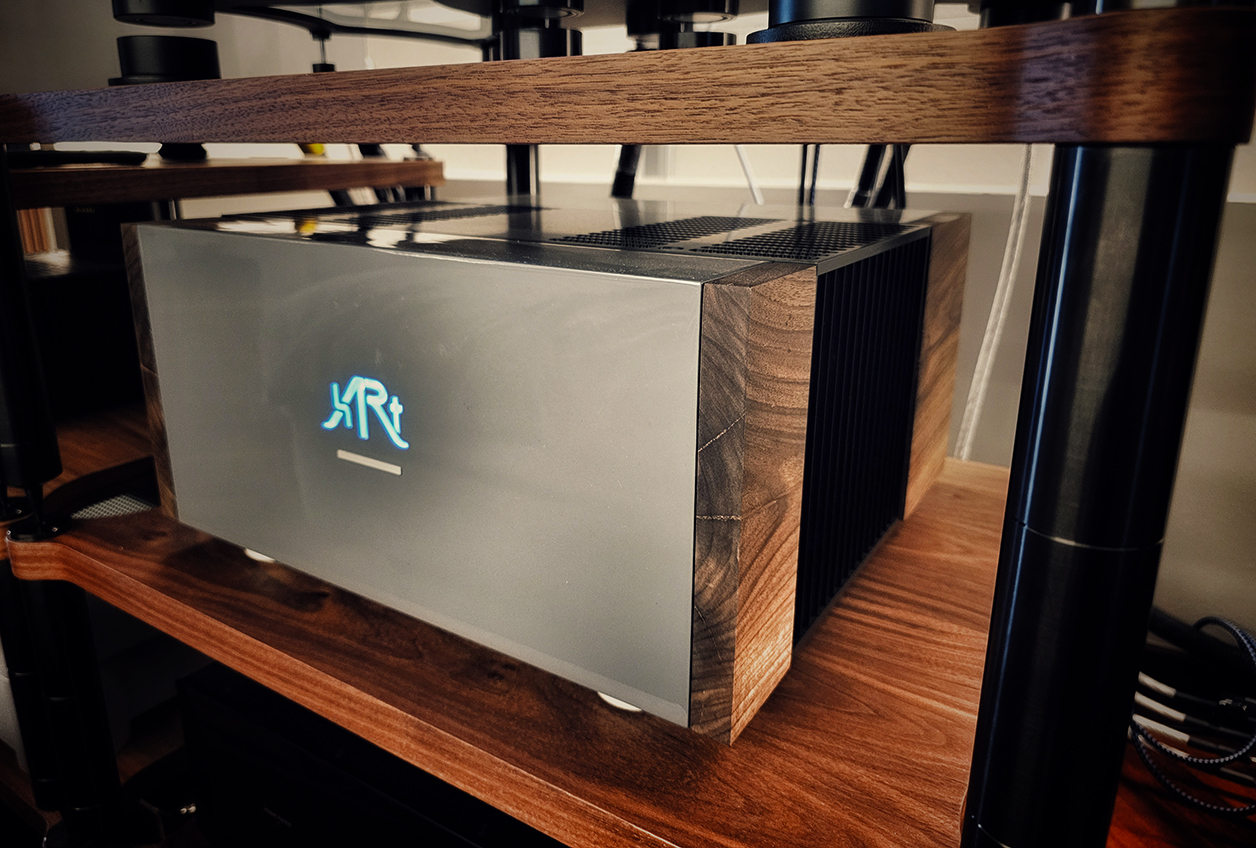
The Tune 3 is easier to describe. It is a dual-mono hybrid stereo amp whose job is to take the preamplifier's voltage signal and command loudspeakers with authoritative current. If the Tune 4 is the sophisticated social creature, the Tune 3 is the engine room. It is an imposing machine, occupying 20x43x41cm volume and 32kg. While not as fancy as the Tune 4, the appearance still captivates given the excellent finishing made more industrial with lateral heat sinks. At 165wpc/8Ω, the first 15 watts in class A, heat dissipation becomes significant hence concessions to aesthetic sophistication must apply. My sample had the same Nardò grey paint with wooden dress panels as the Tune 3. That made for a striking combo on my rack. The front panel hosts the back-lit logo and touch-sensitive mains switch plus the two frontal belly buttons for hue and intensity. The back sports RCA inputs and paralleled speaker terminals to bi-wire like my Diesis Aura and Spendor LS3/5A support. The Tune 3's true dual-mono architecture gives each channel its own custom-toroidal power supply and just two gain stages— tube-based voltage amplification via two CV181 double triodes then current gain via four pairs of lateral Exicon Mosfets. The CV181 of the Tune 3 and Tune 4 is broadly associated with the 6SN7 family of double triodes and valued for linearity, generous tone and strong drive. The Tune 4 power supply is different. "The VAcc battery emulator—VA for virtual accumulator—is our distinctive solution to solve the constraints of typical audio power supplies without introducing the real-world compromises of traditional physical battery banks. Standard audio power supplies rely heavily on large capacitor banks to smooth out AC rectified to DC. However, they remain highly susceptible to real-time mains fluctuations, HF line noise and impedance shifts as the amplifier dynamically draws power. Our VAcc acts as an active electronic barrier. It leverages custom-wound mains transformers and specialized high-speed regulation circuitry to mimic the behavior of a massive DC battery bank.