"We pursue a strict minimalist design philosophy focused on zero feedback loops across the vacuum tube and Mosfet stages. In traditional amplifier designs, negative feedback is often used as a crutch to clean up distortion and power supply noise. Because we avoid this, our power supply's native noise floor must be practically non-existent. We selected the VAcc topology for several reasons:
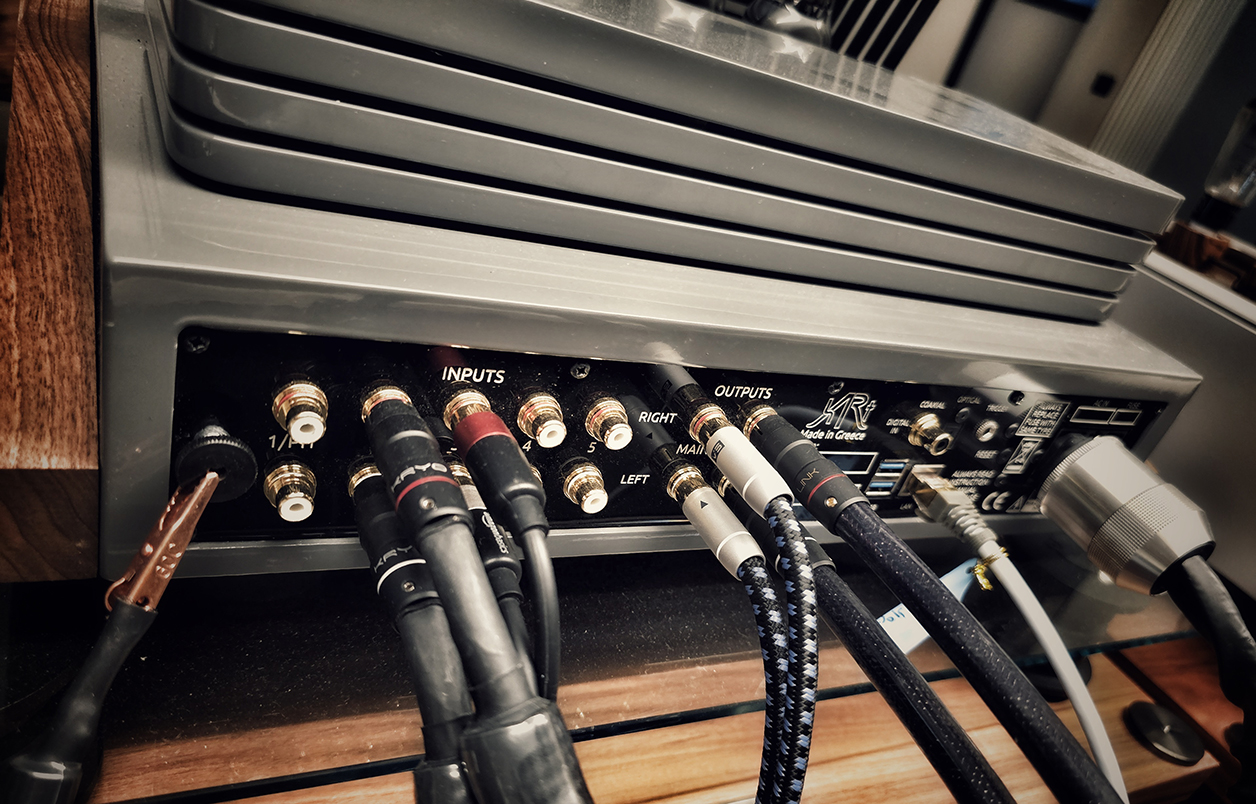
"The topology is pretty simple just as it should be. There is a single class A vacuum-tube driver stage that amplifies the signal voltage which feeds class AB (first watt in class A) transistor outputs that amplify current without voltage gain. Between the two stages sits only a very high-quality paper/oil/polypropylene copper-foil coupling capacitor from Miflex. What you don't see in the earlier photo are the two massive power transformers behind the fascia covered by the fixed part of the chassis. The LEDs inside the Tune 3+4 are diodes used to provide bias to the vacuum tubes so not artistic illumination like the logos. The circuit has zero feedback of any kind. This enables correct timing and phase behaviour of the signal. This is very important for the soundstage and particularly its depth."
As expected, this purist/minimalist approach applied to a high-power amplifier and refined after more than 15 years of development driven more by listening tests than record measurements means distortion figures, bandwidth and damping factor more typical of SET than transistors. Independent measurements add nuance. AVMentor reported that judging the amplifier by a 3% THD+N power threshold gives misleadingly low numbers because distortion rises in a manner tied to the tube voltage stage. Real clipping power was measured close to the official rating: 162W/8Ω, 275W/4Ω. The same report noted a damping factor of ~34, low noise, dominant 2nd-harmonic behaviour and smooth transient behaviour without obvious square-wave problems. That information frames the Tune 3 as a consciously voiced amplifier rather than testbench Olympian. A dominant second harmonic and no feedback point toward dimensional density and textural continuity over vanishingly low distortion. The design wager is that the human ear/brain does not perceive all distortion equally and that a circuit's time behaviour, harmonic distribution and feedback strategy matter at least as much as astonishing THD. Whether one agrees or not, the Tune 3 doesn't hide its character. It is engineered around it. This is what Epaminondas added on the challenge of achieving the virtues of low-power designs in an amplifier with enough muscle to drive most modern speakers: "You are correct. Achieving purity in a minimalist low-power design is comparatively easy. The best example is the single-ended tube design. The key point is simplicity. The challenges with higher power are parallel active devices; greater circuit complexity; thermal stability; and mechanical vibration. Our approach was to design the amplifier like a low-power, purity-focused circuit. This meant just two gain stages—class A tube voltage gain and a Mostfet current buffer which operates to ~15wpc in class A depending on load. This gives us single-ended topology over the first few watts with fewer stages than a pure SET whose output transformer becomes an additional stage of arguably the worst kind. We achieve power scaling without altering the intrinsic signal topology and strictly control device matching and thermal symmetry." 200W idle consumption tells us that this is no cool-running high-efficiency amplifier. Even before playing it spends energy to maintain its operating conditions. That is part of its ownership equation. In an age where many listeners value low heat and standby guilt, hARt Lab champion more traditional high-bias seriousness.













Over the three months I had the Tunes at home, the average daily temperature in Florence was a record-setting 34°C. Considering the beneficial effect of a 2-hour warm-up period, this gear contributed – uh, enthusiastically to the sub-tropical climate in my listening room. Air conditioning was a lifesaving necessity. But the sound was rewarding. The general sonic signature of the Tune 3+4 system is weighty, organic and three-dimensionally sculpted. Its strength is continuity; a sense that tone, image and dynamic pressure are made of the same stuff. Far from ultra-dry studio exposure which pins each performer to the wall with forensic exposure to leave the listener wondering why nobody moves, these hARt electronics point at a more embodied framework. Images have volume not outlines, vocals chest and mouth not just diction, strings wood below the bow, brass breath behind the flare. This is no pairing for listeners who equate truth with austerity. It is for those who believe that truth includes temperature. The overall gestalt is of ripe control—not romantic excess nor muscular sterility but ripe control as the sensation that a note is allowed to bloom not sprawl, that harmonic colour is present but not artificially glossed on, that the amplifier can play quietly without collapsing and loudly without turning white. Bass is consistent with this aesthetic. It has body and pitch rather than overdamped dryness. It may not pursue the locked almost synthetic grip of certain class D or ultra-low Ω amplifiers but neither does it behave like a vintage valve amp whose woofer control depends on sympathetic loudspeakers. You trade some subterranean extension and tectonic authority for bloom, resolution and elasticity. The treble is persuasive, luminous and never overly etched. Harmonics aren't spot-lit, ambience won't spray, cymbals not turn to silver confetti. There is a tasteful dose of sweetness which makes less than perfect recordings more tolerable than usual but without congealing as when cymbal metal turns to mist or energized extension is hampered by manufactured softness. The midrange is expressive, luxurious, enveloping yet not syrupy, slow or blurry. It's coherently integrated with the spectrum where tangibility and plumpness prioritize over hyper definition and aerial quickness. Vocals are emotional and incarnated with a clear communicative projection of the relationship between the singer's bodily features and the sound projected onto the mic.
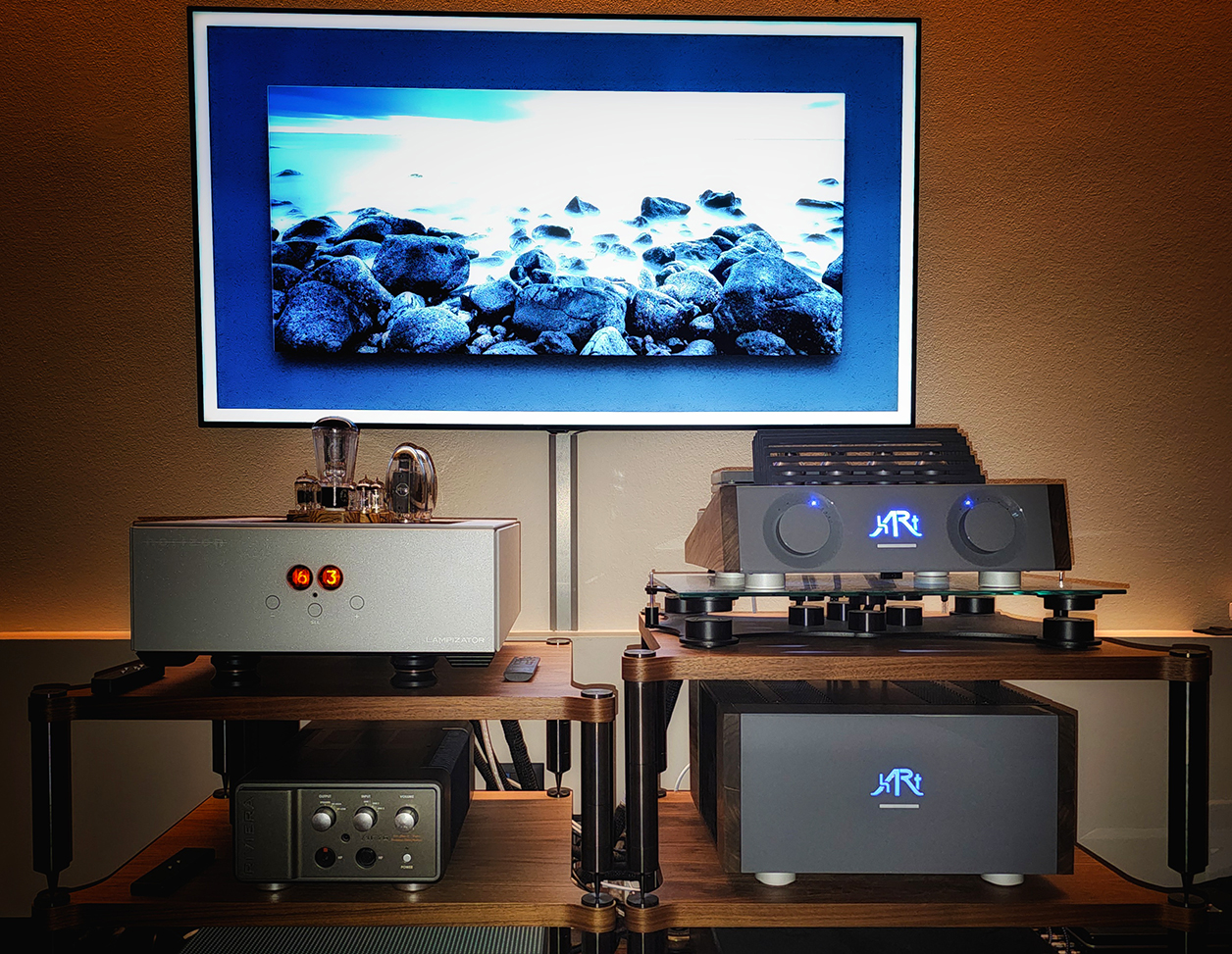
 These attributes are especially characteristic of the system configured with the direct output from Tune 4⇒3. Wired through the hybrid/main path, the Tunes change personality. It's not a Jekyll/Hyde shift but apparent enough to be worth exploring for system synergy, personal taste, even genre matching. Dynamic contrast and perceived speed become more pronounced, image solidity deepens, the soundstage feels more composed. A general feeling of increased tautness informs the presentation. Rock and electronica feel more exciting and dimensional while with acoustic genres I missed some of direct drive's harmonically complex aura and relaxed seamless. Some nuances simplified as an outlined version of themselves whereby music's structural side took a more prominent role than its cohesive wholeness. A recording that exemplifies this is the II volume of the Bach Harpsichord Concertos by Francesco Corti and the Il Pomo d'Oro ensemble. The Tunes happily reproduce the vibrant colour palette of this Baroque material, even highlight a certain saturated side to seemingly amplify the ensemble's dynamic range and the basso continuo's weight. Through the hybrid output the vivacious tempi, venue cues and contrast between harpsichord and ensemble are the main anchors of musical enjoyment. The direct output seduces with slightly longer more relaxed decays to have one more appreciate the harmonic richness of various instruments, the continuity of phrasing and ensemble interactions.
 The eponymous opener from Caverna Magica, the groundbreaking 1982 album which had Swiss harpist Andreas Vollendweider and sound engineer Eric Mertz experiment successfully with 3D soundscaping technologies through sophisticated use of Lexicon digital reverberation systems is an ideal showcase for the Tunes' ability to portray sound in space. I found this to be one of their major strengths at least on par with the best I had in this room thus far. What makes the experience rewarding is the combination of soundstage size particularly in width, rock-solid stability of the central image and instrumental separation. Some systems achieve soundstage expansiveness through a somewhat homogenized transformation which may produce satisfying room fill but often comes with a lack of proportion between images and their actual physical counterparts, with fuzzy contours and relative flatness. Not with these Greek electronics. Their enveloping effect consists of genuine ambience cues inhabited by clearly defined, believably sized and well localized musical objects. To push the boundaries of room-filling powers and textural
 complexity further whilst elevating dynamics range by an order of magnitude, I tried Shostakovich's 10th symphony in the DG edition with the Boston Symphony under the baton of Andris Nelsons. This was a truly staggering experience and so exciting and satisfying that I found myself turning the volume knob a tad or three beyond normal to maximize the feeling of being physically swept away by full-blown orchestral passages and percussion delivered with elastic organic texture, articulation and breath that only invited more.
No signs of tonal hardening, image collapse or acidification meant that listening fatigue vastly procrastinated. This brings me to another solid asset of the Greek electronics. They make you strive to stretch your listening sessions to infinity one more track at the time. This is a very valuable feature especially for listeners who do not limit themselves to immaculately recorded material where the Tune 3+ 4's inclusive nature becomes a blessing.