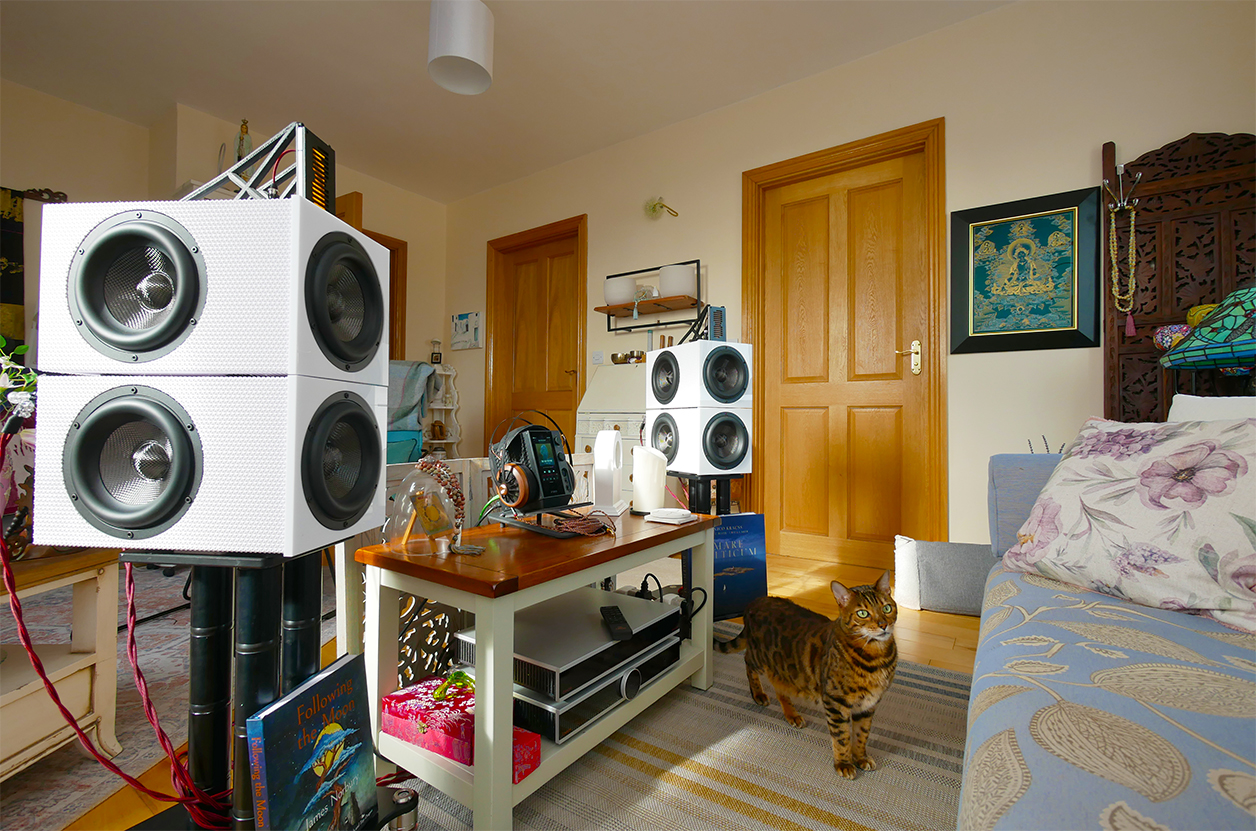
Heavy metal. On the cm/kg score, these 4-Series decks really move the needle. Unpeeling them from their precision-cut hard-foam clamshells triggered my internal shock gauge. I'd somehow expected undercarriages of regular bent sheet metal. What unpacked was more substantial and thickly painted in metallic fleck paint. In short, the hands-on vibes were proper luxo. Highly reflective glass fronts over black look super slick but are uneasy to photograph in closeup unless one is a light-absorbent pro with plenty of drapes. What drapes? So take my word for it. This dress code is black-tie stuff; sharp, understated and elegant. To put some mileage on these clocks, I set up the twins in my upstairs nearfield system. When I needed quiet whilst working other reviews in the house, I switched to Meze's 109Pro headphones. Even Chai Baba my Bengal cat wanted in on the photo op. What a hamburger. Power users wanting to enter the I4S as a quasi power amp of 'standard' 26dB voltage gain will simply set the attenuator to -9dB then operate their beloved preamp as usual. On the subject of which, what does voltage gain become in home-theatre bypass which we recall any of the three inputs can be set to? "In HT bypass, the gain is as you select it. You select the desired input, adjust the volume you wish to run at that input, then lock it in with the HT mode menu. Re: upsampling and reclocking, the remote we supply with Verto D4S and Virtus I4S also works models from the Performance and Foundation lines. Unfortunately Verto D4S doesn't support these features but we still must update this information in the owner's manual to properly reflect it." That answered all my remaining questions. On my HP Z2 workstation updated to Win 11/64 last year, Verto required no Windows driver install. Audirvana Studio recognized it immediately as PCM768/DSD256 compliant though setting its r8brain upsampler to 705.6/786kHz caused minor distortion. However, 352.8/384kHz was smooth sailing. So was DSD256 though as with prior ESS DACs, I preferred hi-rate PCM. My discrete R2R Audalytic DR70 thus far is the exception. I prefer it in DSD256 mode.
 FiiO R7 as SD-card transport USB out into Verto.
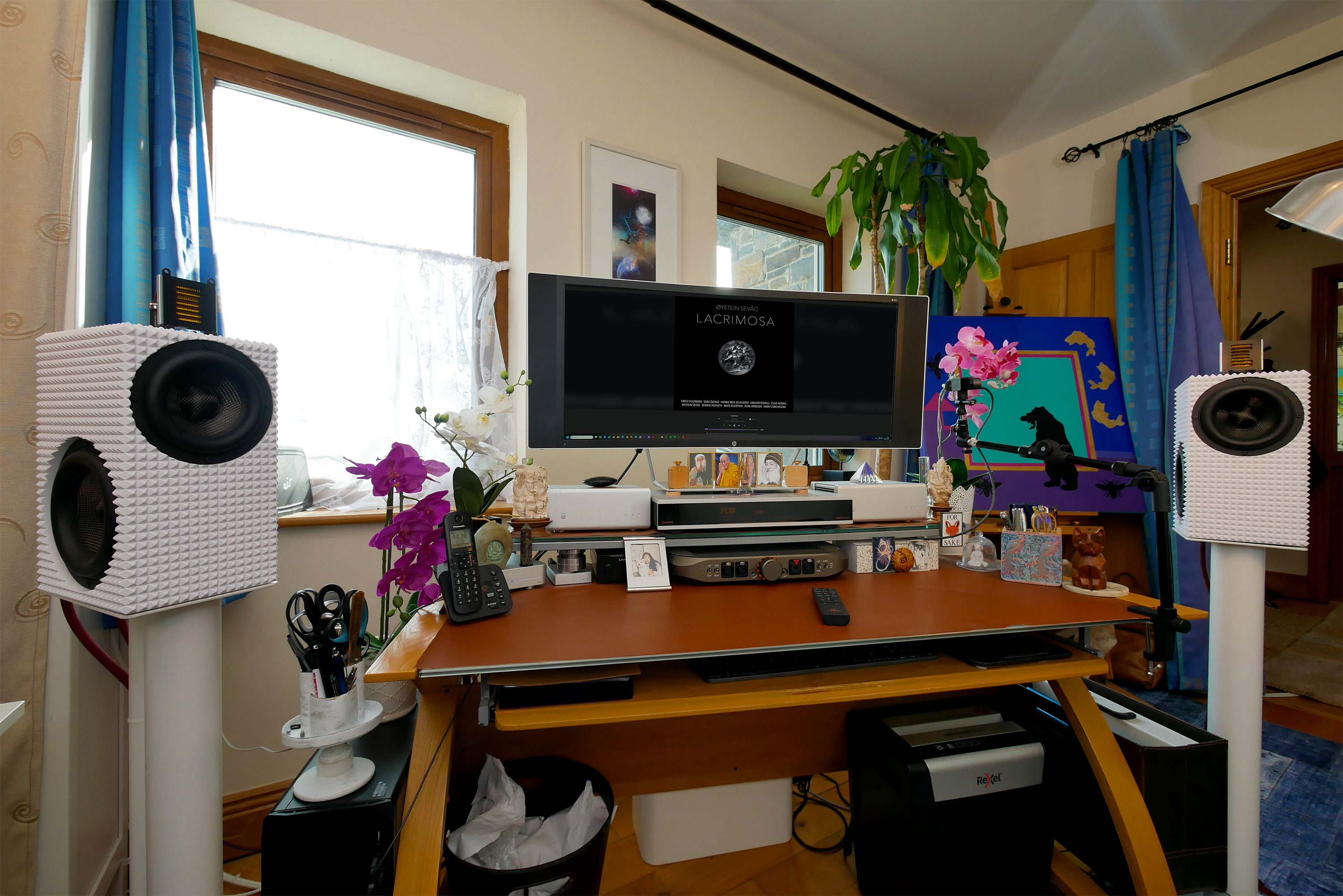
Here we see my office desktop where Verto played balanced into a FangSound Dionysus as balanced preamp for the Topping B200 monos fronting Virtual Hifi Viper monitors. Whilst most would consider the Verto/Virtus twins overkill for a desktop, their lowrider profiles certainly do go places. Also, in my Hifi Bible nearfield systems like the above or below are the smartest way to most easily maximize performance from speaker systems when expectations model on premium headfi which completely eliminates the room. To really hear planktonic detail without wearing headphones, the nearfield is gold. Recording engineers know this. Why not the average audiophile? Do they think their hearing beats the pros to make up for the room-conflicted difference?











For a first stack impression, the Canor twins replaced my usual GoldNote IS-1000 Deluxe integrated in the below video 2.1 system. Digital 48kHz signal came off an Oppo universal player. Speakers were Zu Method monitors with their matching Method sub in preset N°2 for basic 2nd-order/41Hz augmentation mode as pre-coded at the Utah factory. Having slowly worked my way into Season 5 of the 12-season DVD collection of New Tricks, I instantly noticed a change in the voices of the four leads. Having by then spent weeks with the same cranky retirees of the Unsolved Crime and Open Case Squad, I was quite surprised by how obvious this tonality shift was from the cooler drier bipolar output transistors of the Italian deck to the more belly-than-chest sonority of the Slovakian Mosfets. To be sure, these actors—one female, three male—cover very limited bandwidth. Yet it's in fact the speaking not singing voice which has our hearing's spider sense most keen. Once locked into a person's timbre, we can identify someone not seen in years solely by their voice. True, this does include cadence, accent, word choices and speech patterns. That said, this hardware swap had clearly modulated the quartet's timbres in ways my ear/brain 'saw' in a moment; a possibly more elemental Sherlock moment than using music. A parallel insight was that the widower of the lot, Jack, could get emphatically louder than before, suggesting that the omission of degeneration resistors really does benefit dynamic range. A functional nicety was that one press of the remote powers up/down both units without any trigger cables. The DAC goes live quickly, the integrated first runs through a thermal stabilization process shown by a slowly completing circle in the display. The latter's two themes are all orange script; or orange and white. With Virtus we can either fly the logo or show the selected input.
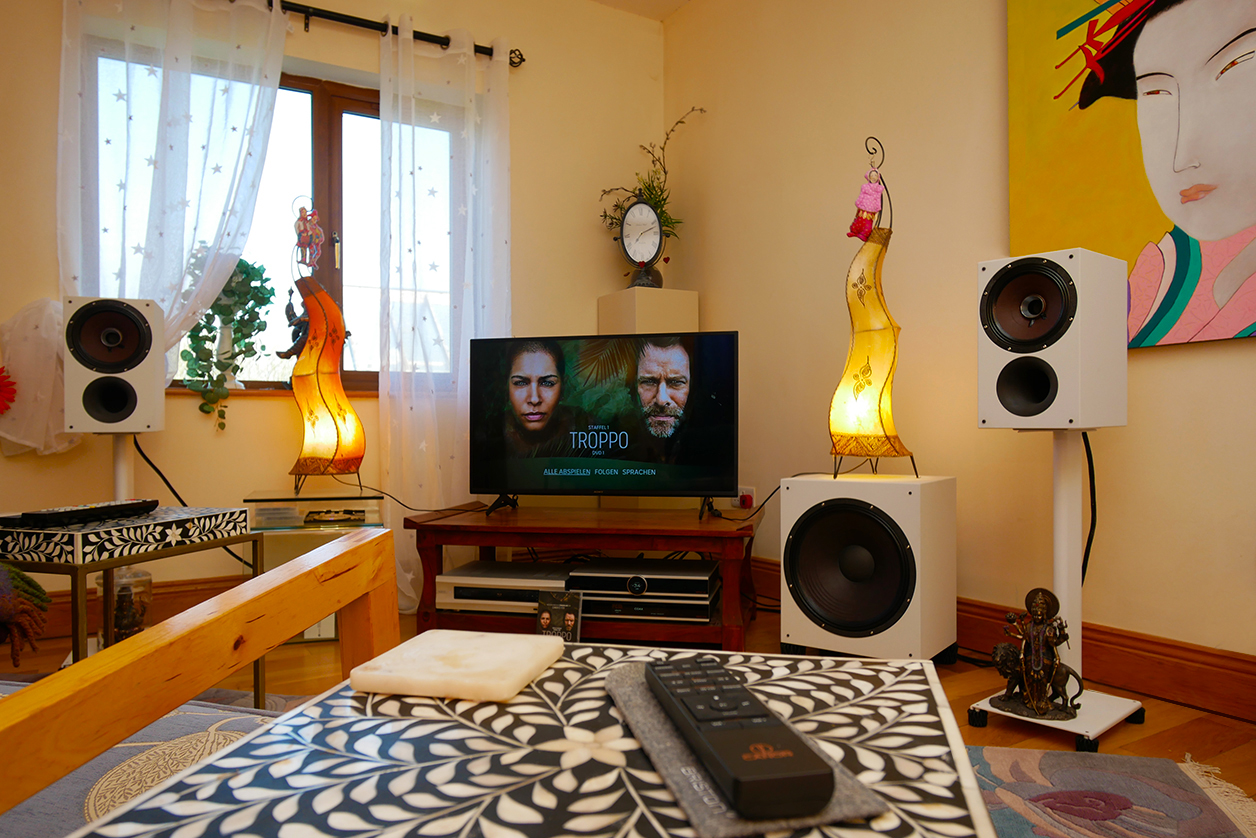
At this juncture, Ivan checked in with an update: "The first two products from the Foundation line are the Virtus I4S and Verto D4S you're currently reviewing. We're now working on more models to complete this line. I can share that there's a CD transport in the design stage already. Additionally we have plans for a preamplifier that will include a high-quality headphone amplifier as well as a dedicated power amplifier, perhaps even a phono preamp. Let’s see how this product line will do. The fact is, all its products will share the same industrial design. But that's not the end of it. We are intensively working on another range called 'Essential' which derives from design features of the Foundation line. The Essential Line will be officially introduced at the Vienna High-End show this year." That was my prompt to get essential. Assess my twins separately, each on its own. For Verto this meant my bigger upstairs system. Here a quad-autoformer magnetic volume control with pure silver wiring performs lossless attenuation and impedance conversion.