By late January 2026, the I4S product page launched. With it lingering mysteries lifted. Canor really did manage to incorporate a classic linear power supply whilst eliminating the need for bristling heatsinks by thermally bonding their class AB output transistors to massive copper bars bolted to the thick aluminium top plate for extra thermally conductive mass. Capacitance is 40'000µF per channel. "An intelligently controlled noise-less fan keeps temperatures stable." This photo shows no fan so some mysteries do remain. But then most hifi shoppers don't geek out over fans. Also invisible is an automated relay maintenance system. That runs HF signal switching to enhance conductivity and service life of the relays administered during the power-down cycle. The phono settings and cartridge adjustments are all accessible from the remote. The amp comes in three colour ways against an always black casing: bronze, silver and all black. The ¼" headphone ports outputs 580/190mW into 30/300Ω, overall voltage gain of the amplification circuit is 35.5dB and phono gain adds another 40-60dB. With a quite standard 43x31cm footprint, the patently non-standard aspect of this amplifier is its flounder-like 7.5cm height. Yet it still weighs a substantial 12kg.
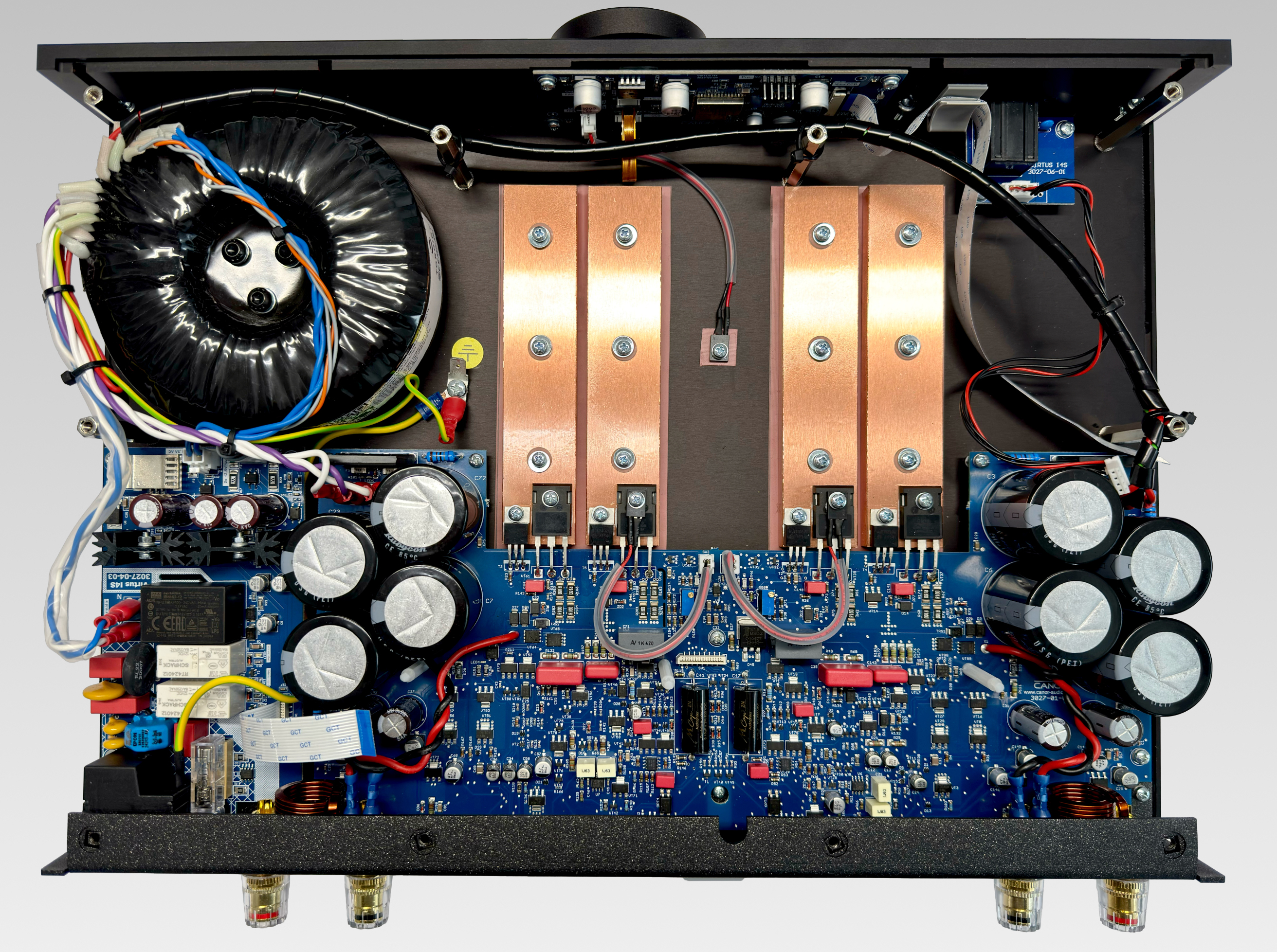 Mundorf MCap coupling caps; small MeanWell SMPS; Rubycon storage capacitance; toroid secured with triple bolts; proprietary flat-wire coils on the outputs.
A plastic-budget affair this clearly is not. That's further cemented by the XLR inputs atypical in this league and the thoughtful addition of variable RCA outputs for a subwoofer for example. Even the 1.8"/45mm touch-screen display embedded in the master rotary bags secret trickery like positional sensors and a choice of two colour themes. Canor may call this their entry level but in general seem to aim rather beyond such generic classifications. And to be fair, €2'800 through a developed dealer network does hit a higher class. So Canor call this part of their new Foundation Line. They clearly mean for us to build a solid foundation.
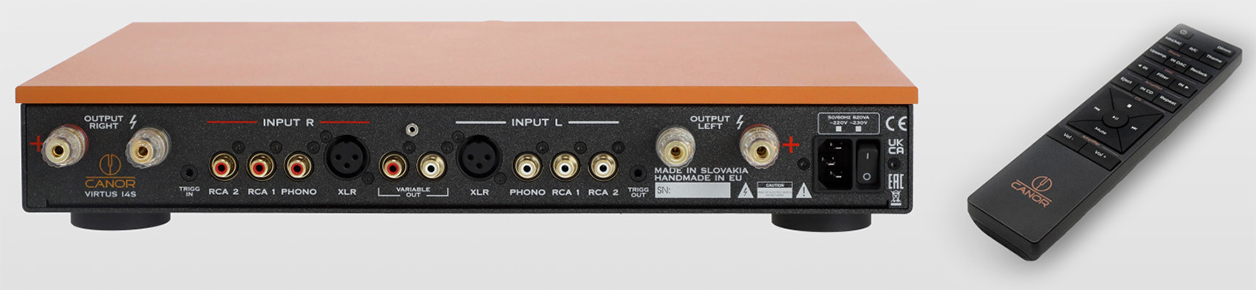
Well prior to laying on hands or ears, I thought this industrial design very well done, its featurization most real-world aware by acknowledging the renewed vinyl interest amongst younger buyers and their ongoing reliance on headphones. Even the 75/120wpc into 8/4Ω power rating is realistic not overkill or skimpy. From where I sit, this was a well-considered effort all around. A day after publishing this page's upper half, "we're ready to ship you both amp and DAC for detailed review in a week. Would that be okay?" Hmm. A detailed review? "Let me think on that and have my people call your people." Of course I'm a staff of one. I'd have to go recruit. Too much bother. Sound bored: "Okay then."










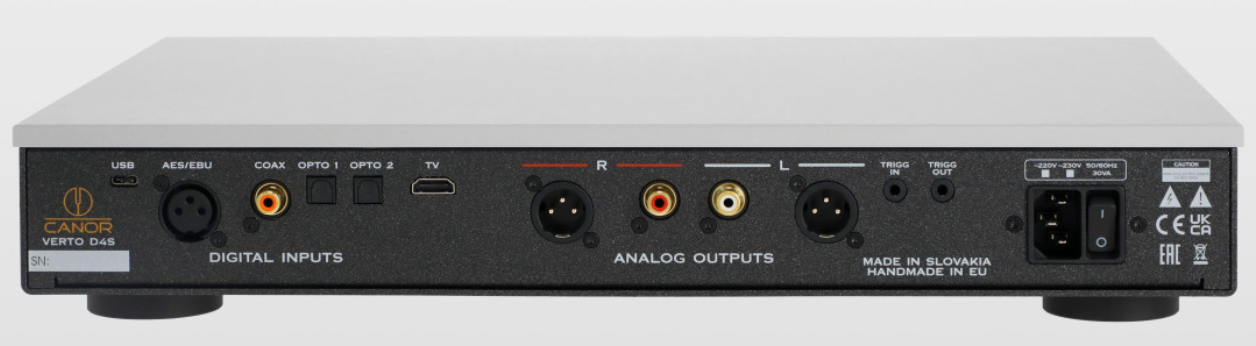
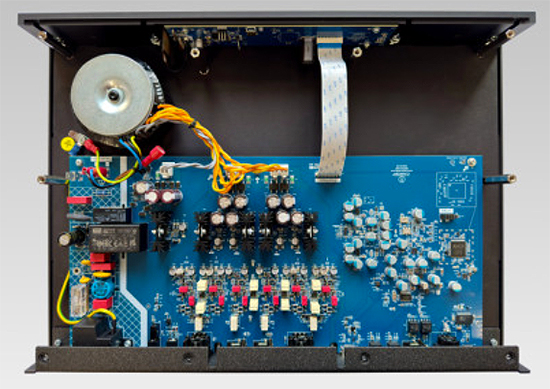 The Verto D4S DAC's dual-mono ESS9038Q2M converters are good for 24/768 PCM and native DSD512, 256 via DoP. Max voltage from the fully discrete output stage is a standard 2/4Vrms on RCA/XLR respectively. Its touch screen without central control knob extends 7" across and all digital inputs benefit from galvanic isolation for lower noise. The linear power supply sports separate regulation for the digital and analog sections. The HDMI input isn't esoteric I²S but a far more practical telly's audio return channel.
Dubbed optimal transient, Canor's custom-written digital filter beyond Sabre's usual suspects "enables true NOS mode to bypass all internal oversampling and eliminate pre- and post ringing. This prioritizes time-domain accuracy over frequency-domain perfection."
About Verto, "it's a foundational Latin verb for 'to turn'. It became the root of many words expressing change, motion and transformation, reflecting the Roman understanding of progress, adaptation and the continuous shaping of form, direction and purpose."
About the Foundation range, "carefully balanced designs provide a solid entry into high-fidelity audio keeping to the core Canor sound character and build standards."
Okay then. Time to go fish with Ivan for other morsels past published specs which include a mention of Canor's proprietary flat-coil inductor in the Virtus I4S first seen in the Virtus 3A. Gleaned from their 02/26 German catalogue, with 30 years in biz last year Canor of Slovakia's Prešov have grown their team to 80 strong and operate 'state-of-the-art manufacturing for the assembly of SMT-populated PCB, chassis production and compliance testing in an on-site fully shielded room for EMI/RF measurements'. Founder Zdeňek Březovják remains chief engineer and co-owner even today which applies formal electrical engineering studies specialized in radio electronics and having worked at a P.A. amplifier firm whilst playing the violin and tenor sax. By the time he met his Canor business partners, he'd already designed mono amps and a battery-powered preamp. The TP101 tube integrated was Canor's maiden project and launched at a 1995 Czech hifi show. It eventually led to a sophisticated in-house tube testing facility called Aladdin which interfaces with an extensive database. Their purchasing department inventories more than 4'000 different parts in electronically controlled storage. Between their own models and extensive OEM contracts with European brands like Musical Fidelity, Pro-Ject or Isotek, Canor's PCB assembly line builds more than 500 different boards. CNC machining, surface processing like brushing, sandblasting, anodizing and final assembly all happen in-house within a comprehensively integrated infrastructure across 8'000m². Canor's design expertise includes pure tube electronics, hybrids including tubes + class D, pure transistor circuits, vacuum-impregnated output transformers, analogue, digital and phono circuits, class A/AB/D operation.

Recurring design details are pure copper-coupled transistors for lower impedance and superior thermal conduction; and opto isolators for galvanic separation. Newer models have begun to integrate touch screens inside mechanically sophisticated control knobs. Another core tech is CMT short for Canor Milling Technology. "It allows the dielectric loss factor of our PCB to approach the loss factor of air where electronic circuits work with relatively high impedances and any deterioration of the tangent as with capacitors causes deterioration of the sound image and airiness. This technology achieves parameters of point-to-point wired excellence based on very expensive high-quality wires with Teflon insulation. However, CMT has the advantage of 100% production repeatability which is impossible to maintain with manual point-to-point production. Furthermore, our connections are several times shorter than classic point-to-point wiring."