
 What it bypasses is not the input/volume stage. There's no pre-out/main-in break to tap into. It just applies volume lock to a designated input now named 'HT' on the display. We can lock volume at any value. If we set zero attenuation, we freeze this integrated at its max 34.5dB voltage gain. That's obviously higher than the ~26dB 'standard' for a power amp because it includes extra gain otherwise contributed by an active preamp. My Topping B200 amps can be set for 11.8dB or 22dB. The newest Mola Mola monos can run at 22dB or 28dB. To not suffer self-inflicted gain poisoning, we should lock A3's attenuator at a reasonable value. For parity with my 250-watt Kinki monos when my math¹ sucks worse than a broken hoover, I looked at the volume setting of my active analog crossover with my resident amps on a particular track. I then left that alone whilst ramping up A3 to matched SPL. That figure became my lock value. Easy. Equally as excellent was zero ear-on-driver noise. With tube circuits that's not easy but Canor managed. Likewise for complete avoidance of turn-off thumps. Being on an indulgent Øystein Sevåg' kick, I spun up "Wind" from his older Caravan album. Once again I had undeniable evidence of uncut fire on the soaring saxophone modulating from throaty to nearly piercing, of violence with the thunderous panned drum hits far in the distance to exhibit no transient blurring or upper-harmonic dulling. Being my big system, I naturally stepped more on the gas for the full immersion in this cinematic oeuvre. A3 was perfectly willing and able to scale up. Had this been a loan application at a bank, even a cranky crimson pen would have granted it.
________________________
¹ Voltage gain equals output voltage divided by input sensitivity.

Once more the primary differentiator over my domestic amps lived in the atmospheric realm of recorded ambiance getting more humid. Once more, the mean trick was increasing virtual moisture content without hazing over percussive spikes or upper harmonics. For sandmen and transistor gals who had gone tube averse because of said haze, A3 eliminates it whilst still portraying the aural landscapes with a more DSD than PCM brush. We might say that it renders music a bit moodier but retains its mettlesome moxy. And yes, I did cheat and looked up that synonym for energetic to expand my vocabulary. Learning English in a German school only goes so far.
 Right-click to open at full 7K/px width in a new window; or use mouse-over loupe to enlarge a playlist of often-used review tracks.









I could cite further playlist examples to bulk things out but the upshot wouldn't change. A3's triode tint is no treacle, just a small tilt up of colour temps plus more focus on the gossamer web of inter-image connections which hifi talk calls greater wetness because it's the opposite of dryness. With some gear tuned for it—Cary Audio's founder Dennis Had called it Deep Triode—this is accompanied by a very noticeable weight change between attacks and decays. By shifting onto the back foot of fades, the musical fabric gains overhang like increasing a room's reverb time. Tone enriches. Separation sharpness fogs over. Transients develop fuzz like wet Irish timbre grows moss. The energetic attitude mellows and sinks into a padded pillow. Many call this effect warmth. When paralleled by rolled-off treble and HF phase shift, it routinely also gets dark. Canor's hybrid doesn't manipulate that transient/bloom balance at all into darkness or pillowy recline. That avoidance plus its excellent S/NR were my favourite bits about this hybrid harvest. Like reader Louis, it made me curious about the prospect of a future mono developed from this circuit. Users like us already have everything else. We prefer pure power amps. Kicking the legs out from under that are users just starting out who want maximum multi-tasking to prevent a mushrooming box count. Should they stumble upon Canor's A3, they could remain blissfully ignorant about how unusual its best-of-both-worlds topology is. To fully appreciate it wants a lot of prior hardware experience. Not having that has zero bearings on complete A3 bliss. It simply falls short at full recognition over how rare this find is, hence how lucky a newbie to chance it amidst the myriad options to market.
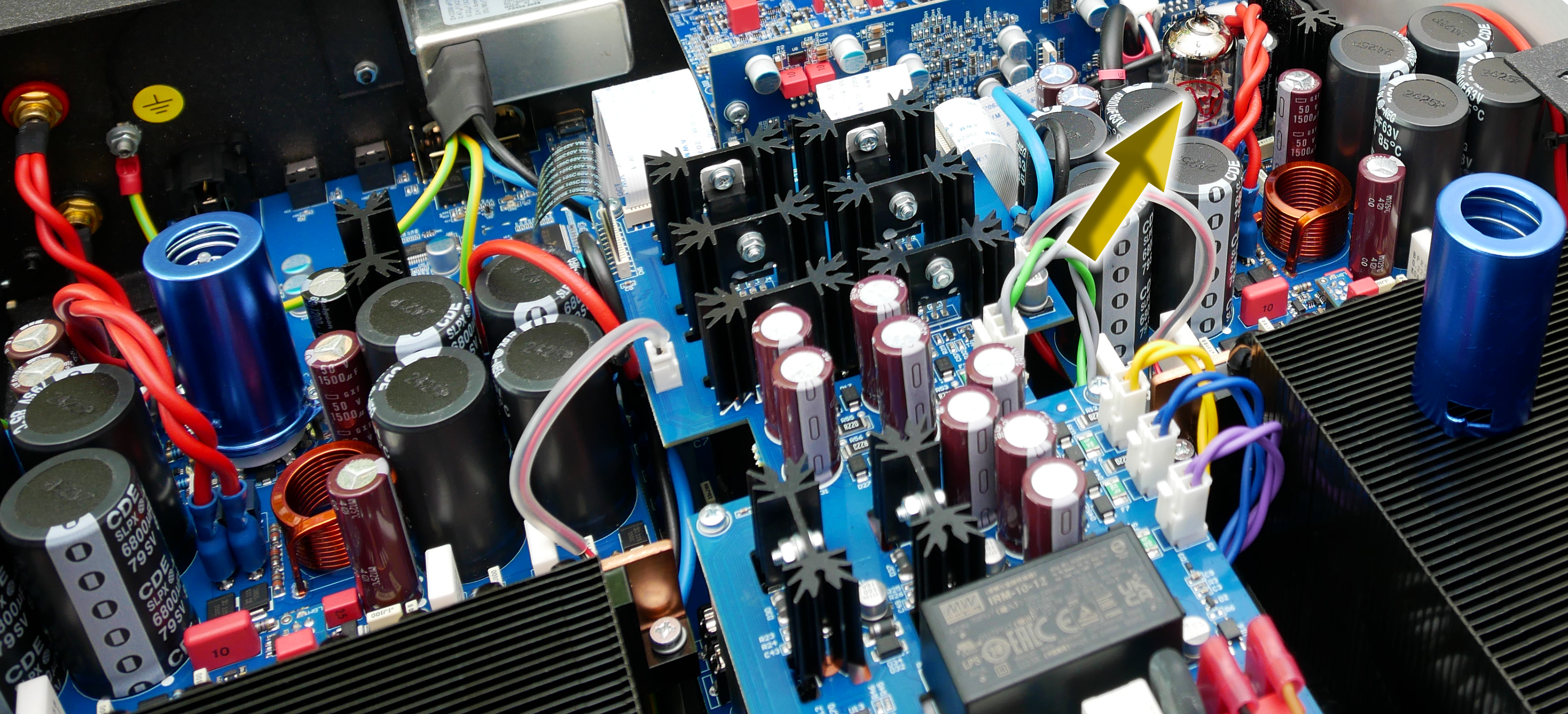
One could spend countless years buying 'n' selling separates and not manage this particular mix when tubes routinely imply coupling caps or transformers; and often single-ended topologies with a different THD profile. All of it is fully legit and popular. This Canor simply walks another path. Here it's interesting that designer John Westlake is self-taught. Rather than have textbook knowledge tell him how things must work or can't work, he can colour outside the lines. Allied to Canor's obvious fabrication resources and apparent reluctance to let greed dictate a High Street price—remember, they don't sell direct so get a whole lot less than retail!—their collaboration has netted an unusual 4-in-1 integrated. It continues where Quad's current-dumping circuit left off, then bakes smack into its middle a direct-coupled small-signal triode. It'll take proper engineers not hacks like me to fully appreciate the accomplishment. But even us techno peasants can fully appreciate its benefits with just two functioning ears. And those benefits are quite something. Also, Canor's current amplifier line does rather play the field like a philanderer. There are pure tube amps, pure solid-state amps, integrated versions thereof plus one hybrid which, Rogue like, combines a tube preamp with a class D output stage. There are linear and switching power supplies. Now the newest A3 does the hybrid thing in completely different fashion. It's as though our Slovakian design team were bored repeating themselves just to mint more models. Meanwhile the forthcoming I4S will reshuffle these cards yet again. It makes Canor an unusually multi-disciplinary outfit. Their extensive OEM work for big established brand seems to have developed the vertical integration and regular cash flow necessary to not have to rush their own catalogue with constant turnovers. They can afford to breadboard unconventional projects then R&D them for as long as it takes whilst other contracts keep their assembly lines and accountant busy. When so many have gone offshore to outsource production, Canor's production remains squarely in the EU. For certain buyers that's key.

With this my only second Canor review in 23 years—in fact my first one happened earlier this year so talk about being asleep behind the wheel—on my board the firm are now two up; well up. At this rate my next assignment on their new entry-level amp seems virtually guaranteed to please; again. That's the kind of repeat which never gets old. All roads lead to Bratislava by the Danube? Why not when the Empire is a faint memory of Nero and Caligula whilst Canor are now and very much kicking up a storm as Rome once did when Cleopatra bedded Julius Caesar. Those names and the asp have become legend. Canor's A3 is far too young for that. But give it time. It might just have the makings. We're simply mindful that whatever happens in high-performance audio stays in high-performance audio. With its soundbars, earbuds and dumbphones, the world at large remains wholly oblivious. At best, this will remain an insider's tip for the few very well informed. So now you are; inside. I don't know what goes on outside with €25K or €250K amplifiers. That's not my game. Inside the €5K-before-VAT sandbox however, today's A3 really goes places. I suspect that for many prepared to spend a lot more on separates which may or may not harmonize ideally, this Canor could be a guaranteed so smarter solution². That also makes it the far better buy. And that's well before admitting to being less invasive than those multi-tier racks bowing with kit. As I said, now you're inside. What you do there is entirely up to you. For a final nudge, think of the old promise of the tube-pre/transistor-power ideal as covering all bases like a sonic Shangri-La. In virtually all instances you'd get output capacitors or transformers between them³. Nothing wrong there but it won't give you Canor's greater immediacy by retiring them; and likely not the balanced mode of operation either. At least that's my take on the matter which is now wrapped. Up. With a bow.
________________________________
² Despite 23+ years of constant hardware exposure, I myself would be hard-pressed to duplicate this particular mix of qualities with separates. My Vinnie Rossi direct-coupled 300B preamp would be one obvious avenue but demanded thrice when it was current without yet covering a standalone power amp. For other atypical tube hybrids which I've not heard yet for myself, I'd look at an Aries Cerat Ianus Protos (€24K), Kora TB140 (€6K) or NAT Magneto Evo (€15K).
³ Take PrimaLuna's Evo 300 Hybrid reviewed in Stereophile. This $7'195 100wpc stereo amp operates in push/pull class AB with six 12AU7 doing voltage gain, phase splitting and Ω lowering to drive a Jfet/Mosfet output stage. Quoting from the review, "the most crucial capacitors," PrimaLuna says, "the ones in the signal path, are extremely expensive tin-foil caps that are made in Europe." Canor's A3 doesn't need them, only runs two tubes, matches the 8Ω power rating, adds a preamp, DAC, phono stage, head amp and touch screen, charges less yet is a bona fide tube hybrid. Or take the $5'950 Linear Tube Audio MicroZotl III, a pure tube preamp using two 12AT7 and two 6SN7 with big Amtrans and Jupiter coupling capacitors. A3 packs a lot more yet manages to omit those parts just as a widebander eliminates them by avoiding a crossover altogether. Classic tube sound. It's not just about the valves. It's about their boutique coupling caps or output transformers. Remove those and you'll still hear the tubes, just in a new and to my ears better way. Point. Made.
Postscript. "I discussed with our team about the minor issues you reported. For 176.4/192 and DSD64 over AES/EBU we need some time to analyse in detail and it would help to know what streamer you have. What we experienced is that the problem is generated by the streaming signal's quality. We have a streamer which plays perfectly, another which has problems even at lower sample rates. It's obviously a task for our DAC to get this sorted and we will look to eliminate the issue as much as possible. [My server was a super-cap powered Singxer SU-6 bridge preceded by a dedicated iMac with Audirvana Studio's SoX upsampler. Ed]. Mute with headphones is no bug but let’s say a 'feature'. It’s no problem to make it work with a firmware update. Our question would be whether this functionality is really needed or used with headphones. [My opinion on that is in the review. Ed]."