Country of Origin

Reviewer: Srajan Ebaen
Financial interests: click here
Main system: Sources: Retina 5K 27" iMac (i5, 256GB SSD, 40GB RAM, Sonoma 14), 4TB external SSD with Thunderbolt 3, Audirvana Studio, Qobuz Sublime, Singxer SU-6 USB bridge, LHY Audio SW-8 & SW-6 switch, Sonnet Pasithea, COS Engineering D1, Laiv Audio Harmony; Active filter: Lifesaver Audio Gradient Box 2; Power amplifiers: Kinki Studio EX-B7 monos & Gold Note monos on subwoofer; Headamp: Enleum AMP-23R; Phones: Raal 1995 Immanis; Loudspeakers: Qualio IQ [on loan] Cables: Exact Express Flame, Furutech; Power delivery: 2 x Kinki/Vinshine Tai Hang on amps and source stack, Furutech DPS-4.1 between wall and conditioners; Equipment rack: Artesanía Audio Exoteryc double-wide 3-tier with optional glass shelves, Exoteryc amp stands; Sundry accessories: Acoustic System resonators, AudioQuest FogLifters; Room: 6 x 8m with open door behind listening seat; Room treatment: 2 x PSI Audio AVAA C214 active bass traps
2nd system: Source: FiiO R7 into Soundaware D300Ref SD transport to Cen.GRand DSDAC 1.0 Deluxe with POW; Preamp/filter: Lifesaver Audio Gradient Box 2; Amplifier: Kinki Studio EX-M7; Loudspeakers: ModalAkustik MusikBoxx + Dynaudio S18 sub; Cable loom: Exact Express Earth; Power delivery: Vibex Granada/Alhambra, Akiko Audio Corelli Corundum & Castello Solo; Equipment rack: Hifistay Mythology Transform X-Frame [on extended loan]; Sundry accessories: Furutech cable lifts, Furutech NFC Clear Lines; Room: ~3.5 x 8m
2nd headfi system: DAC: Cen.Grand DSDAC 1.0 Deluxe with POW; Headamp: Cen.Grand Silver Fox; Headphones: Raal 1995 Magna, HifiMan Susvara
Desktop system: Source: HP Z2 work station Win11/64; USB bridge: Singxer SU-2; DAC/headamp: iFi iDSD Pro Signature; Speakers: DMAX P61 Headphones: Final D-8000, aune SR7000
Upstairs headfi system: FiiO R7; Headphones: Meze 109 Pro, Fiio FT3
2-channel video system: Source: Oppo BDP-105; All-in-One: Gold Note IS-1000 Deluxe; Loudspeakers: Zu Soul VI; Subwoofer: Zu Submission; Power delivery: Furutech eTP-8, Room: ~6x4m
Review component retail: €5'033 ex VAT
Hurray, the current dumped me. "At Canor we have huge admiration for the groundbreaking work done at Quad by P.J. Walker and M.P. Albinson with the ESL speakers and current dumping amplifier designs. However, our implementation of current dumping in the Virtus A3 amplifier is without the classic Quad bridge circuit. Quad's current dumping is actually a misnomer though Peter Walker patented it with its proper name. It's a feedforward amplifier design formed by a passive bridge circuit with the infamous inductor replacing the more conventional resistor element in one arm of the bridge to facilitate manageable power dissipation. However, this inductor was one of the topology's greatest practical weaknesses. The non-zero DC resistance and non-ideal characteristics of real-world inductors unfortunately worsen with increasing frequency and power levels. Even with the best air-core inductor it results in the feed-forward bridge circuit introducing rather than nulling distortion. The bridge itself becomes increasingly imbalanced due to worsening non-ideal characteristics of the inductor. This unrealistic expectation of a 'perfect' inductor and finite gain of the Class A 'reference' amplifier prevents idealised distortion cancellation. In reality the bridge's imbalance errors cause distortion beyond what can be achieved with modified topologies. The Virtus A3 implements a very linear Class A amplifier based around a vacuum tube front end with a combined Mosfet/bipolar Class A power stage arranged to always control the Class AB current dumping output stage. The highly linear Class A stage always rides the output signal whilst the Class AB stage provides the 'brute-force' current. As the current dumpers handle the high current, the Class A stage sees a benign load to operate very linear. That determines the sound quality because it always rides the output signal with enough power headroom to correct for any error introduced by the current dumping stage.
"It would be more accurate to describe Quad's current dumping design as a low-power Class A design current dumped by a Class C power stage because the conduction angle of the current dumpers is less than 180°. The abrupt transitional loading on the Class A stage by the Class C current dumpers as they come into conduction results in a highly nonlinear loading on the finite output impedance of the Class A stage. This creates higher-order distortion products in the Class A stage. The A3 design prevents this as our current dumping stage conducts at all times without abrupt current-loading transitions on the Class A stage. The tube-based Class A amplifier stage is designed to be as simple as possible without the typically high distortion levels of tube amplifiers. Current is typically the nemesis of tubes. However, as the current-dumping output stage in the Virtus A3 isolates its tube-based Class A stage from the heavy speaker load current, the Class A stage operates very linear without need for high feedback. The tube Class A stage powers by a discrete low-noise low-impedance regulator. As the sound quality of the power stage is primarily determined by this Class A stage, we gain the performance benefit of a regulated PSU without the typical high-power dissipation of a regulated amplifier including the high-current output stage. The Virtus A3 is as dual mono as possible with independent power supplies to each channel including the power amplifier stages.








"Each current dumping channel has its own local multi-capacitor bank to provide a low-impedance fast power reserve as close as possible to the output stage to allow high short-term peak currents into difficult low-impedance loads when required. The Virtus A3 signal path is fully differential and servo-controlled DC coupled. Single-ended analog input signal immediately converts to differential followed by a differential stepped attenuator. The tube power amplifier input stage too is fully differential, allowing for a fully differential feedback loop so both positive and negative speaker output signals are 'Kelvin-sensed' at the terminals and the feedback loop correctly senses the output load current/signal. We do believe that the ultimate sound quality of P.J. Walker's design was limited by the parts quality and design ethos of the time but that takes nothing away from the ground-breaking technology developed at Quad. With hindsight we believe that Quad during P.J. Walker's period was one of the great bastions, if not the greatest bastion of British HiFi." Who knew that getting dumped would be accompanied by such a wet smooch?
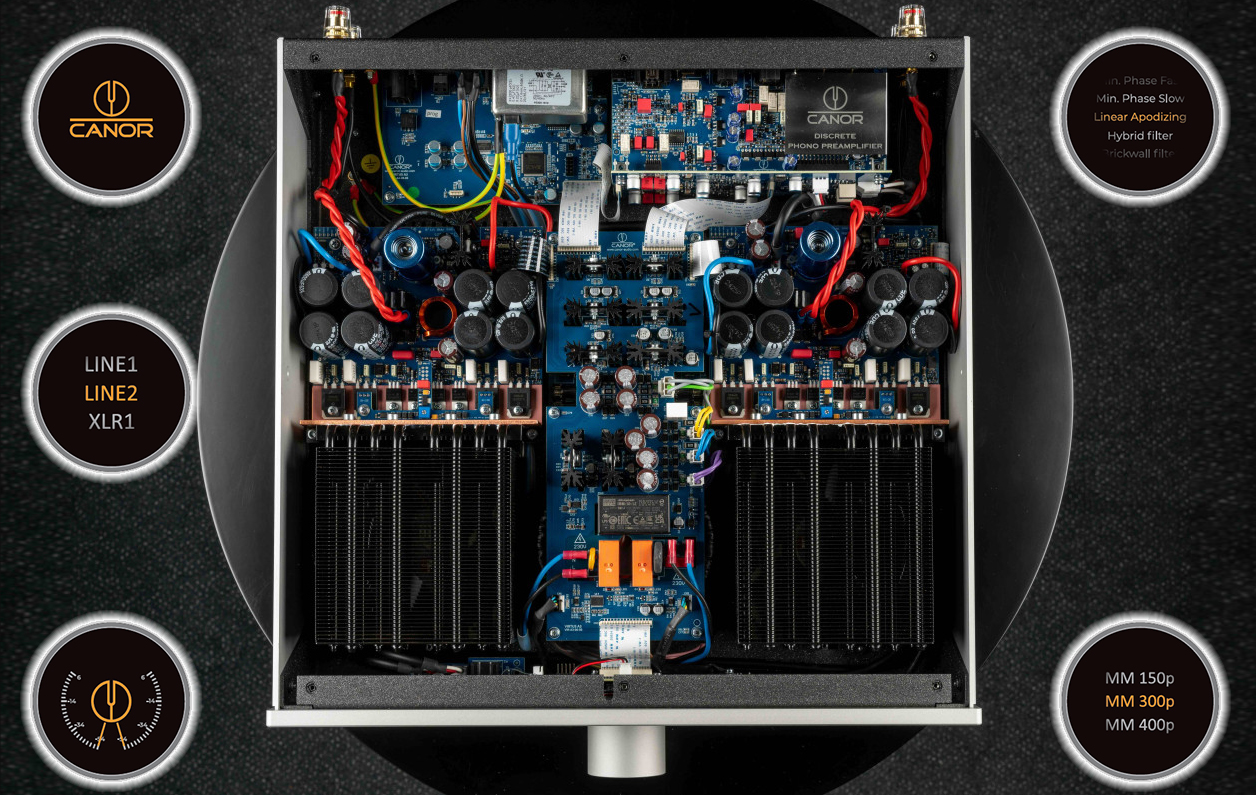
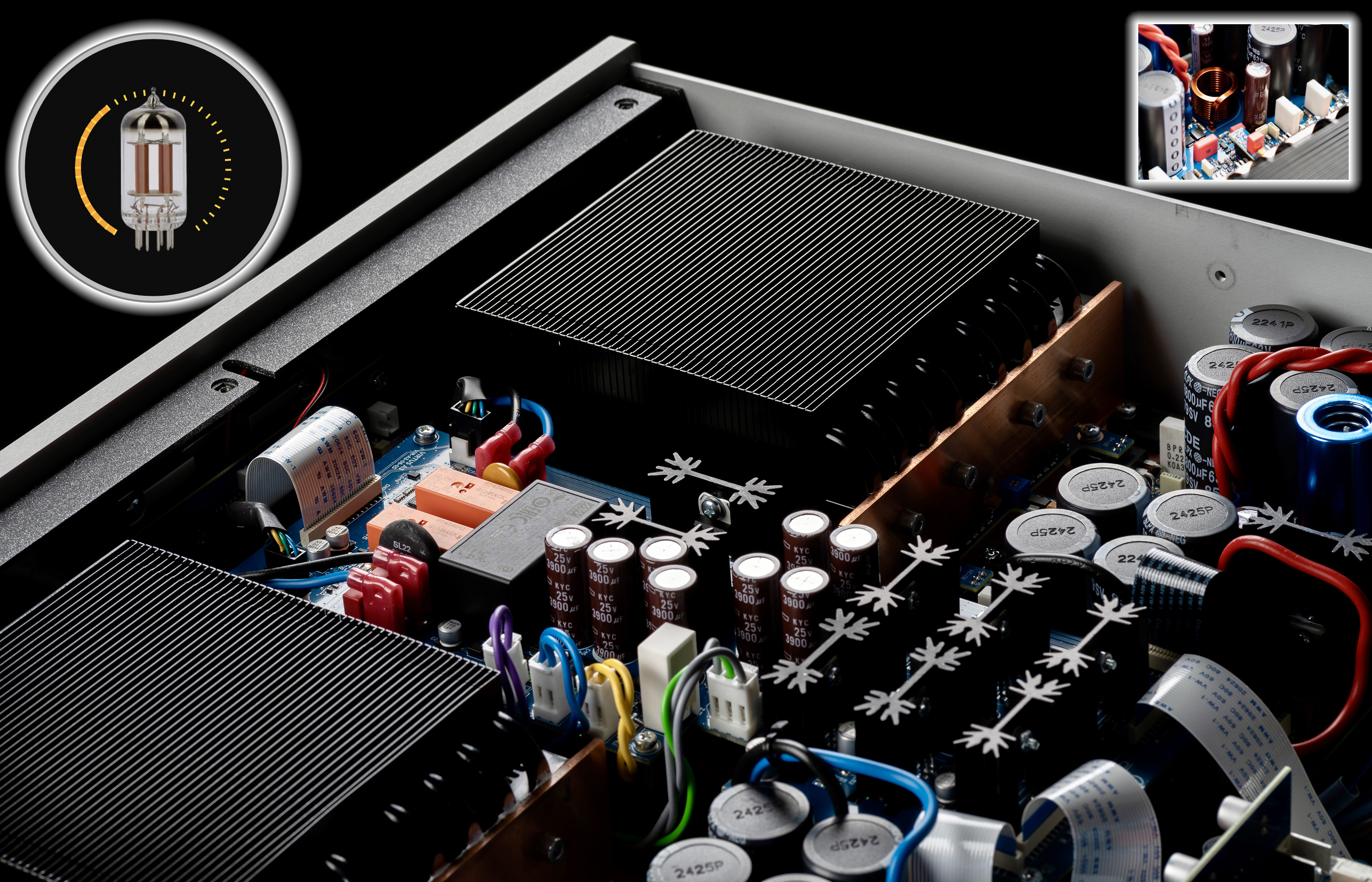 Custom flat-coil inductor in detail insert.
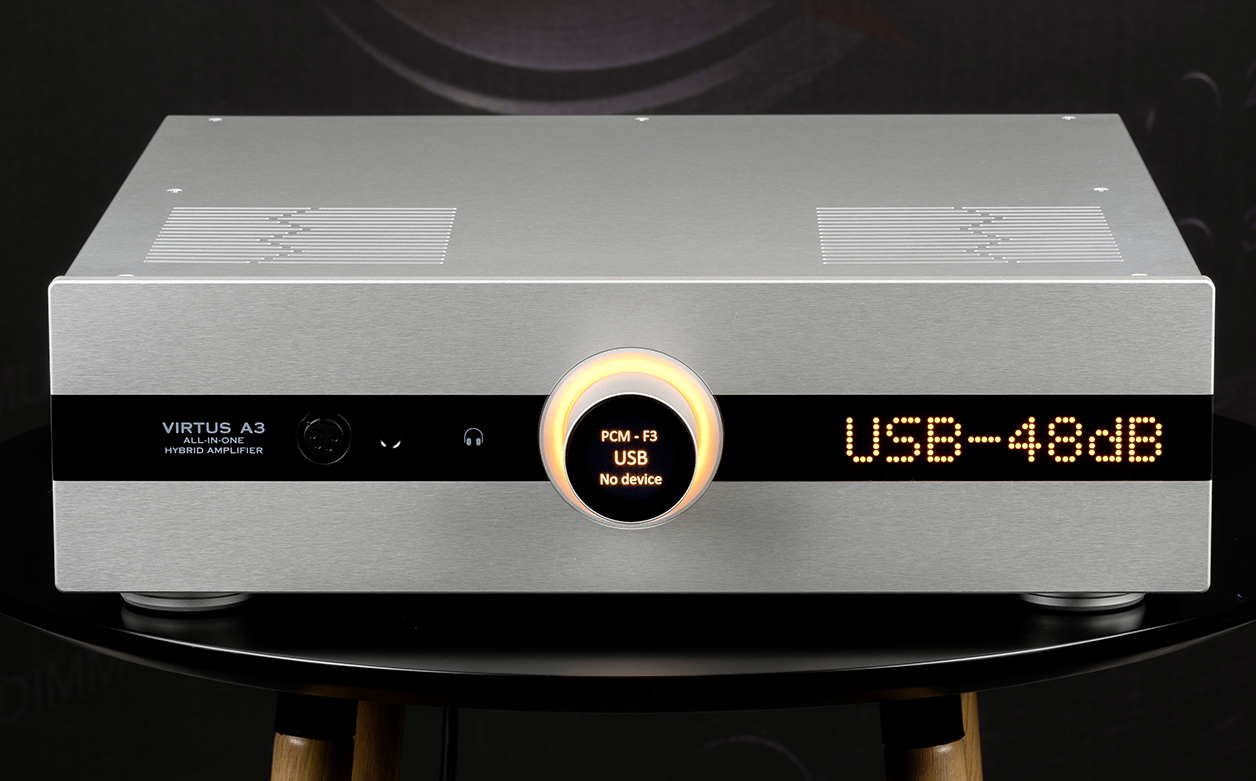
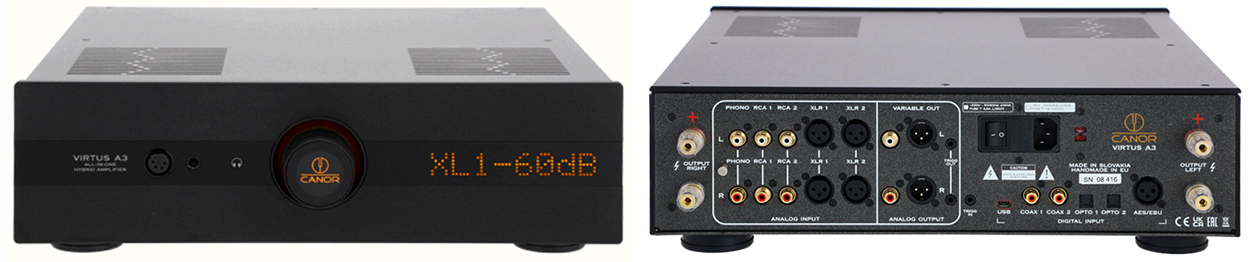
18kg Virtus A3 should really go by A4 since it's a 4-in-1 tube-hybrid integrated amplifier with 35dB of voltage gain; MM/MC phono stage; class A fully balanced 500mW/32Ω headphone amplifier; and dual-mono ES9038-based DAC. There are 3:1 RCA:XLR inputs, RCA:XLR variable outputs, two each coax:Toslink, AES/EBU and async galvanically isolated, reclocked and RF-filtered USB with a rear-panel error indicator. Available in silver or black, the obvious cosmetic star attraction is the smart nose aka controller knob riding on twin ball bearings. It embeds a touch screen from which to select inputs, digital filters, MM/MC loading, a VU meter and more. Under the hood we find these liquid-cooled heat-piped power blocks with slow-running so quiet fans over the switching power supplies whilst the output transistors mount to solid copper for lower impedance and superior thermal dissipation.
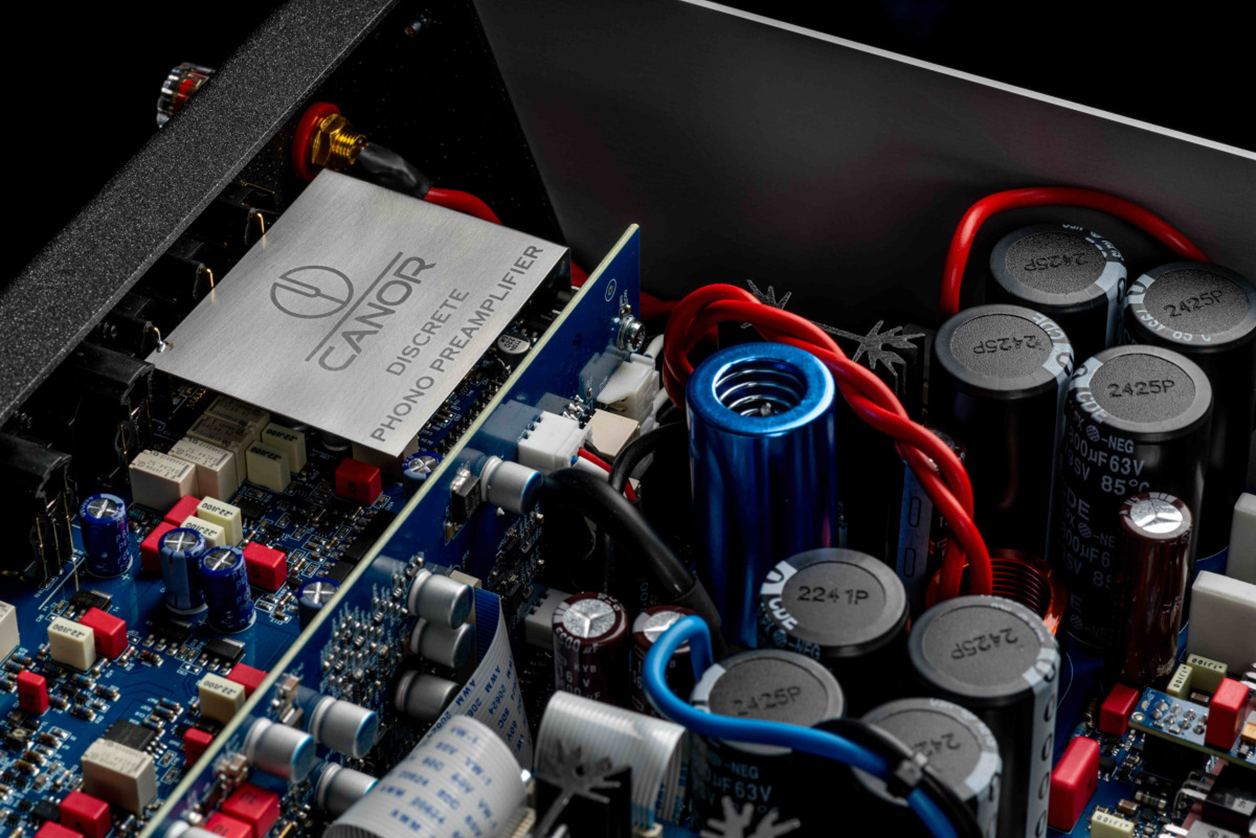 One of two E88CC/6922 tubes locked and loaded in its blue chimney.
I wonder what P.J. Walker would make of the adoration our Slovakian team has for his patented Quad amplifier architecture to update it for the 21st century? Having never heard his original, my ears would progress directly to Canor's interpretation of it. How would my views be standing on the shoulders of these British giants?