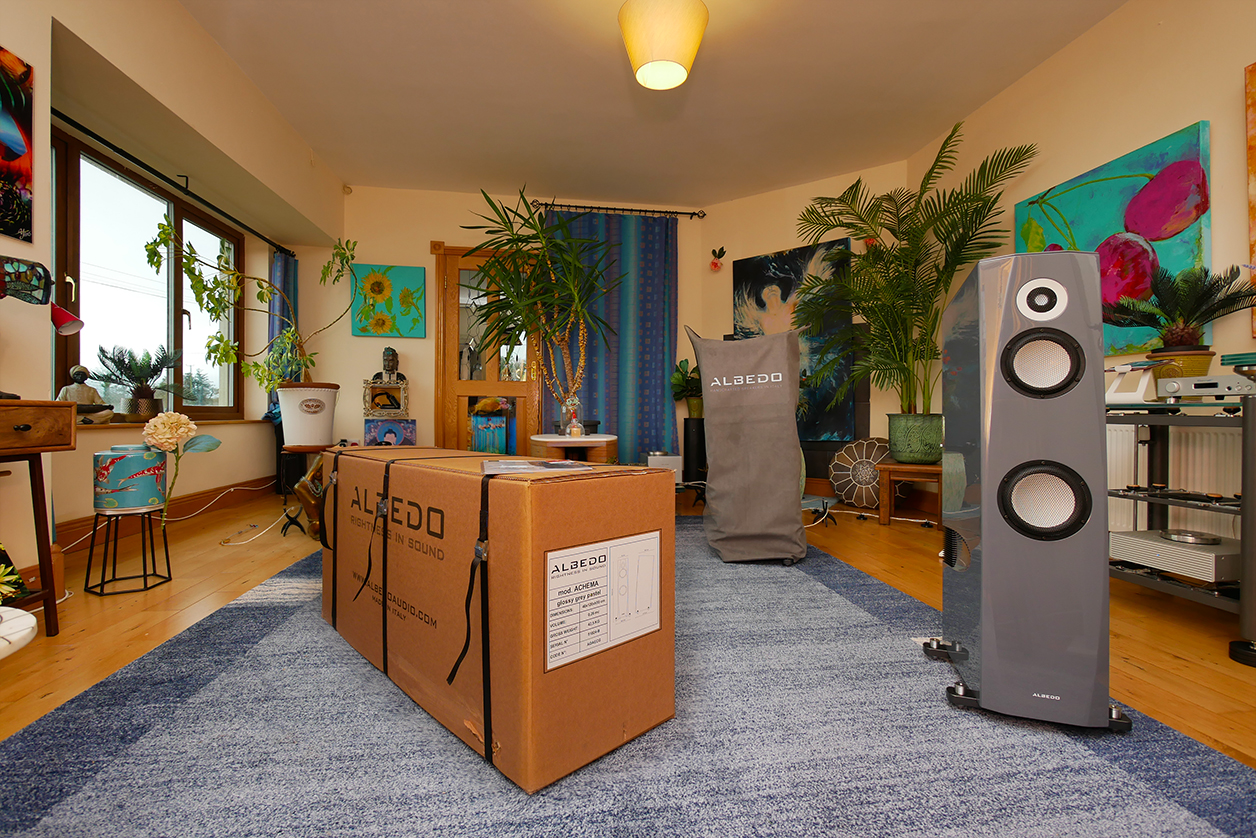
10-day delayed FedEx dispatch was via "trusted 3rd-party agent" i.e. outside contractor with a lorry, liftgate and pallet jack. My chap had gone AWOL (Irish translation: vacation in Belfast) without making arrangements for the goods he'd already collected from the local depot. FedEx were duly clueless as big multi-nationals with AI-powered customer service are these days. But once my local guy was back motoring, delivery proved uneventful and rain-free. Albedo's cartons simply strap to come apart fully, making flat storage easy. Thick covers suitable for a luxuriant spa robe protected the gloss skins beneath. With outriggers and spikes already installed, there was nothing to this gig at all.
This small separate box contained floor protectors, banana-to-spade jumpers given the biwire terminals, an owner's manual and artfully pre-aged certificate of authenticity with affixed seal looking splendidly serious like a rare very expensive bottle from a private reserve. The entire entrance felt rather formidable and licked to a 't'. Albedo's experience showed strong. Being under strict orders to de-new this pair with a minimum of 100 hours, my Italian visitors had some noisy work to do.
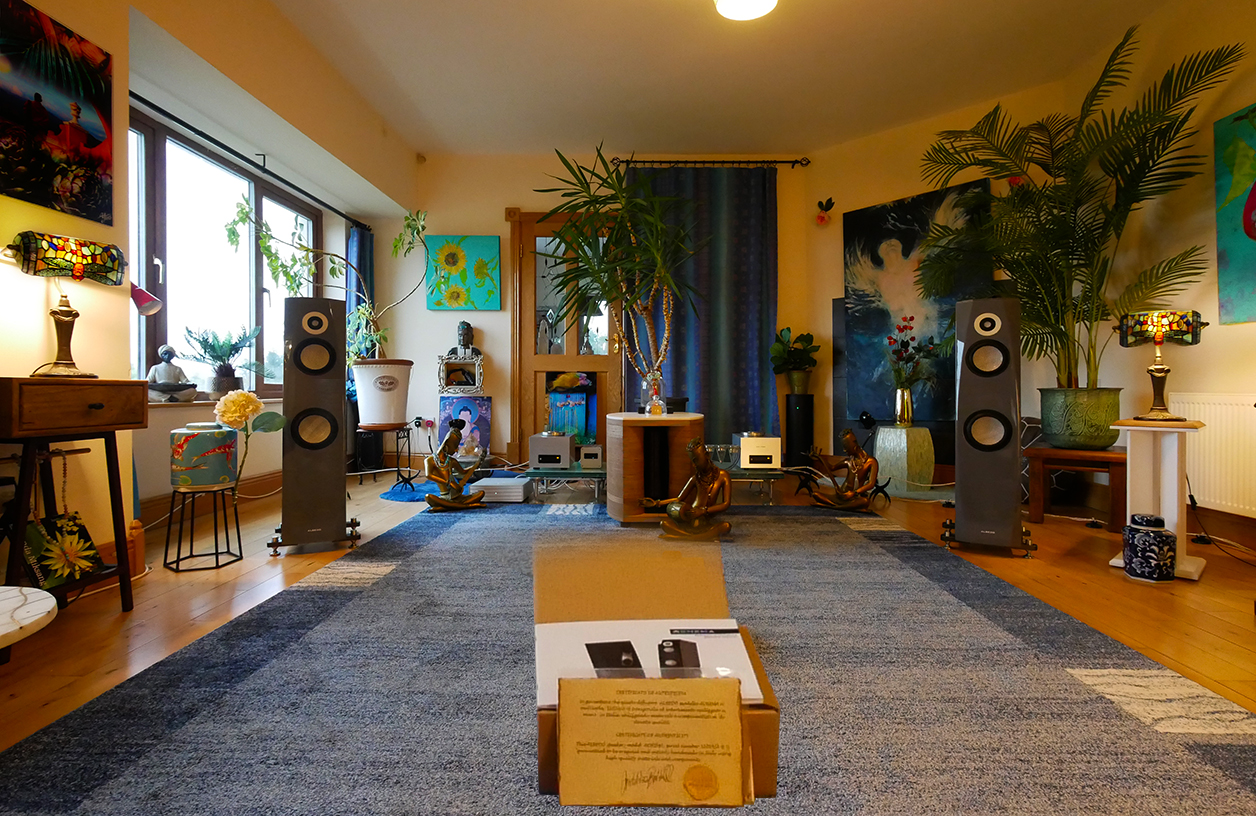











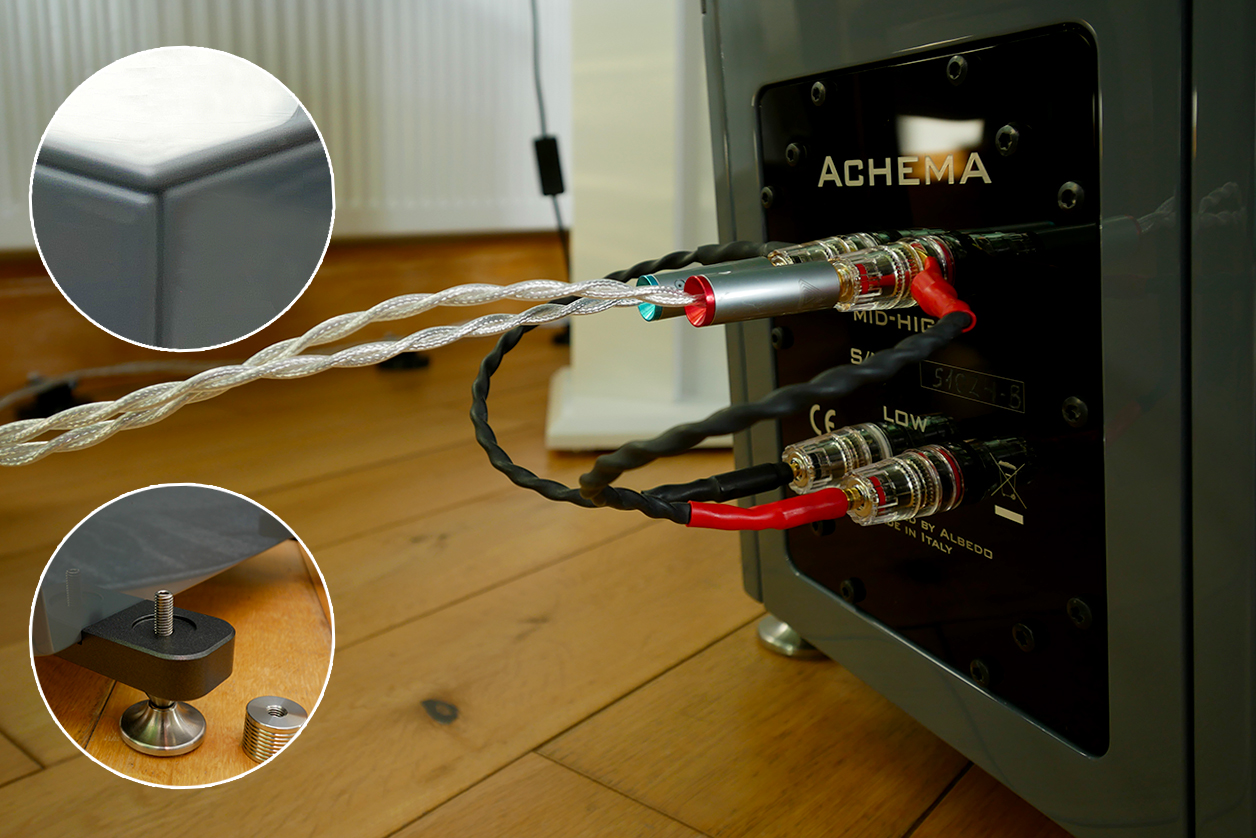
Before we proceed from après travail to hopefully avec grand plaisir, a word on detail execution. As stated, short wired jumpers include to strap Albedo's biwire terminals for single-wire cables like my Exact Express. The massive ribbed posts atop the outriggers are dressy cap nuts. They conceal very long spike shafts with hex openings for easy height trim from above. Cosmetically, Achema adds real interest by executing its front/side/top edges as individual stacked plates shown for one upper front corner in this insert. Now some words on my install centred on a dual 15" stereo subwoofer from Swiss brand sound|kaos. Its main job isn't to add but (gasp!) subtract bass. It's a folded open baffle whose front slot emits the combined front waves, its twin rear slots the rear waves. The resultant radiation pattern is that of a 'super' dipole also called Ripol aka the Ridthaler Dipole for inventor Axel Ridthaler and his expired German patent. There is perfect figure-8 lateral counter-phase cancellation to eliminate the side walls as reflective contributors, hence also their transverse room mode. There is the same cancellation up and down to undercut floor and ceiling reflections. Finally a peculiarity of the Ripol geometry is lower output at the front wall than listening seat. Hello directional bass approaching cardioid. Unlike ported and sealed loudspeakers which below ~200Hz radiate omnidirectional to reflect off all walls, floor, ceiling and objects for so-called room gain with max stimulation of standing waves, cardioid bass sacrifices much room gain in pursuit of far reduced bass reflections. That demonstrably improves the time domain because late-arriving snookering reflections and resonant nodes suppress. Bass notes stop better rather than linger. Now you see the sub's purpose. It's not to add LF extension and power though it might do a bit depending on the speakers. A precision adjustable fully analogue discrete outboard xover from Lifesaver Audio called Gradient Box II handles traffic routing by way of a 100Hz 4th-order Linkwitz-Riley symmetrical hi/lo-pass. That extends the sub's room-treating dispersion pattern across my 35/70Hz main modes. Remote-controlled 'bypass' on the crossover instantly defeats its signal split from the seat. I can compare omni vs cardioid bass to turn LF reflections on and off at will. But there's more. Two PSI Audio active bass traps working below 150Hz sit in the front corners to absorb remaining pressure build-up along the front wall. Those too I can turn off. That really demonstrates what omni bass allowed to run amok sounds like without either conventional so very large bass traps; or my combo of far smaller but active bass traps and directional LF.
This preamble set up that it was predictive and according to the laws of acoustics that against my stereo 2.1 split, full-range Achema would have to come in second on time-domain precision or LF amplitude linearity. No acoustically untreated room outperforms one with effective bass absorption and/or heavy DSP compensation either. My room treatment simply doesn't look conventional. It can be easily mistaken for bass lust when it's all about 20-100Hz quality. That said, whilst my 2.1 work-share program will always outperform omni bass, there's still a vast range of difference between the latter's executions. The best cause far fewer issues than the worst where 'quite good' already is a compliment. It gives me an idea on performance in fully untreated rooms like mine when I hit 'bypass' and power off the clever Swiss active bass traps. Before we dive into the deep end of today's pool, a quick finger poke in its shallow side. In Accuton's early days, speakers rocking their drivers had a class-D type reputation for being dry and monochromatic, precise but clipped. But the wheel of hifi dharma has turned. "Ceramics are made from a mix of inorganic non-metallic materials like clay, sand and feldspar mixed with water and fired in a kiln at high temperatures. Advanced ceramics use materials like aluminium oxide, silicon carbide, tungsten carbide or yttrium barium copper oxide." It's aluminium oxide which factors in speaker drivers. Variations on the theme—ultra-hard nano skins atop softer cores—have become more widespread and amongst others factor at Børrresen, Canton, Monitor, Raidho and Vivid executed with layers of diamond-like carbon, tungsten, titanium, zirconia or aluminium chromium nitride. Meanwhile Albedo, Mårten and the earlier mentioned Tidal speakers keep the Accuton faith. So do my upstairs MusikBoxx monitors from Germany's ModalAkustik boutique. The point is, this extended family of diaphragms differs in makeup from plastics like polypropylene, from cellulose-based and carbon-fibre types. That tends to express somewhat different virtues. We might perhaps draw a faint connection between paper diaphragms and tubes; and metallic membranes and transistors. Either group has admirers and detractors. Most casuals don't give the matter much thought. That's useful when it confronts things at face value rather than allows assumptions to distort the picture. Now we're ready for tunes.