"Basso continuo. It's an endless bass line of Baroque and early Classical music's harmonic/rhythmic foundation typically played by cello or bassoon then embellished by a harpsichord, organ or lute to improvise harmonies based on a figured notation. It acts as the rhythm section for the other instruments' melodic lines." Again, in playback we don't want two types of bass generators where one is the recorded signal's direct sound replication, the other the room's time-delayed superimposed/injected resonant signature. We don't want 'continuous' bass which lingers past its recorded sell-by date even drones on whilst riding standing waves. So I'm thrilled to report that in my bypass test, Achema's cheeky venting of its lengthy transmission line worked exceptionally well. Whilst its general LF output was higher due to room gain, its time signature was surprisingly clean, its amplitude response free of lumpiness. This was possibly the best integration of subwoofer-reach passive bass in this room across my past four years in it. By contrast, in bypass the Virtual Hifi Cobra über monitor just reviewed proved utterly unlistenable in the exact same spots. Its six 7" passive radiators per channel kick in below 60Hz to have compound 15½" cone surface breach 30Hz. They threw up serious ringing from snookering reflections and triggered resonances. I must also convert my usual ported Qualio IQ in this room to quasi sealed via dense foam bungs to linearize the bass response. Yet it still improves when my sound|kaos sub takes over. So did Achema; but by a decisively narrower margin. My takeaway? In untreated rooms of similar dimensions, Albedo's latest compact floorstander should be guilty of demonstrably fewer bass liberties than conventional ported competitors whilst reaching low with real power to decommission all desire for subwoofer augmentation. If that sounds like faint praise, au contraire absolument. It's precisely why earlier this years, numerous full-range floorstanders flew my coop for new Irish homes. Why look at big speakers plus a big sub when in such split configurations, rather smaller more affordable speakers work every bit as well then style far harder to the eye? If as a constant reviewer's tool I wanted back a full-range floorstander of the passive persuasion to stand in for the vast majority, Achema would top my list. Still think it faint praise? Then you've not yet dealt with bass-quality shifts from effective room treatments whilst using room-liberated open-backed HeadFi as reference. Having beautifully cleared that deep-end hurdle, let's kneecap ceramic cynicism on the shallow end. I don't know by what closed-eye metric or means you'd audition this implementation and identify its aluminium-oxide bits. In Achema's tuning and with its current transducers, early-gen tells no longer even whisper. That's the short of it. The long form will occupy us a bit – well, longer.
What exactly was the critical ceramic conceit of yore? My memory calls it a combination of early class D and electrostatic bias. The latter speakers were always admired for their speed derived from lack of energy storage for fabulous low-mass acceleration but far less so if at all for their relative leanness, starchiness, lack of bass power and see-through ghostliness. After all, music has body which extreme replay transparency can steal from. Music is not just about sonic beginnings—their leading edge or transient—but their middle of bloom/sustain and the ending, the latter called decay, falling edge or trail all suggesting an event occurring over time even if just across a nano window. If those fades don't render or only incomplete, music assumes an ever more clipped military gait and looses its innate flex. Likewise, tone colours dumb down because subtle overhang no longer mixes them and micro-dosed upper harmonics clip off. We might think of the contrarious enabler as excess damping. In gain circuits, similar observations can apply to negative feedback. Too much—or any if the circuit is well behaved without it—injects that more mechanical rigid gestalt whose absence goes by fluid, pliant, elastic, generous. Opposition terms include dry, damped, strict, exacting and the like. As counter polarities, there's plenty of room between the extremes. That's occupied by the majority of systems whose compound actions along this axis tend to result from their owners' mix'n'match approach. It sets this balance between lush and lean, loose and taut to their liking. The intended takeaway is that in the early days, Accuton allergies considered their gestalt too monochromatic, dry and overemphasized on the transients to the dismay of natural fades. In the interim I've paid insufficient attention to ceramic speaker specimens and their successive driver iterations to know when such criticisms mellowed then disappeared; if indeed they ever vanished entirely. But it matters naught. Revisiting them is its own conceit to contrast Achema against in the hear.now.







With 2.5MHz DC-coupled class AB amps driven off a Sonnet Pasithea DAC's variable reference voltage on its R2R ladders, my hardware fronting the transducers deliberately prioritizes speed, transparency and a treble free of phase shift. In that context, Achema surprised by emphasizing the minorly fulsome, dense and fully embodied over micro detail, quickness, airiness or ultimate separation. Just so, its more relaxed gravitationally enhanced feel didn't rely on subtle blur to come off. To my ears warmth so often is a by-product of blurred timing and sloppy stoppages. Hence the 'w' word didn't make my initial short list of descriptors. Fulsome, dense and gravitationally enhanced did. If this doesn't sync with the above paragraph, that was its whole point. Achema isn't a last-decade ceramic. Neither stems it from Oslo, Bergen or Copenhagen but sunny Italy where, cliché be damned, the ideal of la dolce vita remains in play. Against the setup of Accuton allergy and one of its lead symptoms, we might perhaps dub Achema's voicing correctly damped warmth? It's my attempt to combine certain elements usually meant by warmth without the imprecision I always associate with it. This sound lacks all metallic remnants yet still feels more articulate than many textile-driver efforts. Still, Achema owes more to Franco Serblin than Michael Børresen whilst falling vaguely between them though closer to the famed founder of Sonus faber. Only Albedo know how Achema's choice of drivers, crossover specs and parts, cabinet and TL loading balance out and fix the final mix of attributes. What I feel certain of? Their result should surprise non-casuals who arrive with specific ceramic preconceptions. Achema sounds darker, gentler and richer than ideas about hard diaphragms and early pronounced breakup modes would ever credit. Whilst the flawless lacquer skins telegraph slick gloss, the sound suggests real-wood oil-finished veneers instead.
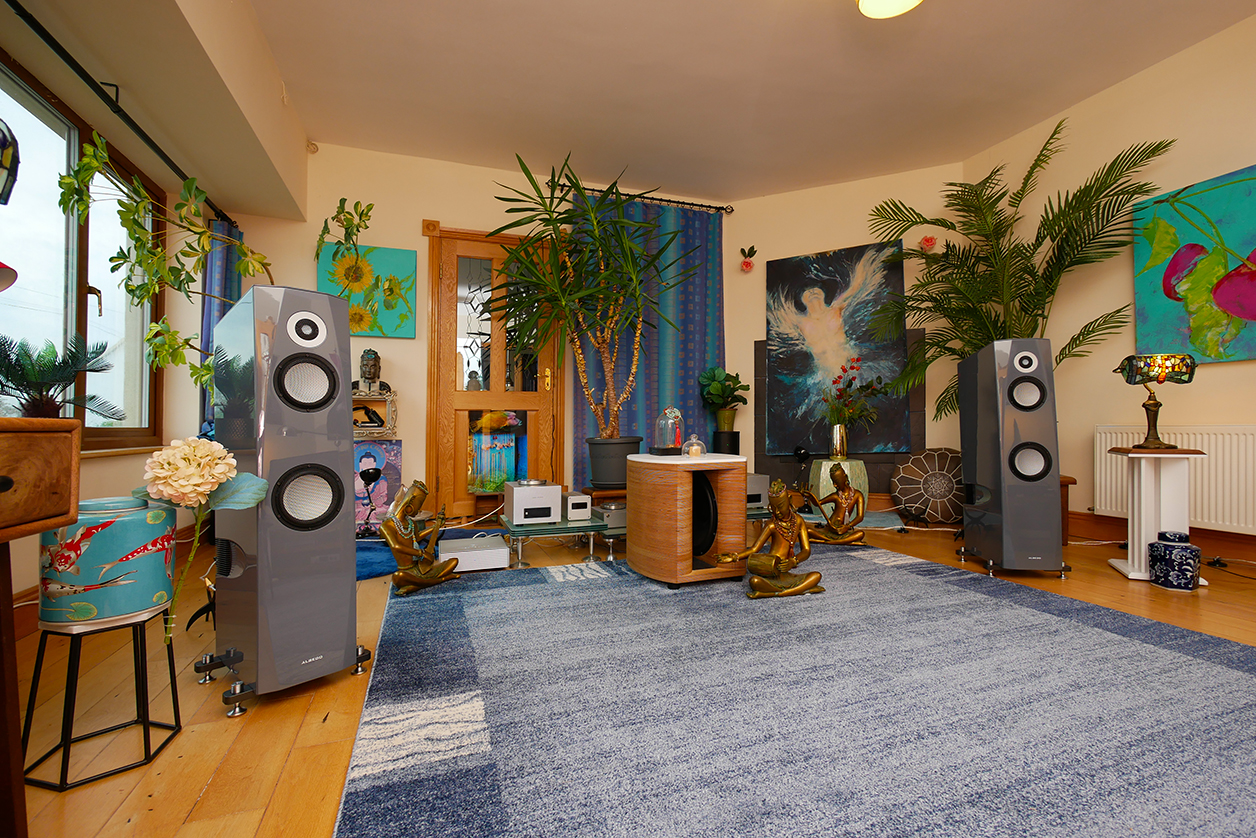
Now underpin the above descriptors with my earlier comments about useful ~30Hz reach of considerable weight, power and dynamics. Though not a tall speaker nor one festooned with big woofers, at my 65-80dB SPL with occasional 90dB peaks during Happy Hour, Achema sounded big, beefy but also muscular because of its transmission line's obvious control over its drivers. It's distinctly far more of a bottom-up than top-down perspective. I found it more gifted on the macro and black than micro and white scale. My hybrid open-baffle IQ with its dipole Mundorf AMT and open-backed SB Acoustics Satori mid for example is more airy, translucent and spatially separated so generically of higher resolution but for it less endowed in the macro realm and not as rich of tone and saturation. If that reads improper for a transducer of hard metal cones and domes, it's simply another nail in the coffin of lazy preconceptions.