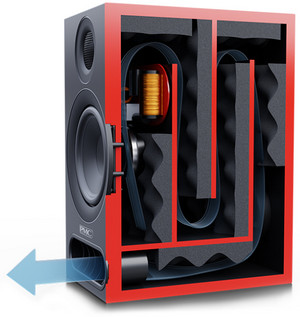
 For now, let's revisit transmission-line basics. A TL is a long, often circuitous, folded and tapered tunnel or maze which a woofer back wave must travel through. Fibrous materials like acoustic foam, long-haired wool or fibreglass lines the transmission path to absorb certain frequencies and control sound velocity. The length of the line often corresponds to a quarter wavelength of the target frequency and introduces a strategic delay to the rear wave so that by the time it exits the line's mouth, it does so in phase with the woofer's front emission. This adds itself to the overall sound pressure to create stronger deeper bass than otherwise possible. Meanwhile the damping materials attenuate unwanted midrange frequencies and prevent them from reflecting back out the woofer cone. Design challenges are a TL's required length when tuned to very low frequencies which can increase enclosure size unless cleverly folded which then makes the build more difficult; and the need for precision of the line length, type, quantity and placement of absorptive materials for optimal performance.
 From PMC: "The transmission line effect over a bandwidth of around two octaves centres on the main resonant line frequency and over this region controls the motion of the driver, massively lowering distortion and raising maximum possible SPL. The resonant line frequency is defined by the acoustic length of the line and is the frequency at which one quarter of a wavelength is equal to the acoustic length of the transmission line." [A classic PMC transmission line at right.] We appreciate how whatever the TL doesn't absorb implies secondary bass emissions at least one cycle behind the woofer's frontal output to emerge in phase and increase LF output.
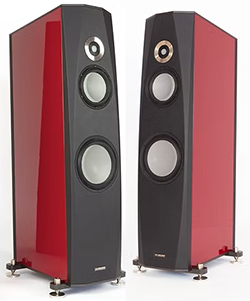
"The new Achema incorporates R&D from the previous Agadia model of our top-line Imperiale Collection [left]. The aim was to not only isolate the crossover from the acoustic load but also the Helmholtz resonator filter used in all transmission lines developed by us. Achema enhanced the transmission line length to 140cm and the side exits allow for easy positioning even in medium-size spaces. Furthermore, the side grilles stabilize the airflow by reducing turbulence while maximizing dynamic range and bass efficiency. Both the 6" mid/woofer and 7" woofer load into the same TL whose Helmoline elements then filter out negative resonances." Fitting a 140cm tapered tunnel into a 105cm tall speaker clearly involves at least one bend and far exceeds the length of a typical port tube. That also implies a well-braced enclosure which defines the necessary tunnel. Another point of distinction are the Helmholtz resonators aka tuned pipes which Cristiano mentioned. Albedo integrate those into all their transmission lines to cancel primary resonances and linearize the response as well as regulate the acoustic load on the driver.
How does a TL differ from ports? The former attenuates at 12dB/octave below resonance, a port at 24dB. In sealed and ported designs, absorption of the rear wave is necessary to not reflect back out the cone but at resonance, the air in the box stiffens. A TL guides that rear energy through an absorptive funnel. This avoids pressurizing the rear of the cone whilst the TL lowers its driver's resonant frequency which extends its response. Another advantage is superior self damping to require less excursion than a sealed or ported driver undergoes for the same SPL. That reduces throw-related distortion and eases amplifier drive. Add impedance well above the standard 8Ω and Achema promises to be a friendly load to valve amps. Their kind is less challenged by sensitivity as long as sufficient voltage gain is in the chain; and far more by impedance plots which are bumpier than a gnarly forest-ranger trail. High-Ω triodes prefer linear high impedance.










"Achema is an easy load for any type amp. It doesn't thirst for power, is easy to control and will express its best qualities even with entry-level amps. Distortion will always be low, tonal balance always the same." In short, this speaker doesn't invoke the 'class D power is cheap' mantra whereby lazy designers justify piggish loads. This speaker was carefully tuned to be an easy load which performs well with already smaller amps. For a mini brand primer, "in the early 1990s, Massimo Costa, editor in chief of Italy's DIY audio magazine Costruire Hi-Fi and Giuseppe Pucacco, a PhD from the Physics department of the University of Rome, formulated a rigorous mathematical model to describe an acoustic transmission line. The first outcome of their research was proprietary software which very accurately modelled the behaviour of any classical transmission line system. This work identified limitations in other projects developed by then and the inconsistencies of several popular assumptions in the industry with regard to the concept of transmission lines.
 "In the end they concluded that although the transmission line system had been the subject of studies for more than half a century, it deserved further R&D. So they worked on identifying the most suitable acoustically absorptive liners and their best position inside the duct with the objective to not compromise system efficiency. This involved a thorough investigation into available fibrous materials." A first model exploiting this research commercialized by 1995. Thirty years later, Achema bundles everything the Albedo team have learnt since then.
Right at this juncture a press release arrived. "On the occasion of their 25th Anniversary, Raidho have launched a limited 100-pair edition of their X2t with upgraded Mundorf crossover parts, Furutech terminals and exclusive finishes in burled Walnut, emerald green or dark blue burl all in high-gloss piano lacquer. Otherwise this remains a 2½-way compact tower with planarmagnetic tweeter and dual 5¼" dynamic ceramic cones with Tantalum coating to push first breakup to 15kHz. Pricing is €21K/pr for the natural Walnut, €23K/pr for the stained versions."
At €16.5K/pr in three high-gloss lacquers with larger equally hi-tech drivers as well as production in the EU and dealer not direct sales, Albedo's 2½-way Achema really does suggest excellent competitive value. Saying so doesn't diminish the weight of its ask. It merely frames it in the current landscape of top-shelf high-performance floorstanders of slender proportions.
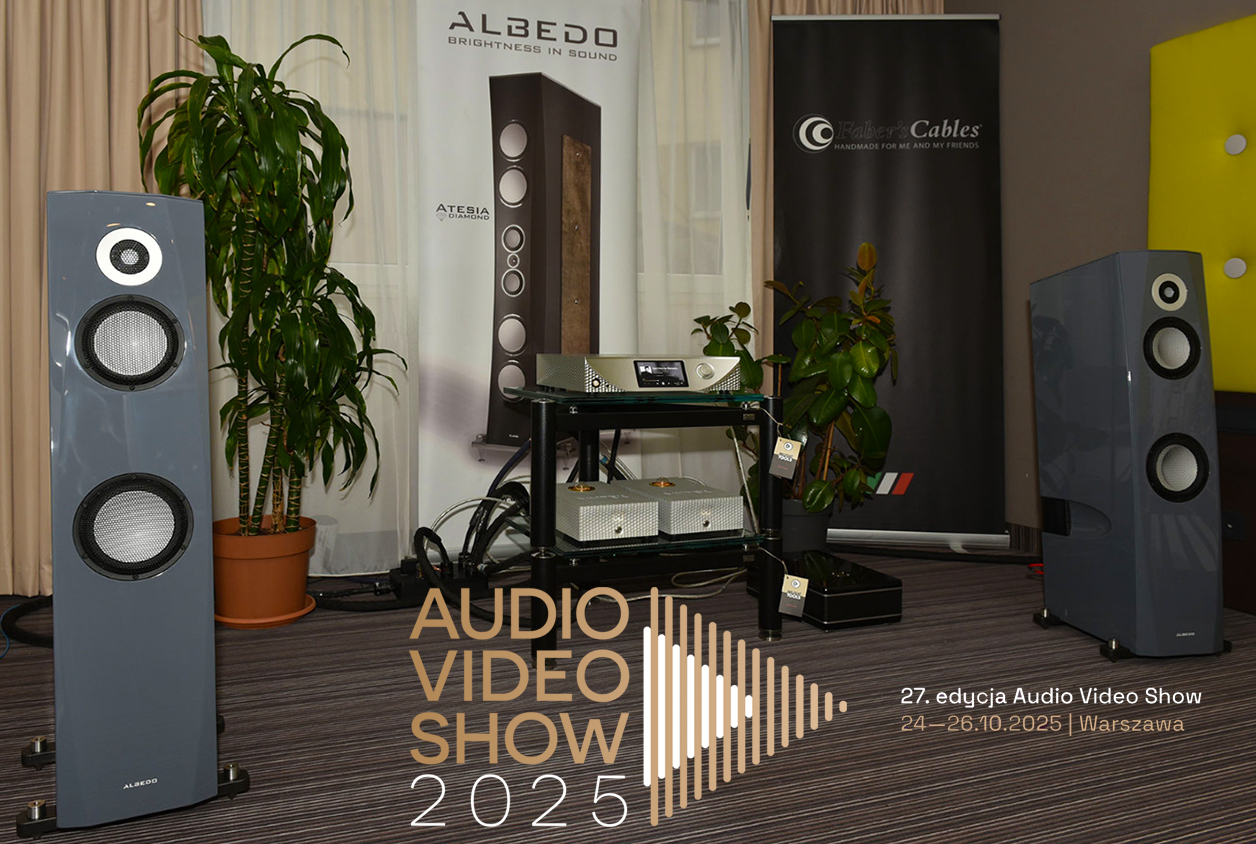
It also shows a very legitimate effort to maximally drive down wallet, domestic real estate and amplifier pain against the brand's ascendant into the upper echelon of size, price and weight. In that context, nobody would bat an eyelash were Achema priced like Raidho's X2t. Yet Albedo strategized hard to do it for +€5K less. That could buy a lovely pair of amps like my 250-watt Kinki EX-B7 monos and still leave money in the till. When the Warsaw show closed, "I'm back at the office and we had a very good event with three rooms to feature our Amira, Achema and Agadia. Several customers thought that our biggest room was best of show. Being glued to our exhibits, we'd like to believe that. One journalist for the Polish Audio magazine asked for the demo Achema but I have another pair in gloss grey pastel ready for you. However, this one is new so will need a minimum break-in of 100 hours."
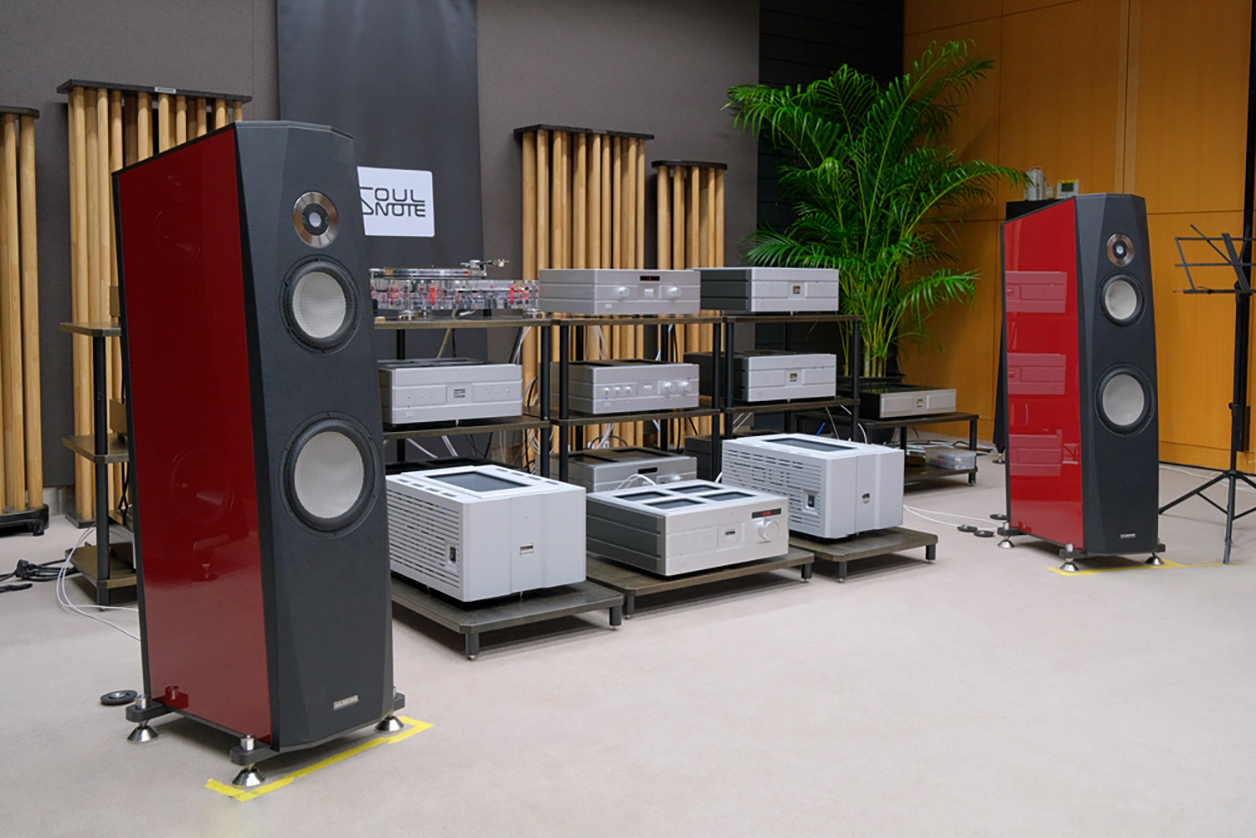
As former contributor Edgar Kramer covered at the parallel Tokyo show for SoundStage Australia, Albedo Agadia speakers also occupied a sizeable room there with a full phalanx of Soul Note electronics whilst Mono and Stereo…
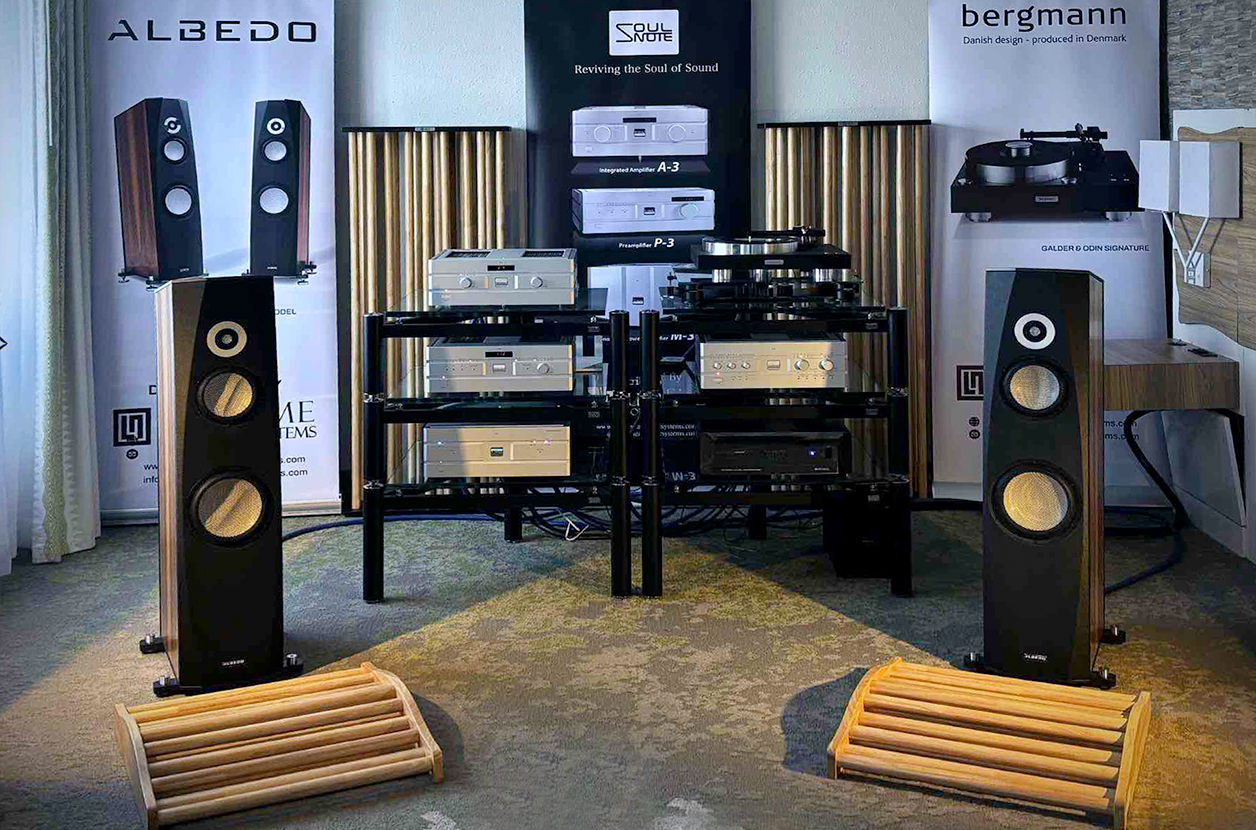
… reported on another such sighting at the NYC show. Fine electronics brands must always partner with speakers of matching pedigree. Popular brands for such pairings have been Magico, Rockport and Wilson. Has Albedo Audio achieved equivalent status now? It appears so. Cristiano Bastianelli also mentioned something I should have known but had long forgotten; namely that his company Music Tools & More srl in Montelabbate of the Pesaro e Urbino province not only runs speaker brand Albedo but like SolidSteel of Città Sant'Angelo does hifi racks + stands as well. If you were unaware, take a look.