

 Coming as I do from dipole AMT and Raal ribbons, Achema's 1-inch Accuton dome was rather less spectacular and dynamic so an embedded team player not occasional soloist. This gels with the prior page's profile. Given its standing in Albedo's catalogue, Achema's HF aren't yet open to the diamond trade as are its dearer stablemates. Here we face Thiel & Partner's proven Al²O³ material when the German driver suppliers shun Beryllium for its toxicity and stronger ringing. Canvassing familiar treble tracks, I heard nothing untoward, forward, bright or strident, in fact felt just a bit wanting for fully traced triangle fades, a piano's close-mic'd upper harmonics or the scintillating fireflies around the massed violins on The Ayoub Sisters. Given my bolded lead-in qualifier, this mellower tuning will appeal to those who fancy a slightly lower centre of gravity and dislike anything approaching explicitness, gloss or flashy brilliance across the top octaves. High female vocals pushing vigorously for edge-of-band peaks remained civilized rather than turn – um, capricious. This repels 'hard tweeters sound hard' platitudes but those still hearing minor coolness on top would be correct. That doesn't affect or alter the overall tuning, just renders high metallic percussive events bluish. The properly damped warmth at the heart of Achema thus isn't from a curtailed opaque treble but the downplaying of aerated energetics and splash help shape it. It shifts more attention on tone kernels so the centre of sounds rather than the sparkly spritzy elements on the surface of, say John Surman's raspy sax. It adds some down-pull to acoustic chamber music like The Khoury Project's stunning Revelation which unlike amplified productions is lighter and upwardly mobile by reaching for a more elucidated treble from its oud, violin and qanun.
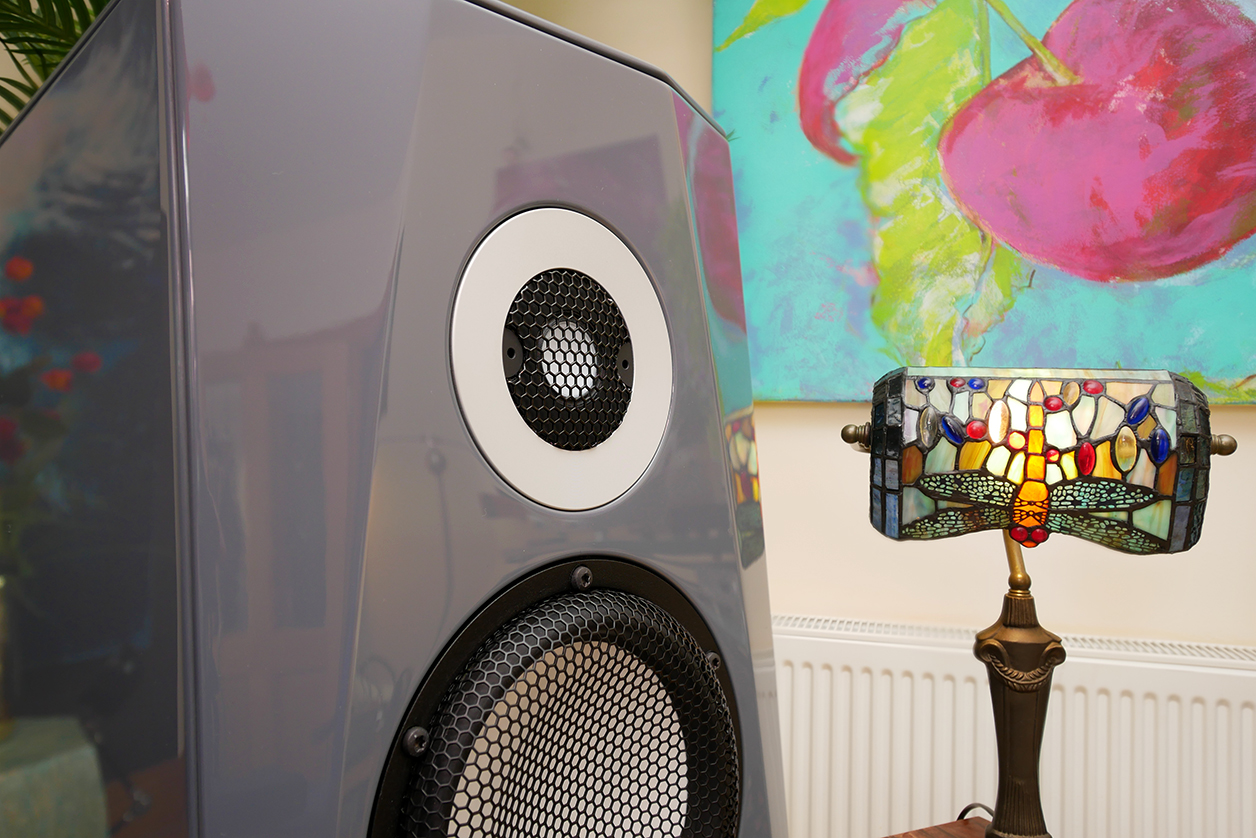 My cosmetic sense would prefer this tweeter ring in black not white.

Achema's special sauce ladles on from the lower midrange on down. Given what on the face of it might seem skimpy air-motion artillery, it's fair to stress what modern driver tech can achieve when fully tapped. Take Raidho's X2t already mentioned. I reviewed it and since read two other reviews. All of us complained of too much bass. After my test, Raidho began to include sixteen small foam wedgies which can selectively seal off their eight-cell ports. The very real need for that is so not what dual 5¼" drivers would suggest. Storgaard & Vestskov's down-low fortitude from two ported 5-inchers on their Gro was equally counterintuitive. Compared to these two Danes, Achema's cone surface is actually bigger. If memory is to be trusted, so could be its cubic volume. Unlike the Nordic colleagues, Albedo then install their invisible transmission line. It not only lowers the resonant frequencies of its drivers. It also applies firmer acoustic control over them. Somewhere in that hidden chicane lives this speaker's biggest difference maker: bass excellence and how this influences everything above it. Needless to say, the hammier our music gets on bass bandwidth and dynamics, the more the gravitas of this asset asserts itself. Translation: unleash the torpedoes. With my order in hand, I armed a special playlist for purpose. Here are some of its tracks:











At the risk of alienating by repetition, describing what Germans call Schokoladenseite—a special feature or quite literally, a thing's chocolate layer—means endless Schönberg not Goldberg variations. That's because once more in German, schön means beautiful. Our beautiful theme around which circle endless variations is on active-type bass control and power with atypically low room reactivity. Due to unavoidable room gain, in my case two sidewalls which usually don't factor, Achema's bass was technically elevated to create the rising in-room response most listeners prefer. If you know anything about black-level tweaks in photo editing, you know how deeper black values increase saturation, moodiness and drama at the cost of diminished shades of grey. Exactly the same happens sonically when bass stands in for black. Colour gets weightier, sonic materialism more robust and adjectives like chunky, substantial and physical raise their hands in the linguistic classroom. And just as happens in combat sports where the lower weight classes dazzle with more blitzing exchanges whilst the heavyweights hit harder but lumber and exhaust quicker, weightier sonics can feel energetically slower or more settled and stately. For Achema to snap to full attention meant somewhat higher SPL to let its dynamic reflexes compensate for its more gravitational mien. Once more, ceramic chauvinism—about rigidly damped more perfectly pistonic membranes being somehow 'quicker'—confronts actual experience to find itself amended like a rough draft returned with corrective notations in the margins. Where classic Franco Serblin sound was arguably midrange first, Achema bolts on US values with very potent low frequencies. Just so, the 'bellissima Italiano' tuning which Franco pursued with textile domes and paper cones remains in place simply executed with ceramics – though we probably ought to strike 'simply'. But the upshot is simple. Whilst capable of far more dynamic violence and scale than early Sonus faber monitors, Achema remains a more romantic slightly voluptuous proposition which one tends to associate with Europe's cradle of the Renaissance. Just like the metallic means towards that realization could surprise, so should the gap between physical and aural stature. Like other modern quite compact floorstanders with latest-gen transducers, Achema goes lower, louder and bigger than elder notions will suspect. The days of needing 12" woofers or bigger to do justice to modern electronica are over. Achema's compound 9.2" surface below 300Hz is obviously sufficient whilst keeping the baffle still narrower by splitting that moving mass across two smaller cones so two motors. Uniquely, their bandwidth isn't goosed by ringy port/s but a progressively absorptive transmission line of unusual window-shutter side exits.

Being 186cm myself, Achema's front baffle ends two finger's width above my belt line. I couldn't lean on it with my elbow without bending down. For a speaker which behaves full-range for all practical intents and purposes, these are domestically super friendly dimensions. Add first-rate finishing, a choice of three colours and far and away most important, surprisingly room-dismissive bass loading. The sum of it all makes Achema an impressively pretty and practical creation from a speaker house which following particularly Far Eastern demands, had spent the past few years producing ever bigger, heavier and costlier models. If that had you write off the brand as not being for you, with Achema they should be back in your good graces. They most certainly are with me and mine. Albedo's evidence also showed me how the topic of effectively executed transmission lines deserves investigation by anyone that's allergic to bloated bloomy bass but who as a renting Joe or Jill can't pursue classic room treatments; or even as an owner, won't countenance their visual intrusion. Between those two user groups, didn't we just tap the vast majority of audiophiles? If so, the world could be Achema's oyster…

Albedo's product page
