Context. With my inner accountant at a complete loss whilst his Teutonic training needed framing, I looked up the preamps which Audio Exotics' catalogue can access. If Chris Leung had selected the Lumen for his audition with China's most famous conductor, it stood to reason that he considered it his stable's finest. What were his other options? I Googled prices which appear in different currencies so for different markets. They aren't meant to be definitive and/or current. They simply convey approximate positioning of these eight models: darTZeel's NHB18NS, a battery-power solid-state preamp at ~€56K; Engström's tubed Monica at £50K; JMF's TRS 1.5 solid-state proposition at $39K; Riviera's tubed APL1 at €24.3K; Robert Koda's Takumi K15 transistor unit at €42K; Synästec's solid-state Fulcrum at €30K; Wavac's PR-Z1 tubed unit at €18K; and Zanden's 3000 Mk2 valve affair at €30K. The entire lot is active and transistors or tubes. Yet Mr. Leung selected his only passive-magnetic for the high-profile demo. With me out of the loop on these rarefied leagues, these mentions are merely anecdotal to help place the Æ within a grander global context. Now this oxygen-deprived altitude has me back in my familiar base camp of the lowly foothills. Already there, the Lumen's difference demonstrated in a big way. If my lesser hardware held it back, I can't even fathom what it'll do when all restraints are off. I'm obviously entirely misplaced to pronounce value or competitive edge. I'll leave that to others properly placed. Instead we'll return to sonic commentary.

Still on vintage tech, it's relevant to remember how the Soviet Union continued to develop tube tech long after the West abandoned it. Designers like Vladimir Shushurin of Lamm and Victor Khomenko & Steve Bednarsky of BAT introduced the West to the triple-nipple 6C33C used in military aircraft; and the 6H30 'super' tube. Alexey Syomin of S.A. Labs continues to work in Moscow on exotic valve gear and transistor circuits with forgotten Germanium and SIT parts. Leonid Burcev of St. Petersburg presently runs Triumph Audio. Whilst class D decommissions the need for large transformers, tube amps may use input, interstage and output transformers just in the main signal path, then add more conventional iron in the power supply including filtering inductors. Vinyl as more vintage tech that's refusing to die still embraces the so-called SUT or step-up transformer. For many years Silbatone Acoustics used the Munich HighEnd show to demonstrate enormous restored Western Electric and Altec-Lansing era systems which weren't for sale. These exhibits were purely educational and meant to expose visitors to the sonic standards achieved long ago. Apparently many listeners walked away dumbfounded. In a recent SAEQ review, Serbian designer Dragan Domanovic mentions last-century audio-engineering books and circuits from the 60s and 70s which constitute his primary sonic reference. Also in Serbia, Sasa Cokic and Mica Despotovic of Trafomatic build their own transformers in a small atelier. On larger premises, so do Nagra in Switzerland. There's Germany's Octave Audio and Greece's TruLife and Ypsilon. Famous Japanese names are Hashimoto, Tamura and Tango. In short, well off the mainstream there lives a fertile underground where vintage remains perfectly vibrant and signal-path transformers are fully up to date. One merely needs to know where to look; and keep an open ear or two.













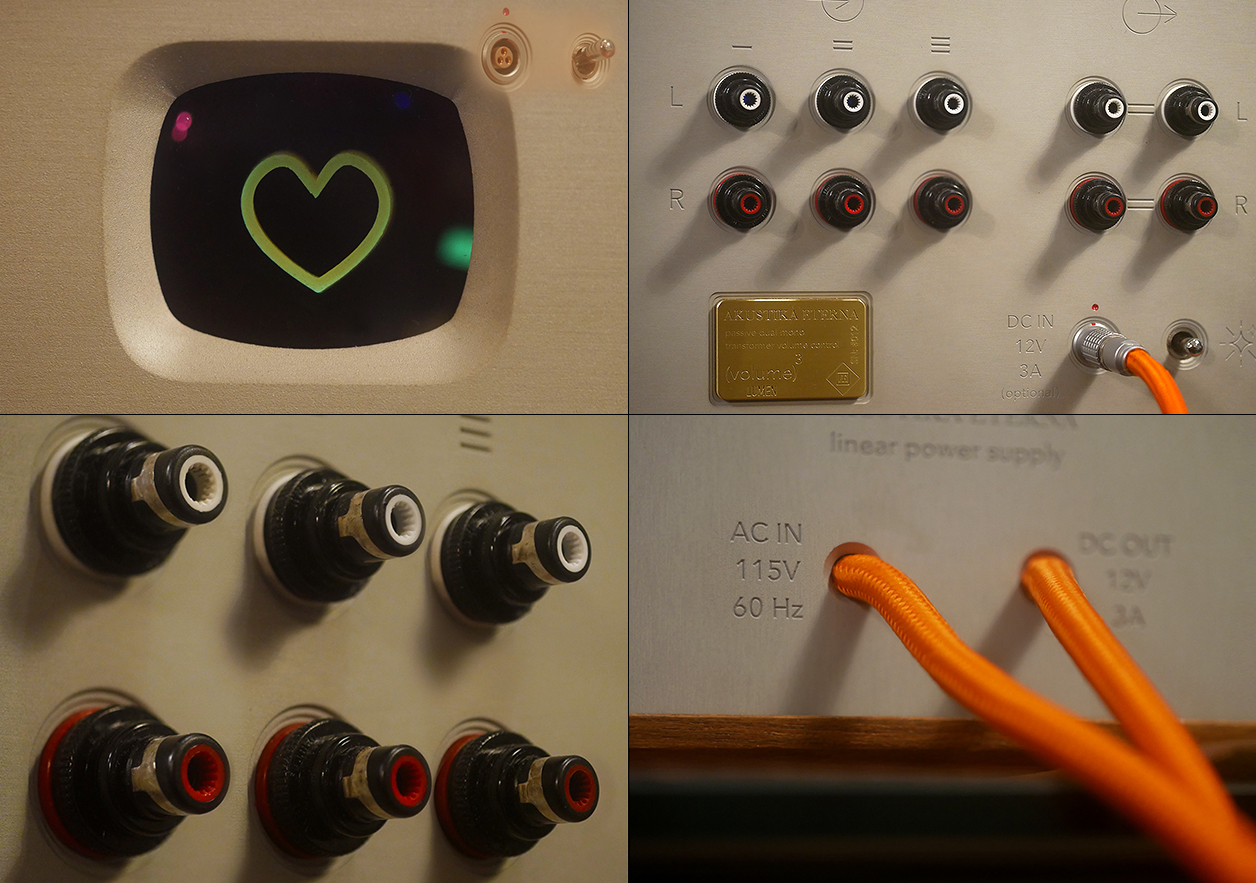
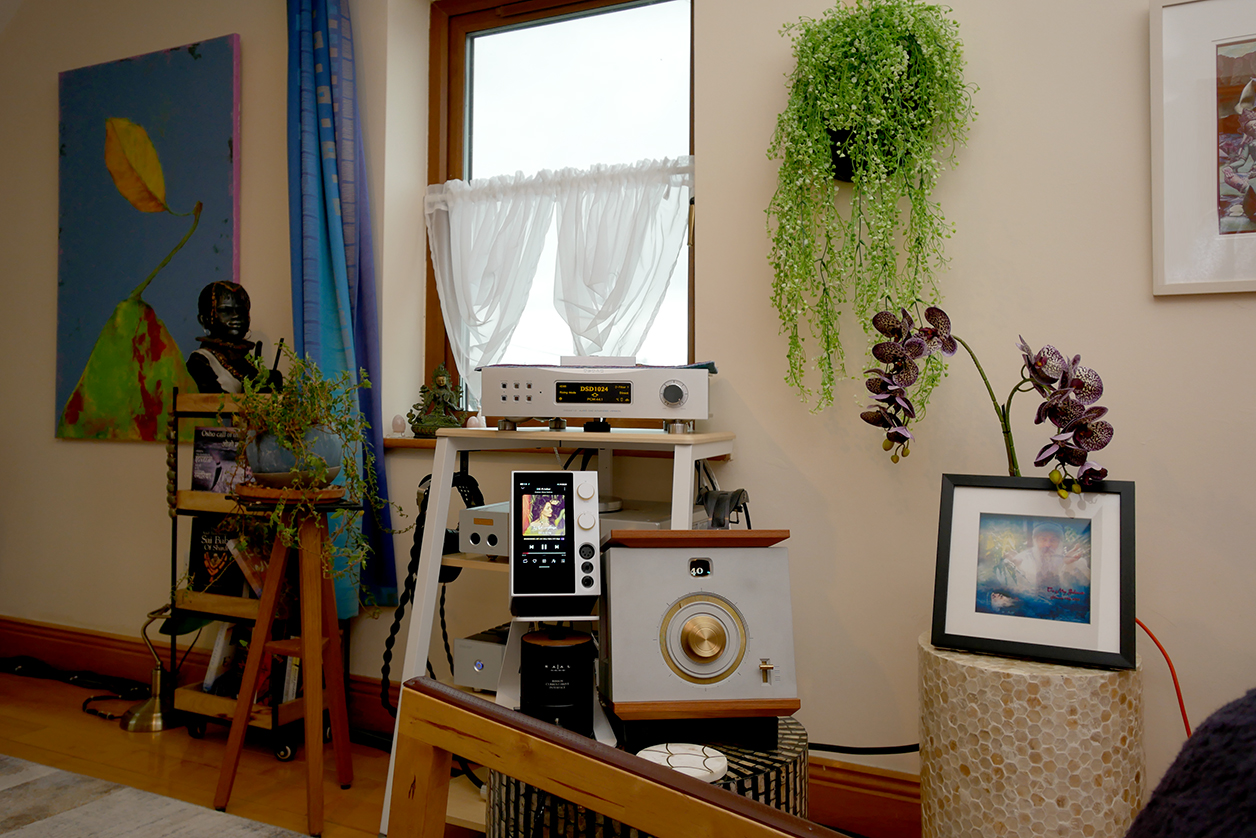
As far as open eyes go, Lumen's volume readout mirrors the magnifying bubble on a Rolex date window. Unless aimed face on, they blur or don't enlarge. Lumen's is worse because we must look through its deeper aperture so be sufficiently perpendicular. On my customary side table in the upstairs system, I sat too high to see any numbers. Meanwhile my icOn's display with its larger numerals flush on the baffle is easily legible well off axis. Using two spare footers of the right length, I tilted Lumen up and presto. On the downstairs rack facing straight out whilst my chair sits at a steep angle, I couldn't see anything either without first seriously rotating the cube to face me. Whilst this display is a trick and whimsical design choice, it requires careful positioning to come off as intended. Its concept probably dates back to a childhood memory of a Soviet Union arcade game where young Stas pressed his eyes against the rubber lip of a periscope to spy the faraway action of seafaring targets he was to torpedo. We're back with the old rogue, Cap'n Nemo. In this rig, Lumen attenuated signal coming off a FiiO R7 SD-card transport supplying first a Soundaware D300Ref USB bridge then Cen.Grand DSDAC 1.0 Deluxe with digital signal. Set to fixed output after applying DSD 1'024 DSD processing, that DAC fed the Lumen a now 3V analog signal.
Being within reach, I could fondle Lumen's luxo knob at will. Rotated fully counter-clockwise equals perfect mute. Fully clockwise shows this heart likely followed by a matching attack. With most modern systems running their normal playback levels at minus 30dB below unity gain—on DACs with silly-hot 12V outputs, that figure will be a lot higher—zero attenuation should mean massive mayhem and quickly overheating voice coils unless stopped pronto. A more appropriate symbol could be a red line through this heart. Whilst mine still ticks, now back to listening.