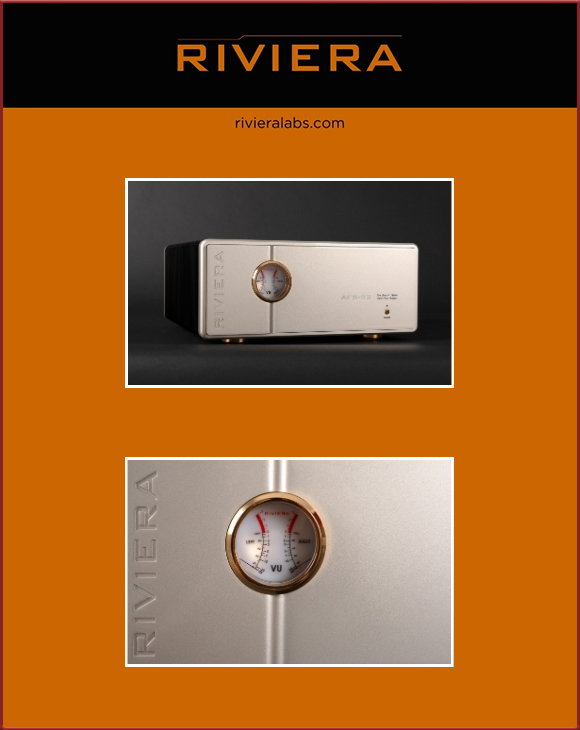
Stas grew up and studied in St. Petersburg, Russia. His parent were in the medical field and not keen to see their son pursue life as a possibly struggling musician though he did start on percussion then saxophone to join a Jazz band. Later though he did switch to formal electronic engineering studies with a focus on audio/video. This led to work for an importer who carried brands like Genelec, Krell, Lexicon, McIntosh, Meyer Sound, Parasound, Piega and Sonus faber, did big commercial installations and repair/restoration work. His Æ collaborator is Mikhail Lucet, a friend of his dad's whose formal career was in radar and radio QC. Circumstance connected them years later to discover that completely independent, both had applied the interim to very serious DIY involving vacuum tubes, circuits and transformers. By that time Stas had relocated to the US, first Boston then San Diego. Mikhail already lived in Lübeck. Sharing circuit ideas and assisting each other on projects, experiments and ideas, things formalized into a brand about 4 years ago. It's when Stas received a carte-blanche commission to design an American audiophile's 'end-of-life' amplifier to drive high-efficiency Tektron speakers. It became the 2-metre wide 3-chassis 136kg AD1 SET named Lucet in honour of Mikhail's contributions who otherwise seems perfectly content to work invisibly in the background. The actual commission was for a circuit wrapped in utilitarian threads. The client didn't desire anything fancy. Given their enthusiastic response to the amp's sonics however, he granted Æ extra time to construct a bespoke housing which they felt was commensurate with the sonics; and later loan them his treasure for show participation. This was the first project to carry the badge Akustika Eterna. Given the physical impracticality of this maiden creation, the follow-on production project was to be universal hence suitable for any type system; and far more compact. Enter today's Lumen. When asked what hifi systems he had heard over the years which impressed him, Stas remembered a Vladimir Shushurin amplifier on Piega speakers; and components from Yoshihiro Muramatsu, Serge Schmidlin, Jean Hiraga and Anatoly Lihinitskiy. In general though he found commercial hifi to lack an essential component of energy transmission to instead build his own. The brand's first two retail partners are The Audio Salon of Los Angeles¹ and Audio Exotics of Hong Kong and Singapore. A new contact in Stockholm he visited just before me might come aboard next. Based on discussions with these shops, planned next are a 15wpc likely triode amplifier and a higher-power hybrid to service a broad spectrum of speaker loads. Requests for a phono stage have also been made already.
________________________
¹ Some of their key brands are Boulder, Cessaro, Dan d'Agostino, dCS, Halcro, Kuzma, TechDAS, Wilson Audio and Ypsilon.

 Amongst personal inspirations Stas cited the Georgian philosopher Merab Mamardashvili aka the Russian Socrates who was influenced by René Descartes and Immanual Kant; and Japanese watchmaker Masahiro Kikuno, the youngest member and first Japanese to be inducted into the Swiss Académie Horlogère des Créateurs Indépendants. Kikuno makes only one or two watches per annum² and has revitalized the ancient Japanese system of wadokei based on day and night time being of different lengths across a year. To reflect the changing times of sunrise and sunset, his temporal hours manifest by a 24-hour dial with 12 mobile indexes connected to a cam which continually adjusts the indexes so that the spaces between daytime indexes as well as the total space occupied by daytime is longer in the summer, shorter in winter. This system is adjustable to a given latitude.
With the Lucet amplifier arguably being a one-off extremist effort unless another client is happy to accommodate a nearly 2-metre wide low-power SET, Æ's future models will conform to more conventional dimensions. Being an obsessive who dreads the faraway day that someone will open one of his creations to discover anything not absolutely immaculate, Stas confessed to not recognizing good enough. He appreciates that the reality of regular production with reasonable labour demands—he performs most all the work in his own studio and for the Lumen only outsources the volume readout's optical cyclops glass, top window and anodizing—will require some concessions to practicality.
After all, following Kikuno-San's schedule of just one watch per year wouldn't suit the hifi sector's dealer scheme. Does anyone need audio gear whose inside surfaces and parts are as polished as the outsides? In the top echelon of watch making or motor cars, it's not about need but desire. Certain clients are perfectly happy to be put on a lengthy waiting list for an exclusive hand-made creation whose inner engine gleams with as much intricate details as the exterior. Within reason, Stas banks on this being true also for top hifi connoisseurs. His first dealers clearly agree or wouldn't have signed up.
_______________________
² During a brief meeting with Kikuno-San, Stas asked him about his production capacity. "Zero or one per year" was the answer by someone who clearly believes that good things can't be rushed and at times don't come out as planned to have one start all over again and make for a year without any production.







Audio Exotics had recently hosted a private audition for Long Yu, Asia's famous conductor dubbed the Chinese Karajan. He fronts his country's top orchestras so the Shanghai Symphony, Guangzhou Symphony and China Philharmonic of Beijing as well as being the director of major music festivals. He had cut a new recording he wished to hear on Chris Leung's very best system at Divin Lab. It included Stas' preamp. Knowing what the recording's orchestra sounded like from his podium, Mr. Long Yu was obviously the only man alive to truly compare the Hong Kong sound system to the intimate live perspective. Apparently he was most impressed and didn't know that playback of such calibre was available. Back to Stas, he could regale you for a full hour on just the intricacies of winding transformers and the influence which mechanical damping and resonance management have on the sound; about core alloys and how his choice differs with application; about mono-crystal silver wiring sourced from different specialty suppliers to arrive at the desired result and much more. It's back at levels, layers and leagues. Many of us are content to surf closer to the surface. Stas & Mikhail aim at carefully matured listening skills to recognize and place proper value on the extra lengths they go to. At Audio Exotics whom I visited many moons ago, the surrounding hardware context and scale far eclipse my own. It was thus questionable to what layers I might descend when inserting Lumen into my system where it trumps my priciest component by a factor of close to ten. Was I about to drive one of Jay Leno's posh super cars in 2nd gear down a bumpy Irish backroad past shaggy sheep and dilapidated stone cottages? If so, it'd not be the Lumen's fault if it couldn't shine at full brightness. Unlike the balanced 5-input CL version I'd expected, my sample was the 3-input RCA-only original without 6dB of step-up gain. Its remote control didn't work because a part for it was back-ordered. Stas had elected to pursue this review sooner than later. Thankfully I had a 6-metre RCA link in lieu of the usual XLR. Getting the piece through airport security had apparently caused a minor scene at the X-ray machine. Stas being able to explain every inside part satisfied the inspector that it was a harmless hifi appliance not explosive device with a manual trigger lever.

How does one assess a preamp's sonic contributions? Ideally against the bypass of a variable source. All three of my systems feature such a one. The arguably least invasive solution is Cees Ruijtenberg's Sonnet Pasithea, an R2R DAC with split-level processing of the less/least significant bits and variable reference voltage on the ladders. Without resistive decimation, this scheme sets the circuit's voltage gain as Enleum do with a variable output resistor on their discrete current op-amp. With my DAC-direct connections, these systems are obviously voiced to perform as intended without a separate preamp. They're not centred on active preamps where the sound would collapse without them. From my perspective, these were perfect conditions to evaluate Lumen. For a hard assessment at the job site of magnetic attenuation, I had Pál Nagy's £3K Lifesaver Audio icOn 4Pro with custom Dave Slage autoformers switched by MCU-controlled FETs. Thus my resident hardware and the American visitor had their marching orders.
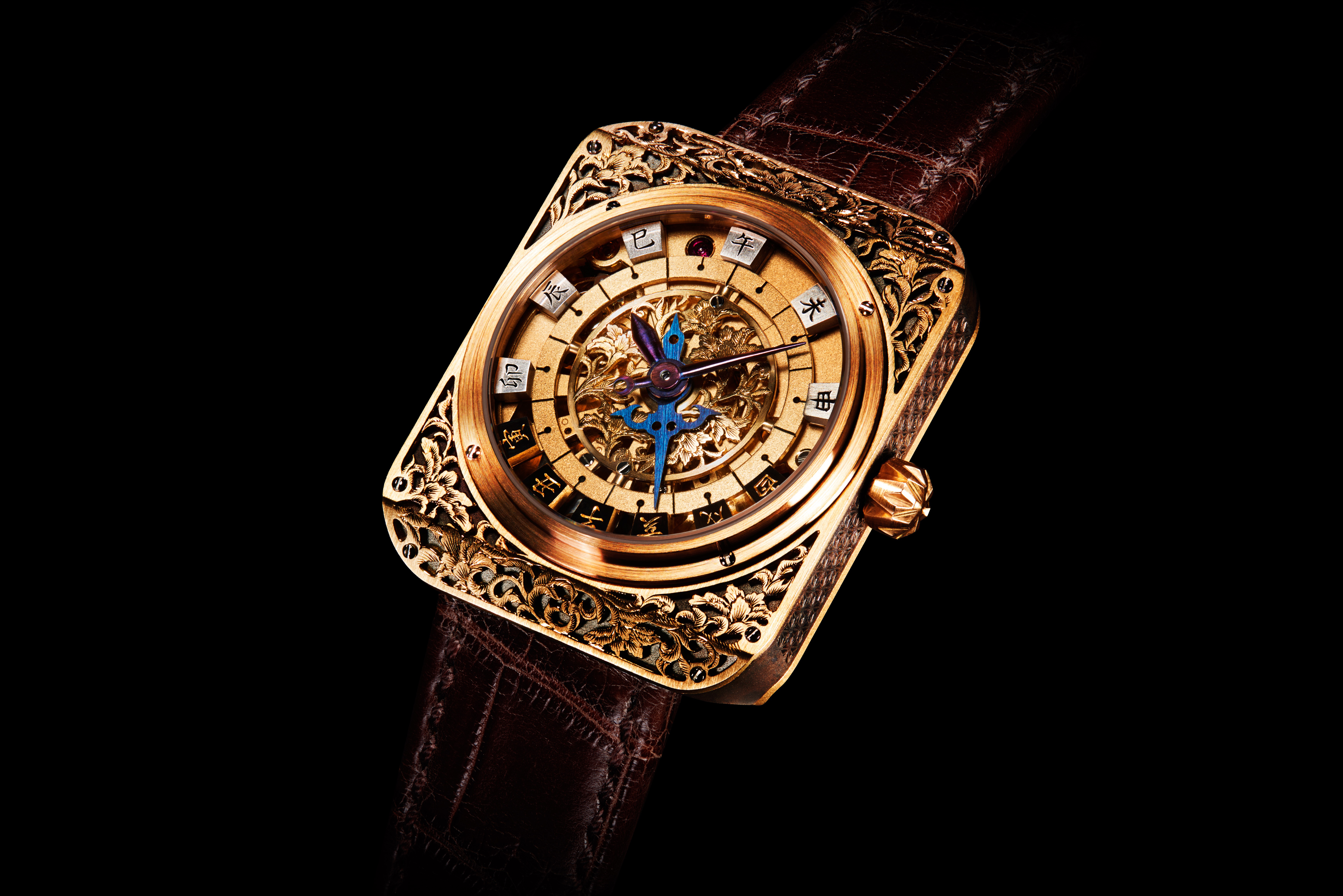 Another Kikuno-San variation on the wadokei concept not for sale. View at full size in a new window.