 Glowing with Gro? Being one letter off the Gro reservation, let's consult Merriam-Webster again, this time for synonyms on warmth. Balminess. Glow. Heat. Hotness. Radiance. Torridness. Those are a few. If we want equivalents for intensity like having warm feelings for someone, hello cathexis and extreme versions like fanaticism, mania, vehemence. Stalking implied? How about warmth? In hifi I see a few causeurs. There's harmonic distortion from the previously mentioned single-ended no-feedback 300B circuit. It might not just lack treble extension because a half mile of output transformer windings limit bandwidth, act as a low-pass filter and enlarge phase shift. It could produce high amounts of 2nd-order distortion. That equals octave doubling in the overtones to enrich textures like a faint back-up singer does an octave above the lead. A subdued treble and/or thick textures cause warmth. Another source is confused timing from phase shift and lack of inter-driver time alignment. This is heard by contrast to single-driver widebanders. Whilst dealing with their own limitations and issues, those put it all on one cone without crossover. They flaunt timing that's simply more sudden. Other sources of warmth are the complementary effects of a subdued treble via an elevated bass or upward midrange.
By manipulating the frequency response to increase the relative output of a limited bandwidth over against the remainder, we can pursue warmth. There's lateness from rear-firing ports. Finally and most common is sub 200Hz room reactance. Room modes aka standing waves cause narrow-band bloom/boom. Even where there's no coarse response wobble, without acoustic treatments there is always time delay from late-arriving reflections. Those are primarily caused by the omnipolar radiation of LF long enough to wrap around their enclosure then bounce off all hard surfaces and furnishing. Only a so-called infinite baffle like an in-wall speaker or dipole/cardioid radiation avoids or minimizes it. A room's delay time in the low frequencies as set by our physical dimensions causes acoustic 'reverb'. Like silt stirred up by wading through a shallow lazy creek momentarily muddies the water, so does acoustic reverb blur our sonic conditions for all frequencies, not just those which cause it. It's how aside from skewing the frequency response, too much in-room bass will blur, damp and confuse the vocal range and treble. This smudged effect of blur and thick somewhat vague outlines too is a form of textural warmth.

This prelude to warmth was key to identify which form is Gro's. It's obviously not tube-based THD unless we bolt it on with such an amplifier. I'd say it's neither needed nor wanted. Surprisingly it's not lateness from rear-aimed ports. Whilst calm reason insists there must be some, experience with competitors insists that Gro's is decidedly less and no obvious factor. Neither does it take liberties in the amplitude response. What factors instead seems tied to Curv. These cones don't create the nearly hyper-pixilated outlines and their intense contrast I've heard with cooler Børresen cones. This doesn't affect Gro's image localization. That's as sorted and specific as a mini monitor's. But it does draw these precisely placed deeply layered images with a softer lead pencil. Also, it covers its majority bandwidth with two drivers. Top surround to bottom surround, they spread across 31½cm. I can't be sure but suspect that the big compound sound source which such spacing creates—on a receding baffle no less which causes minute time differential between its two mid/woofers—is another contributor to Gro's glow of minor warmth. As my grotto paragraph described, the quicker reflexes of small mid/woofers sharing the work load minimizes typical driver inertia and its lag. Just so, Gro presents us with some baked-in warmth. Its extent and type simply didn't bother this widebander fan who had just finished reviewing Voxativ's Alberich2 days prior. I can unequivocally state that if the short Berlin stack represented high-rate PCM on Spectral gain to prefer more of a FirstWatt SIT4 or equivalent valve amp, Gro assumed the DSD256 position already on my 2.5MHz direct-coupled amps. What further played to the familiar tuning of my mono amps were those Satori tweeters and their unexpectedly brilliant energetic reflexes. Their lemony freshness played antidote to any potential chocolate consistency. Just so, with Gro we do grab minor opulence. Hello gropulence.










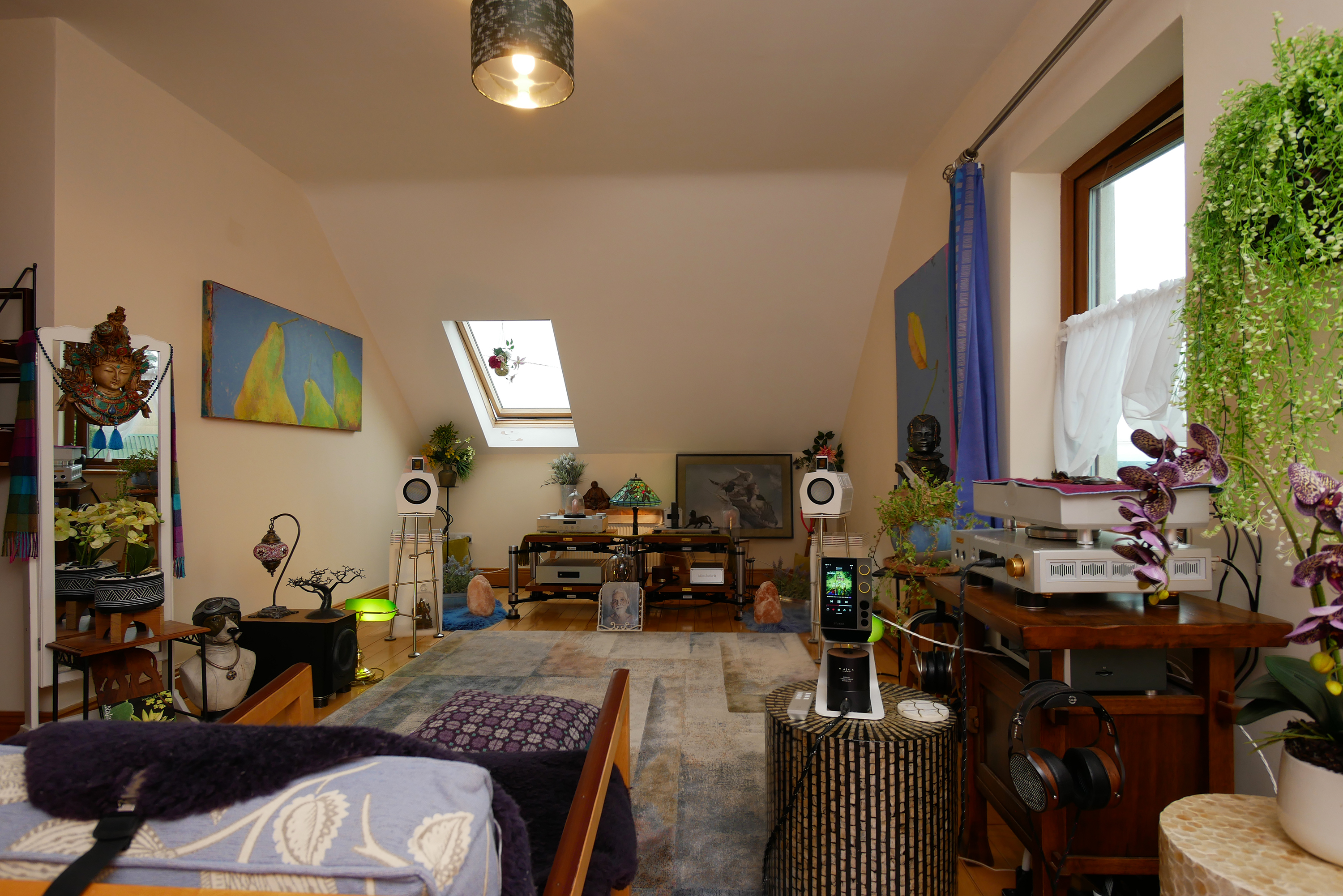
Growing into a groupie? Having grokked Gro on paper and photos then taken it for spins around my tracks, I could quickly grow into a fan with benefits. In my ~45m² space left open into a capacious hallway then adjoining open rooms, I neither require nor desire anything bigger of stature or artillery. In an actual transaction, its stiff sticker could certainly stop or at least stutter my ticker. But on a review's temporary basis, it was no different than accepting a ride in a friend's shiny new German limo. I appreciate that his wheels are wildly beyond my station in life but dig the drive regardless. One has nothing to do with the other. It leaves the crass coin toss to his accountant. Having very recently arm-wrestled mine into submission with the acquisition of ModalAkustik's MusikBoxx for my upstairs rig, I had to invoke self-imposed abstinence. But make no mistake. Gro's tuning and physical package with its customizable finishes did ring my imaginary till hard as alternate flavour to my downstairs domestics.
 Gro in grosz or groschen. One is Poland's steel/bronze currency at 1/100th of a zloty, the other the decommissioned Austrian equivalent of 1/100th schilling. Call it my coin count or penny pinch. That means value versus a writer's familiars. Having reviewed Raidho and Børresen speakers which thus referenced throughout, Storgaard & Vestskov belong in the same discussion. After Mundorf's dipole AMT as used by Qualio and ModalAkustik for two of my speakers, Raidho's planarmagnetic tweeter is my 2nd-favourite treble maker. It creates particularly gilded very airy atmospherics of gorgeous tone. Børresen's core tuning is about the dragstrip—co-founder Lars Christensen's big BMW is of the dual-clutch dual turbo sort whose mad acceleration he demonstrated to me repeatedly with adolescent glee—plus virtually holographic soundstaging. Gro's tuning has its own gems. On Merriam-Webster's gro list, I learnt of grossular as a commonly green variety of garnet. But in audio terms, I will highlight the trinity of tone, timing and bonhomie. These qualities combined into one gestalt. They didn't factor in any particular sequence. In my world, timing holds hands with speed but also, ideal control between amp and drivers.
Gro's take on timing quite differed from Børresen's leaner racier variety. It gave Gro richer tone than I'd expect from an equivalent Audio Group Denmark model though they offer multiple tiers of speaker families and I only heard a few. The bigger deal of Børresen's umbrella company owned by a consortium is the fundamental difference with SV-Audio's family profile. The former must keep their investors happy. This necessitates a very different scale and type of operation. Whilst that's no sonic consideration, it should very much reflect on relative value as measured by profit margins. How much of our spend flows into actual hardware not the many-layered costs of doing large business with annual payouts? In this crass capitalist consideration, it seems fair to accord Gro far weightier value. As a more blue than white-collar guy with a German Navy dad, weightier value always has my vote. We'll revisit my Navy connection on the next and final page.