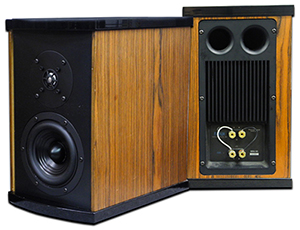
 Groundbreaking with Gro? 30 years ago I sold this Platinum Audio Solo at Northern Cali's Soundscape shoppe. It was one of the earlier 4" stand-mounts to hit a solid in-room ~35Hz with signs of life quite beyond it. Stereophile's John Atkinson measured them flat to 32Hz in his smaller room and they even made "a brave try at reproducing the 25Hz band". Given that its designer played funky slap bass à la Marcus Miller, such boisterous crack was a shocker only for the diminutive artillery producing it, not its author. For its day it likely was a genuine breakthrough. In 2025 we have numerous compact speakers on stands or on the floor which duplicate or exceed Solo's stunt. Many in fact are Danish. Dynamic driver design hasn't stood still even if its raw makeup—cone, voice coil, former, inner and outer suspension, magnet, lead wires, basket—has. As a 5" 2-way with twin mid/woofers good for a genuine in-room ~30Hz and both paralleled drivers upwardly mobile beyond the medium-shallow 2nd-order 2'750 filter, Gro breaks no true new ground it seems. Where with contemporary Danish precedents it slightly does is by advocating hi-tech plastic cones over carbon/foam laminates with nano-thin ultra-hard skins or similarly treated ceramics. Beyond that, the same tradition loves paralleled small drivers, many paralleled small ports and hating big on 3-ways. What does put Gro on a Dansk diaspora to feel displaced is its 3-driver 2-way concept. As we inspected already, its domestic doubles all are 2½- or more-ways.
It's legacy audiophiles who haven't shopped speakers since the last century whose first date with Gro could break truly new ground. That would be particularly so if €20K last looked at three/more-ways with bigger woofers in far taller heavier cabs; and not just because the same coin then bought more. Serious shoppers equated top performance with big boxes, period. What's different too is the concept of performance. It used to be divorced from appearance. In fact, good looks back when could suggest compromised seriousness. As upscale modern hifi drifts ever deeper into the luxury sector, style and appearance merge with the total performance package. Here great sound without serious cosmetic grooming doesn't perform. And since Steve Job's iPod, mod-con shoppers of means equate desirability with compactness. Why use a PC or heavy-lens camera where a smartphone will do? Why big over-ear headphones when an ambitious IEM styles far harder thus performs better? For them, Gro is squarely of today not yesterday. And though not truly square—not only does it lean back, it slightly curves its baffle segments—Gro conforms closer with the classic concept of a transducer box than the narrowly spined wind-slippery curve jobs of bulging cheeks proposed by the current domestic competition which adds protruding port pipes like sporty car exhausts. Squaring things out a bit isn't exactly new ground. Neither are narrow baffles. But perhaps being more angular is ground less trod today to pack just a bit of a retro remit? Going custom anodize to match the baffle, terminal plate, port flares and outrigger plinth to perfection isn't retro but rad. It really goes the extra kilometre on SV's custom concept. Imagine my loaner done up in ivory paint with this same blue trim. Be still my bleeding heart.











Grouting with Gro? Wikipedia sets this seemingly unlikely scene with "grout fills gaps or reinforces existing structures. Grout is used in crack repairs, for water stoppage, as tile-seam filler and soil stabilizer." Gro certainly reinforces existing systems which aim for linearity, dynamics and clarity without any deep-fried crispies. Those often sizzle in the treble with dynamic forwardness where for example an AMT might outdo its coned mate; because absence of time alignment has the high frequencies arrive at our ears before the lower parts; because dome breakup intermodulates the audible range. Should existing electronics suffer such cracks in their smoothness like plaster over shifting brickwork, Gro can repair them. Its driver integration is seamless, its treble suave without any metallic undertones, its loudness potential stable for the kind of space Gro is meant for. If stabilizing sonic soil looks at a solid bass foundation and properly hung lower midrange, we already covered that. The grouting angle works, no spin involved. As to any water-stopping powers? Gro isn't groomed for the sharp-edged sort of extreme separation and its usual follow-on, soundstage analytics. Such qualities ratcheted up tend to primarily talk to visual listeners. They often are bystanders as in, watchers. Gro's driver remit, wiring and filter tuning focus more on 'organic coherence' to use a poncy term. To my ears that prompts a more emotional connection based on image density, weight and rhythmic expressiveness. It's about feelings and the belly more than looking at things with the head. If feelings cause a few tears of musical involvement and partycipation, the Danes should call it mission accomplished.
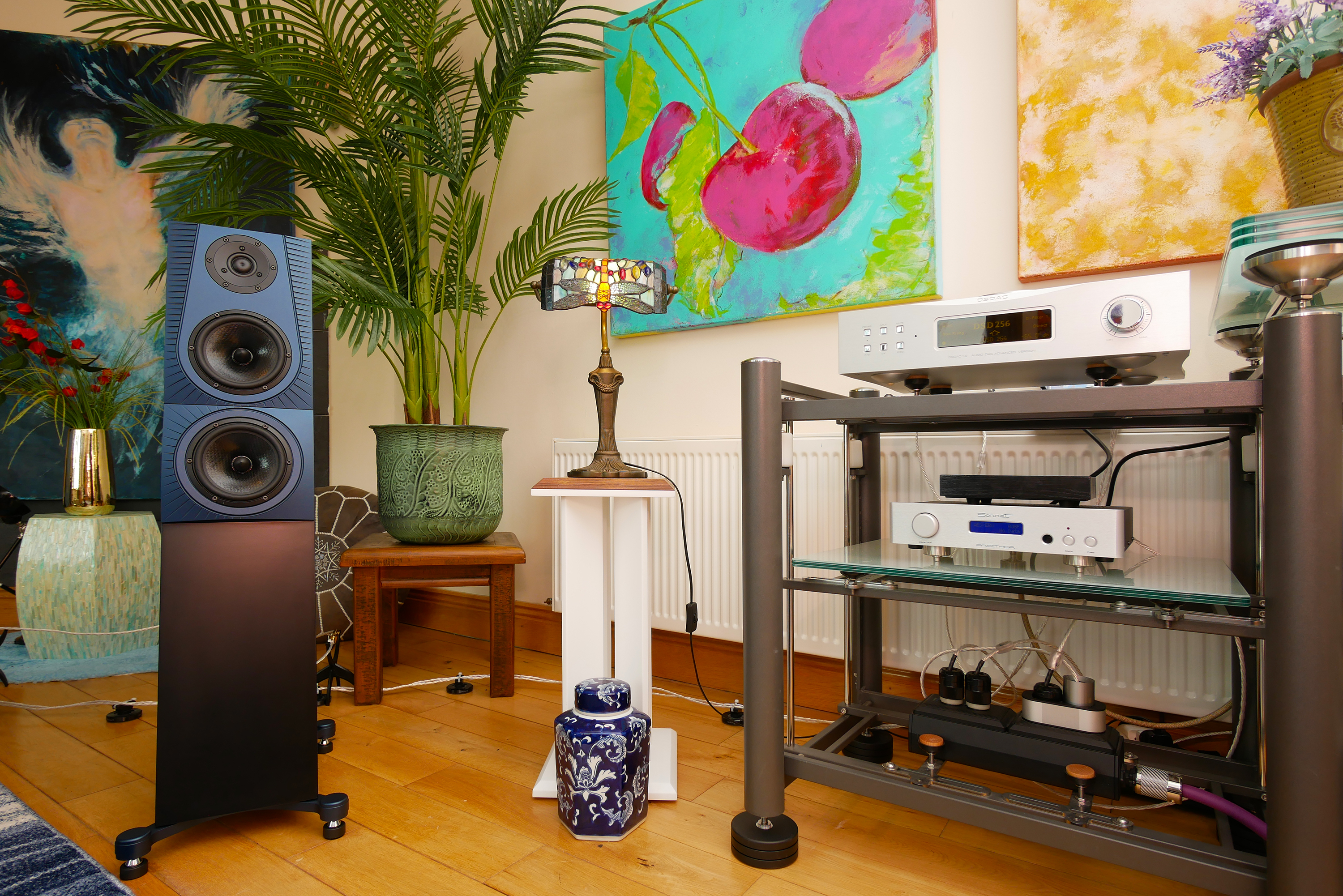 Cen.Grand DSDAC 1.0 Deluxe fed DSD256, Sonnet Pasithea 176.4kHz PCM.
 Grooving the grotto? This reads rather more Baroque than "Rock the Casbah" yet works once groove equals timing. It's that element of rhythmic propulsion called playing in the pocket. Even actively trading boxers use it when not feeling each other out from a safe distance. We should probably invoke pistonic precision from rigid small cones. Their lower mass starts and stops with greater alacrity. Doubling on motors splits excursion range. That cuts motion times in half. Quicker reflexes. Prompter acceleration. Superior diction from quicker braking without apparent overhang. Ringing would cause subliminal wooliness. That often mislabels as warmth. It's really confused timing. In crisp not sloppy timing, crossover execution is another factor. SV-Audio invoke a TIM¹-reduction circuit and minimized group delay². Also, the totality of Gro's contributors doesn't rely on ultra-hard nano coatings over metallic cones. Like earlier Accuton ceramics, those can overemphasize transient incision. With it, the sonic gestalt's subjective damping goes up, tone colours desaturate and the musical gait feels more clipped than fluid. Gro played pertly in the pocket yet did so with high colour temps. Its Curv cones don't do dry or monochrome. Neither does the Satori tweeter. This leads straight to the next G-Man combo.
¹ TIM aka transient intermodulation refers to an amplifier's or speaker's inability to track rapidly changing signals like steep leading edges. This was classically caused by feedback delays being slower than such signal. Sonic results were smearing, reduced dynamics and possible harshness during complex signal with many simultaneous transients.
² Group delay is about how a given crossover's frequency division affects its drive units' phase shift. Less group delay means less inter-driver delay difference for superior temporal linearity. For example, sufficiently late bass could sound sluggish, treble arriving early forward even bright.