About scratch in my ancillary context, I'd play poor Irish relative to Gro's posh Danish uncle. Though fabulous to my ears, neither my Sonnet Pasithea DAC nor Kinki EX-B7 monos carry the kind of pedigree and prestige many SV-Audio punters might bring to their party. This would be a case of pony down. But since Lærke clearly wasn't troubled by my hardware standing, neither would I be. Just one final confession before we start listening. I'm a stereo 2.1 fan to exploit active adjustable bass and in the downstairs rig, directional hence less room-reactive bass. That's generated by a folded open-baffle 2×15" sub with dipole-typical lateral out-of-phase cancellation plus reduced front-wall output. Whatever that asymmetrical radiation pattern doesn't cancel of my 35/70Hz modal room resonance, a pair of PSI Audio active bass traps operating below 150Hz absorb. For proper phase/time interleafing with the mains, an analog precision crossover from Lifesaver Audio splits the signal into hi/lo-pass legs at 100Hz/4th-order Linkwitz/Riley. This RiPol subwoofer's primary raison d'être is not more/lower bass—my usual Qualio IQ 9½" 3-ways are good to ~25Hz—but considerably fewer room reflections than typical ported/sealed omni bass. The crossover's remote-controlled 'bypass' can eliminate the sub from the seat to route full-range signal to the mains for instant A/B. Nobody pursuing a deluxe small tower with response into the high 20s will be a prime candidate for stereo 2.1. If we plan on covering the bottom 2-some octaves separately, why spend the long green on an unusually hung speaker? That only needs to make ~60Hz to hand over cleanly. All this by way of explaining that I had a solid 25Hz in-house comparator to gauge Gro's Mariana Trench ambitions; but would only use it for context. My main MO would be full-range since that's what I expect most prospective Gro shoppers will apply, too. About grokking Gro the name to use Robert A. Heinlein's word for intuitive understanding from his novel Stranger in a strange land, "Gróa was a seeress of Norse mythology who could heal even Thor with her song. A symbol of sound as magic."
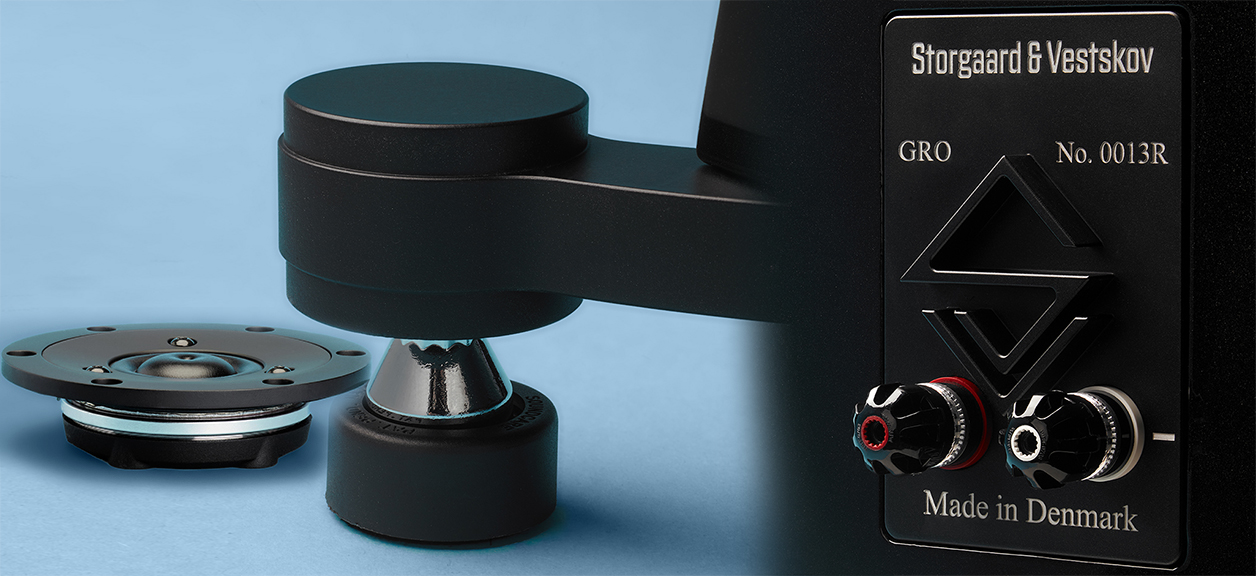
For a final Dansk trend, much of the country's speaker scene dislikes large drivers. SV-Audio's Fenja runs 4 x 7" woofers instead of a single 14-incher, Gro simply doubles up on Frida's 5er. Audiovector's top R10 Arreté nets Fenja's compound surface with 8 x 5". Børresen and Raidho likewise practice multi-paralleled smaller woofers. Even Raido's first descent into subwoofers this year stopped at 10" woofers (twin active 10", 4 x 10" passive radiators in the big model, twin 8" actives with dual 10" passive radiators in the small model). Børresen's parallel entry into RiPol subs kicked off with 4 x 8" woofers.
 It's as though the country's speaker engineers had signed a unilateral agreement to leave 12-inch and 15-inch woofers to the Americans like JBL and Klipsch. I don't know what if anything this signifies but it seems like an interesting observation nonetheless. Considering bandwidth ambitions, Gro's woofer is compact. There must be something in the salty sea air around Denmark that affects driver diameters? There's even a whiff of burnt rubber since Casper & Kim consider themselves true motorsport enthusiasts. Aston Martin's Valkyrie [left] inspired their one-up British Racing Green Frida pair shown at the British Audio Show Deluxe near the famed Silverstone racetrack. There's also a direct connection to the Olympic sport of the discus throw since Casper's Denfi Sport brand produces the eponymous discus developed with world record holder Jürgen Schult since 1989. Casper also owns the Mill-turn machine shop in Jutland's Herning but SV-Audio operate out of local ISO 9001-certified Borntek Industri A/S in Rønne, another of Casper's multiple operations. It's how our new Danish speaker brand can work from a rural location on a small island. It taps into quite the pre-existing infrastructure.











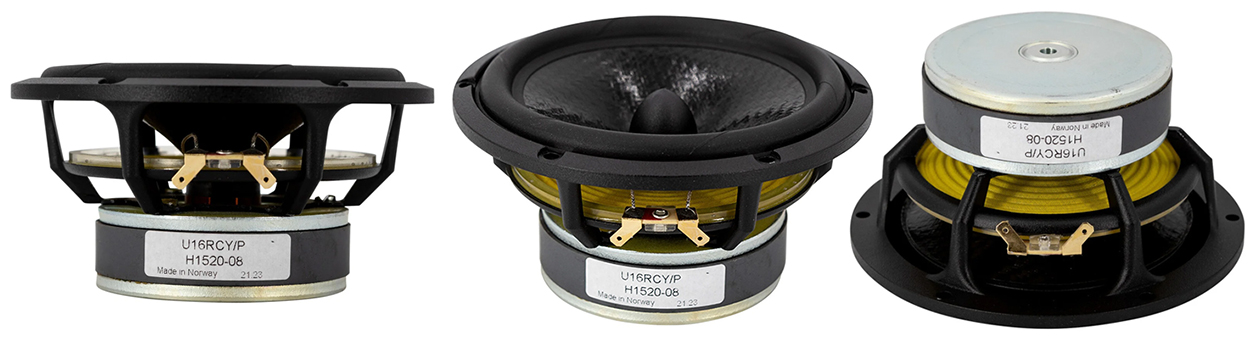
With its woven polypropylene cones as a formally custom version of the below Norwegian SEAS Prestige model with 36Hz resonant frequency, 10.26g of moving mass and 6.2Ω voice coil, Gro sits seemingly halfway between Dali's reddish cellulose pulp and the ceramic/carbon composites of Raidho and Børresen who like their Monitor and Canton colleagues in the UK and Germany apply hi-tech ultra-hard nano skins to drive breakup modes ever higher out of band. Allied to a classic soft-dome tweeter, do SV's material choices predict anything about Gro's general tuning as perhaps leaning toward Harbeth and Spendor? As a 2-way not 2½-way like Fenja, both of Gro's mid/woofers reproduce the complete vocal range so act as a 7" driver with reduced excursion requirements whilst their central metallic phase plugs double as air-cooled heatsinks to reduce voice-coil temperature and with it, the rise of resistance with its dynamic compression. The filter capacitors are Miflex from Poland, the Jantzen inductors 13-gauge air cores. For those who love tech, next comes a deep dive into the SEAS cone material.