When looking at a full display of big DHT arranged in an exotic configuration first promoted by a Japanese designer whose aim was to "drive with endless energy and sorrow" a single high-efficiency loudspeaker in mono, one may feel compelled to associate the Master 300b with stereotypical vintage triode sound. Think romantic, focused on a relatively narrow band where loosely controlled bass and an overly round treble are not only tolerated but purposedly sacrificed on the altar of a prodigiously expressive midrange. This probably wasn't Sakuma San's intent and certainly isn't a remotely accurate description of the Solaja Master 300b. That plays with a masculine, authoritative, energy-packed yet transparent allure which I appreciated well beyond expectations with my Diesis Audio Aura SE 93dB 6Ω speakers. Of course modest 22m² room size and 2.5m listening distance probably facilitated things to never feel that the Serbian 8-watter struggled. The sound was always breathing freely, direct and clear. The full-bodied midrange magniloquence occurred in a vast open reference like the Hogwood/Academy of Ancient Music reading of Händel's Messiah where the angelic yet powerful Emma Kirkby incarnated like a Canova sculpture exposed in the theatrical embrace of the choral section, with period strings acting as cluster of Cherubim to elevate her above our mortal reach. In the Petrucciani, Gadd and Jackson Trio's Tokyo recording, the immanence of the three musicians acted as a teleporter beam to the Blue Note jazz club in the most classic manifestation of the you-are-there hifi tricks.

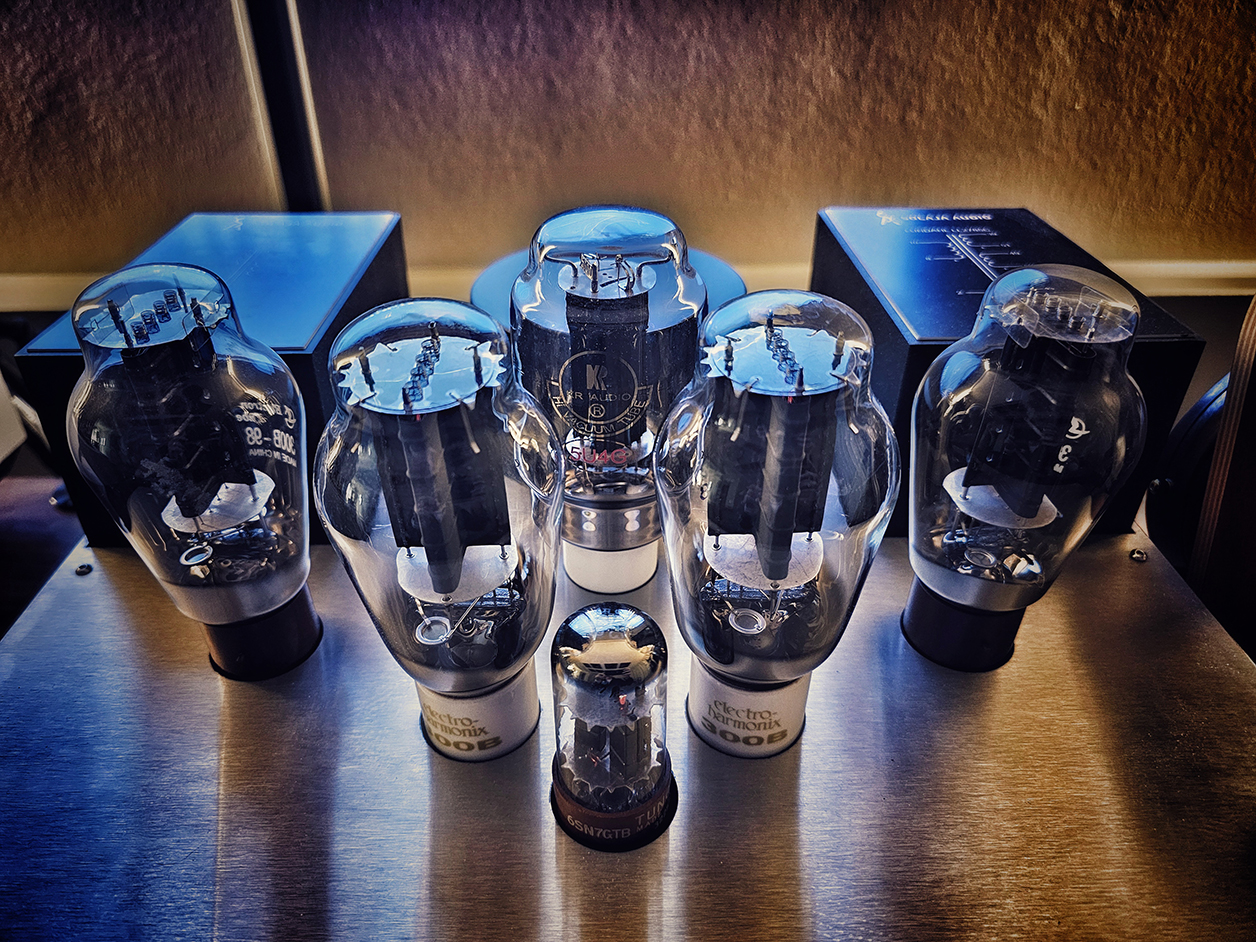
A tube amp review would be incomplete without some tube rolling so here we are. The Master 300b came stock with a more than decent set of which the lion's share was the quartet of Electro Harmonix Gold DHT. I wish I had some modern Elrog, Takatsuki or vintage WE300B to compare but that was not to be. However, thanks to some generous friends I could borrow a nice pair of Gold Lion 4300B, a few NOS 6SN7GTB including Philips and US-made Tung-Sol (black or brown base) plus a KR Audio 5U4G rectifier. With the wild rise of premium new stock or even worse NOS tubes, one could easily reach the paradoxical condition where the tubes cost as much as the amp. My lot was easily about ¼th of its price. However, tube rollers know the thrill of popping a new bottle, in some cases hunted down after months of relentless searching full of expectation on what's to come. Sometimes that means valves nearly a century old in almost unused condition which we reverently paw in our aptly gloved hands like small treasures surrounded by an aura of legend from a lost era. After some mixing 'n' matching, I ended up with the brown-base Tung Sol and pair of 4300B Gold Lions in the power stage where their impact was more immediate than as drivers. I also noted that rolling the 6SN7 was in relative terms most audible. Perhaps that would change with a set of top-flight 300B but at much higher cost. This almost ritualistic exercise brought the Master 300b to new heights which was testimony to its transparent circuit design. The improvement was a general sense of further refinement, the grain of sound being resolved to nano scale, dynamics variations even more carefree in their spontaneity. The trademark holographic powers of well-designed single-ended DHT elevated further, the layering of musical objects became still more obvious within expanded three-dimensional space. This was good news for prospective owners of the Master 300b as I bet few of them will hold onto the stock tubes for very long.











Across the past 1½ years I experienced several amplifiers and reviewed some very good ones. The Master 300b revealed itself to be special, escaping the cheap idiomatic categorizations typically associated with low-power SET – a real compliment. Compared to the Auris Audio Headonia 300B, the Solaja was more muscular and energetic, the Headonia more seductive and alluring. The Trafomatic Primavera using the less common SV572-10 for similar output power is very authoritative, big, fast and bold. The Master 300b came close but offered more sweetness, bloom and liquidity. At 30% less, the SAEQ Astraeus was the quietest of the lot and a better companion for sensitive headphones like Nur's Harmonia. Astraeus' pure, tight and highly contrasted current delivery obtained a synergistic balance also with Valkyria where the Master 300b was more about summing up exuberances. With speakers and Immanis, the Master 300b delivered a more imposing presentation with larger scale and freely breathing dynamics swings combined with richer organic tone.
The comparison with my AIC-10 [~€20K] was interesting as strengths and relative weaknesses overlapped in intricate fashion. The AIC-10 has an earthy visceral sound whose centre of gravity sits between midrange and upper bass to make it slightly darker than neutral, a faint coloration I have come to appreciate over 6+ years of ownership and which sometimes acts as a bias to my ear/brain against clearer airier amplifiers. The Master 300b resonated well with my tastes from the very first notes likely because of a somewhat similar nature. However, at the extremes of the spectrum lived a more distinct stylistic departure. Where the AIC-10's bottom end is punchier and more voluminous, the Master 300b was slightly less extended but more articulate. The top end of the Riviera is a tad smoother and thicker while the Master 300b seemed to resolve sparkles of high-frequency content in more surgical fashion which felt more realistic. Spatial presentation was another mix of similarities and differences as both amps project a very wide soundstage and similar depth of field but the placement of images was more forward with the Serbian. This resulted in a more intense feeling of intimate presence, a more theatrical experience of large-scale music for the Italian.

I must admit that when I unboxed the Solaja, I was not fully taken by its finish considering the price. For OCD people like me, tidier internals would also not go amiss. The build and finish quality of the Munich 2024 prototype design later dismissed due to excessive costs would do fuller justice to the outstanding sonics of this amplifier even if upping the price further. The only other caveat is not to use very sensitive headphones or IEM due to self noise. That said, the sonic performance with my Raal 1995 Immanis and Diesis Audio Aura SE loudspeakers was at least on par with the very best I experienced thus far and even surpassed my reference in some respects. Letting the Master 300b depart after having spent over two months with it is hard when during this time I have developed a sense of attachment to the pleasures I got from it on both an emotional and analytical level. The Master 300b brought seemingly incompatible sonic characteristics together such as a gargantuan scale, weight, boldness and precision, refinement and airiness, extension, control, resolution and midrange hydration, steely attacks and jubilant decays. For users of medium-to-challenging headphones and/or 90dB+ speakers fully focused on musical prowess over appearance, I only predict endless hours of joy with the Master 300b whose musical achievements are immense.