My first experience of Solaja Audio was driven by the Raal SR1a ear-speakers which I owned and loved for a few years. At the time of their late 2018 introduction, the SR1a still required a +100wpc speaker amp to do their magic and a resistor-based impedance adapter between amp and headphones to transform their 0.2Ω near short circuit. But power was the easiest spec to match. The real challenge was to identifying a high-power amp with the finesse and organic nature which my ears called necessary to enjoy the SR1a to the fullest. I then started a nearly 2-year quest to track down my perfect SR1a amp including 5-figure exotica. By circa 2021 Raal introduced some compact amplifiers—first a transistor then tube unit—which could direct-drive the SR1a and regular headphones. These were game changers for existing and prospective SR1a owners. They were made in Serbia by both SAEQ and today's protagonist, Solaja Audio. When I heard the SR1a with Solaja's VM-1a running on a set of gorgeous vintage tubes, I thought that I could end my quest at a fraction of the cost of the high-end speaker amps I was contemplating. Fast forward to early 2024. Aleksandar Radisavljevic launched Raal 1995 and with it his next-gen ribbon headphones. I immediately embraced the notion of ribbon sound from a physical package which unlike the SR1 enabled the headphones to achieve full-range response from a head amp and purchased the flagship Immanis which remains my reference transducer. It parallels three ribbons which increases impedance but still requires a now transformer-based adapter. But promptly at that year's Munich High-End show, Solaja Audio presented the Vortex amp as their upgraded version of the discontinued VM-1a. It again can run the multi-ribbon models directly as well as the closed-back Raal CA-1a, regular headphones and speakers. When I attended Munich to sample the Immanis/Vortex combo, I was surprised to see one more amplifier in the Solaja booth. It was the prototype of a 300B design which at the time had no name yet but speaker and regular headphone outputs to need Raal's transformer interface. When I tried it, I felt like listening to possibly the best sound I had thus far experienced with Immanis. Meeting Dragan Solaja was charming and his passion for his work, kindness and humility instantly won me over. It took almost 1.5 years but finally Dragan sent me one of the first production units of what became his Master 300b. With little to no information about him on the web, I was really curious to hear from the man himself about his evolution as an audio electronics designer and entrepreneur.
SR: Can you talk about your background and how you arrived at creating Solaja Audio?
DS: As a graduated electrical technician, I worked for various companies. The last one was Electronics Industry Nis in Belgrade (EI Nis) which had a well–equipped library with books by for example McGrow Hill on vacuum-tube theory, circuits and calculations. It was my Holy Grail. I spent a lot of time in that library and management finally decided to gift me those books because they were surprised that someone was interested in them. Before I started working with vacuum tubes, I made several transistor preamplifiers and power amplifiers. We are talking ~1985. After studying books on tubes, I decided to start designing and building my own preamplifiers. Why preamplifiers first? I see the preamplifier as the most important component in a hifi system. A well-designed preamplifier will improve the quality of music replay. I designed many successful preamps like the SA-R and Grand Excellence tube models, TVC (transformer volume control) and others. Next I started working on tube amplifiers. At that time it was difficult to import quality output transformers into Serbia to force me to produce my own. After studying output transformers, I made my first pairs. They were a success. After that I was able to build many good-sounding tube amps. In June 2005 I lost my job and after very many phone calls with Alex from Raal, I decided to follow his advice and on the 13th July 2007 registered Solaja Audio LLC. Since then I design and build vacuum tube amplifiers professionally.

SR: What is your relationship with music in general and what kind of music suits you most?
DS: My unconscious interest in music started at one year old. My mom told me that I always slept to music on the radio. Must I mention that it was a tube receiver? We are talking ~1960. At 12 or 13 years old, I started to listen to music with passion, exclusively to Rock at the time. Over a short period I then tried to learn and play the bass guitar but nothing serious. When I have time, I sometimes still play it just for fun. I listened to Rock, Hard Rock and Rock'n'Roll but when I started with tube amplifiers now as an experienced listener, I realized that Rock recordings aren't of high-enough quality for evaluations. Then I switched to Jazz and Classical, especially recordings from the 1950s to '60s. Most the time when I listen to music in moments of relaxation or when evaluating my amplifiers, it is Jazz.
SR: Are there designers or brands that inspired your career?
DS: I do not really have a specific designer or brand that had a significant influence on me. When I was young, I had a Technics amplifier whose name I can't remember and when I opened it up, I thought that I could make it if not better then at least as good. It was the last amp I ever bought. This is how and why I started to build my own. Nelson Pass and Jean Hiraga were super popular in Serbia's DIY community and many of us built amps based on their circuits. I was aware of and studied them but decided to follow a different path because I wanted something of my own. I have to mention Susumu Sakuma, the legendary Japanese builder of tube amplifiers. I accepted from him that the driver tube should be the same as the output tube.












SR: What are your priorities when designing a new piece of electronics?
DS: The main priority is to make a good-sounding amplifier, nothing less, nothing more. That is probably the top priority of every amp designer but paths differ. For all these years I tried various resistors, capacitors, types of power supplies and I know how it all works and apply it. In addition to knowledge of electronics, a designer must have an intuitive sense of how something will work and sound. At least that is how it is for me. There must be a mutual connection between the designer and the amplifier in the process of creation.
SR: What makes your designs different from the competitor?
DS: I wish I knew. I built a preamplifier called the SeDra 3, a 6N6P tube buffer so probably a concept made by countless manufacturers. Audiophiles who listened to many such preamplifiers reported that the SeDra 3 stood out from the rest. Why? Maybe my choice of tubes, operating point and bias current through them, maybe the choice of parts, the layout. There are so many variables but one thing is certain: I love what I do and do what I love and the parts I connect into forming an amplifier gives me back. Maybe this seems funny to some but I really feel that.
SR: How do you combine measurements and listening during the development of a new product?
DS: Each amplifier must meet the prescribed technical standards (frequency response, distortion etc.). But an amplifier with worse measurements can and often does sound better than one with better technical characteristics. Many audiophiles know that. Technical characteristics are easy to achieve, sound is something else. I have a friend who says with a laugh that whenever I make a good-sounding amplifier, I have been lucky again. I tell him with a laugh that luck has nothing to do with it although it is not bad to be lucky.
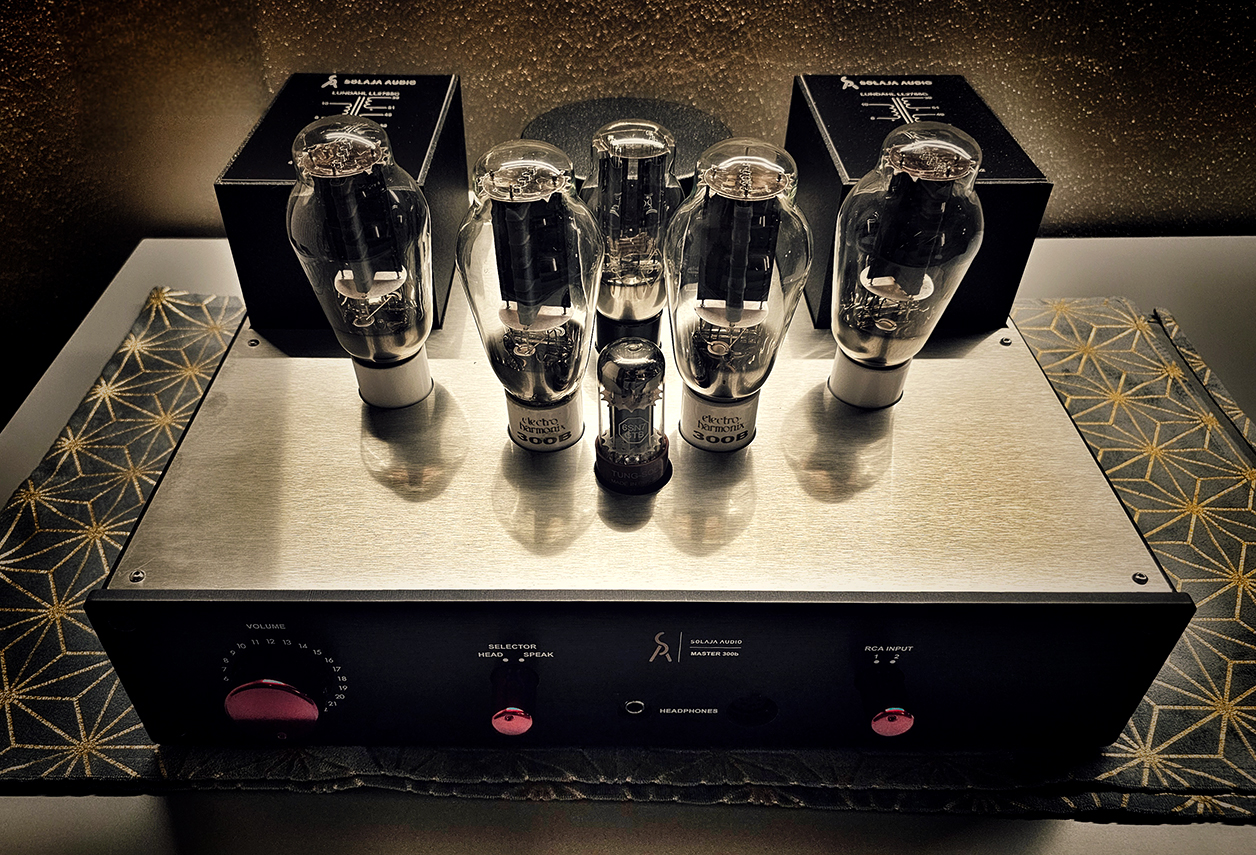
SR: What are the advantages of a topology where a 300B drives a 300B? And why is it so unusual?
DS: As I said before, Susumu Sakuma deserves credit for my adoption of this concept but he wasn't its inventor, simply the first to use it in hifi. The first amplifier I built this way was the Mirada, an EL84 push-pull where the driver tube and phase splitter were triode-strapped EL84. After measurements and sonic evaluation, I decided to transfer the concept to my next project, the VM-1a. Then came the Vortex, an improved version of the VM-1a using the same concept. The Master 300b is a logical continuation. Unlike the previous ones, it is single-ended. The main advantages of this like-drives-like topology are the sound and THD cancellation. I do not know why it is so unusual to find.
SR: Is there something about the topology or component selection that you would like to remark on as a special achievement?
DS: The topology itself is a special achievement. The parts choices are a bonus.
SR: The option of using the Master 300b for both speakers and headphones is very attractive. If you had to design an amp for speakers only with the same output power, what would you change?
DS: Actually, I wouldn't do anything different. This amplifier is exactly what I want for either speakers or headphones.
SR: When dealing with low-power designs, what are the peculiar challenges of designing speaker amplifiers vs. headphones amplifiers?
DS: The main challenge is noise especially with headphones.