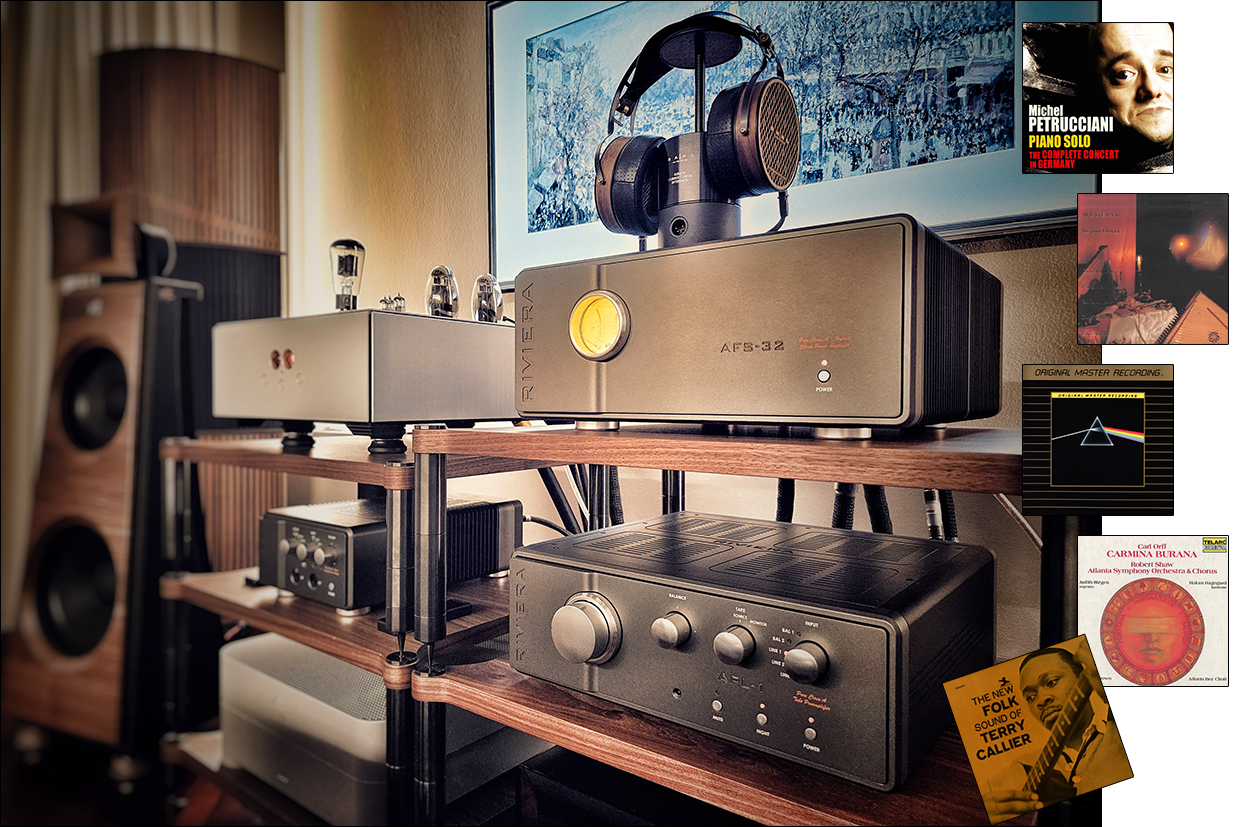
With the additional horsepower at my disposal, I was tempted to reach for the most dynamically demanding album in my collection, Telarc's Carmina Burana with the Atlanta Symphony Orchestra & Chorus under Robert Shaw. According to Roon, this recording has a dynamic range of 25, one of the largest in my library. That shows up especially on limiting systems where one keeps fiddling with the volume to make the softest passages more enjoyable and the loudest not too offensive, hard or downright dangerous for the speakers or electronics. With the AFS-32 driving my 93dB/6Ω Diesis Aura, I appreciated the inner workings of the quietest choral passages where various voices separated from each other and the background all well articulated due to transparency even at a very low level. At the same time I felt full-body exposure to the most violent outburst of the full orchestra with no apparent signs of compression. The music continued to breathe even whilst pumping air to fill the entire room without collapse, distortion or loss of control. At this point I was ready to pork out and install the APL-1 to form the intended Riviera Labs pairing. Now my LampizatOr went back to volume control bypass to leave the APL-1 in charge. Two pairs of Faber's Cables La Potenza unbalanced cables carried the signal between the three components. I immediately felt at home with the Riviera Labs house sound I'm so fond of. The best of my two previous experiments added up to a magisterial mix of raw power, tonal truthfulness, palpable body and refinement. I was happy yet slightly disappointed. I'd secretly hoped that given the praise the LampizatOr Horizon 360 receives for its preamp chops, I might skimp on a separate preamp for the continuation of my system's evolutionary journey. The APL-1 proved that wouldn't be the case at least for my rig and tastes.
The first effect was the sonic fabric. The APL-1 made it more complex, rich and colourful. When we more closely look at objects, we typically discover that their colour and texture which may have seemed monochrome and solid from a distance are really an intricate combination of hues enriched by small surface variations where light gets trapped, reflected or diffracted to create really unique colours. With the direct DAC connection I experienced a simplified version where the fundamental note's prominence was exaggerated, hiding important nuances. I acknowledge that this type presentation may be preferred by a listener who enjoys a very sculpted forward sound with minimal or no connective tissue at all, making musical objects appear and disappear out of nowhere in an almost magical act. Those who value organic portrayal and a balance of density and coherence which exposes the fuzziness that governs the time and space occupation of especially acoustic sounds as heard in a real venue should likely find the APL-1 more realistic. The next improvement the APL-1 brought was with soundstage layering. The lateral expansion I noticed with the AFS-32 replacing the AIC-10 now combined with increased depth that structured better. Even the height dimension expanded. Resolution went up another notch especially at low volumes. On the opposite end of the loudness scale, raw dynamic impact came off in even more relaxed fashion to dissolve previously heard hardness.










 Take a recording like the 1972 Decca of Puccini's Turandot featuring a stellar cast of soloists with Zubin Mehta conducting the London Philharmonic Orchestra. Reproducing this kind of scale and complexity in a domestic setting is taxing to say the least but this recording gets us there more effectively than most – if a system is up to it. The APL-1/AFS-32 performance was utterly convincing, combining iron grip in the low end and full-blown chorus + orchestral climaxes with a crystal-clear depiction of the soundstage where soloists solidified in front of me in spooky fashion, occupying a space beyond the speaker location yet maintaining realistic size. Moving to modern genres, I had an epiphany when listening to Pink Floyd's The Dark Side of the Moon on the Mobile Fidelity Sound Lab remaster. This I must have played a few thousands times across the last four decades. Never was it so pervasive in my room to transform into a microcosmos of the most diverse sounds from mechanical to natural to electronic floating interwoven like a maelstrom of colours.
In terms of sheer power draw, only by looking at the VU meters did I appreciate that my Aura absorbed just a moderate dose considering the modest size of my room and listening distance. I then installed my LS3/5a to check how dropping to 82.5dB/11Ω might rattle the Riviera Labs 32-watter. After I adjusted the APL-1's volume by a few clicks, I was taken aback. The minute Spendors had undergone testosterone and steroid therapy, growing in size by a considerable margin. That wasn't a matter of loudness where already my AIC-10 can play to very uncomfortable levels. It was the new authority which impressed me. The size of instruments, the viscerality of dynamic swings, the ease of breath were on a higher level. Laws of physics exerting their dominance, the Aura performance remained out of reach on scale and low-end extension but the LS3/5a clearly became more versatile, maintaining their stronger suits of midrange realism and pinpoint imaging while adding some muscle. If anything, I had to be careful with the volume knob to avoid hitting the tiny woofer's stops and tweeter's limits.