
Country of Origin

Reviewer: Simone Ragionieri
Source: Generic 5G router into Taiko Audio network switch both powered by a ferrum Hypsos; Taiko Olympus XDMI Server; LampizatOr Horizon 360 DAC
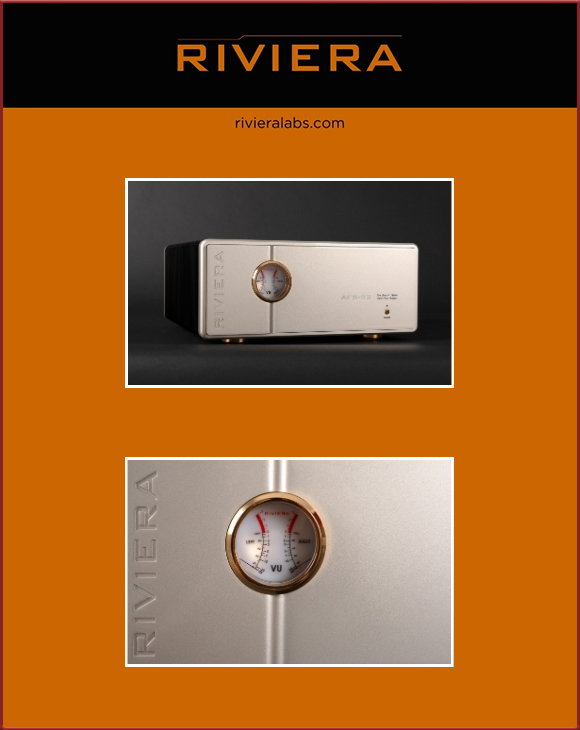
Headphone amplifier: Riviera Audio Labs AIC-10
Headphones: Spirit Torino Valkyria, Raal 1995 Immanis
Loudspeakers: Diesis Audio Aura SE
Cables: complete Faber's Cables La Potenza loom
Power delivery: Faber's Cables La Potenza power distributor and ground box, Furutech NCF AC wall plugs on a dedicated spur
Room size: 5 x 4.5 x 2.7m
Room treatments: Eight ceiling diffusers, floor-to-ceiling acoustic curtains on sidewalls, Vicoustic VicTotem Ultra VMT in front corners
Review component retail ex VAT: €22'500 pre, €24'000 power

My first exposure to Riviera Labs dates back to 2017 so the very beginning of their journey. An audiophile friend regaled me with hyperbolic feedback on a headphone amp from a new firm in southern Italy, brainchild of an already well-known high-end electronics designer. That piqued my interest. The brand was Riviera Labs, the amplifier the AIC-10 headphone/speaker amp, the designer Luca Chiomenti. I was already hugely invested in upper-echelon HeadFi. But when I learnt of the amp's close to €15k price incl. VAT— still a whopper by today's standards, even more so at the time—I still was a bit shocked. Yet my curiosity only increased further after I read the 6moons review which came out around then. Long story short, after a home audition I bought an AIC-10 for my headphones and this little gem remains with me to this day. It's my longest audio dalliance except for vintage LS3/5a speakers and a Teac VRDS-10 CD which I keep around mainly for sentimentality. One of the main reasons I justified the purchase of the AIC-10 to myself then was that I could use it for both headphones and speakers. That came to fruition about a year ago when I finally had opportunity to install a proper speaker setup again. Having found in the 93dB efficient 6Ω Diesis Audio Aura a splendid partner, the AIC-10 has accompanied me in the completion of my transition to almost 100% speaker-based listening. During the past few months I never had any inkling that the AIC-10 held back the open baffles due to power constraints. Just so I was interested to learn if I missed out on anything when even their designer Giuseppe Garbarini had suggested that I experiment with more horsepower. Being so fond of the Riviera Labs sound—a balance of weight, density, speed and refinement I particularly enjoy—my first thoughts for starting this exploration went to moving up the Riviera ladder. So I contacted Luca Chiomenti. Considering my speakers, room and feedback on his AIC-10, he proposed the APL-1/AFS-32 combo as the natural next step up for both a quantitative and qualitative enhancement. As co-founder of Riviera Labs and designer of all their electronics, Luca was kind enough to then grant me this interview:

SR: What is your background and how did you end up creating Riviera Labs?
LC: I've been interested in electronics literally since being a child. My beginnings as a graduated Electronic Engineer were in the early '90. Throughout that decade I collaborated with various brands like Bartolomeo Aloia and Galactron for the most well-known; and with technical hifi magazines Fedeltà del Suono, Costruire HiFi, Stereo and others. In 1999 I created my own company Kiom which I ran for the next 15 years until in 2017 I founded Riviera Labs together with Silvio Delfino.
SR: Kiom electronics were low-powered SET designs while the entire Riviera Labs portfolio is made up of hybrids. Why the change?
LC: All my designs aim to realize the same idea of sound. Kiom electronics demanded that I be directly in charge of all manual tasks involved in their manufacturing to achieve just that. When I created Riviera Labs, I wanted to rethink the design and manufacturing process to focus on all the critical steps personally then distribute production of mechanical parts to a network of trusted suppliers. All critical components like the transformers for example remain proprietary designs and all electronics assembly is done in-house and by hand.
SR: You mentioned an ideal sound as inspiration. What is it?
LC: The easy answer is the sound of real instruments in real space, played live. How to achieve that is another story. I sensed since my university days that to bring this ideal to achievable terms, I had to consider the most important component in the audio chain: the apparatus of our human senses. It's why I added to my study plan two exams from the biomedical engineering path called "neurosensorial biological systems" and "biological control systems". These studies plus those on electronics applied to audio formed the basis of my research which began in the second half of the 1980s and is ongoing.
SR: This sounds intriguing, can you expand?










LC: My studies of the physiology of the ear and how the human brain processes sonic data combined with my electronics studies led me to interpret standard audio measurements, particularly those for amplifiers, in a totally different way. My aim is for our ear/brain to perceive the sound as unprocessed. One major aspect is distortion and how it varies with SPL. Scientific literature indicates that our hearing apparatus introduces increasing levels of distortion as sound pressure increases. This mechanism originates in the cochlea. For a sound pressure level of ~90dB so well withing typical playback range, it introduces about 10% distortion! Yet our brain 'cancels out' or 'overlooks' this distortion so we don't sense it. Our brain compensates for that specific distortion which is characterized by a peculiar shape of harmonic distribution made up of exclusively low-order harmonics with progressively decreasing amplitude so the fourth harmonic will be lower than the third which will be lower than the second. Meanwhile we don't filter out so perceive as unnatural and unpleasant very low distortion percentages of upper harmonics of a different shape. Another example is that timing accuracy both in the attack and decay stages is essential for the perception of a real i.e. natural sound.
SR: How does that translate to your circuits?
LC: As in all other engineering processes, when designing audio electronics, making choices is inevitable to best balance out parallel requirements. Therefore it's of utmost importance to understand what is most important to achieve the best possible result within given constraints of size, budget, target power etc. For example, chasing extremely low distortion figures requires circuit complications and systematic negative feedback both global and local. Having worked over my career with several topologies and component types, I concluded that this approach does more harm than good. Simpler circuits with no global feedback and local feedback only where strictly necessary deliver more natural sound. This basic choice leads to a whole series of follow-on choices which are virtually logical.

SR: I see that all Riviera Labs electronics share a similar design logic so aside from no global and minimal local feedback, what are the other pillars of your approach?
LC: As mentioned, many other choices become an almost predictable consequence of the fundamental choice against negative feedback. I prefer tubes, particularly triodes, in the voltage gain stage. When used well, triodes are still the most linear voltage amplification device extant. Another consequence is that to achieve maximum linearity without feedback, all my electronics operate in Class A. With Riviera Labs, I developed a power-amp topology that uses MOSFET and BJT to achieve the desired speaker drive. I don't chase triple-digit damping factors but focus highly on power supply design both in terms of size and sophisticated topology with pi filtering. Another key point of the power supply is its distributed capacitance. We use multiple fast so low-value parts rather than a few big slow parts. There's also the managing of vibrations by appropriate mechanical means as another design principle I use throughout my work.