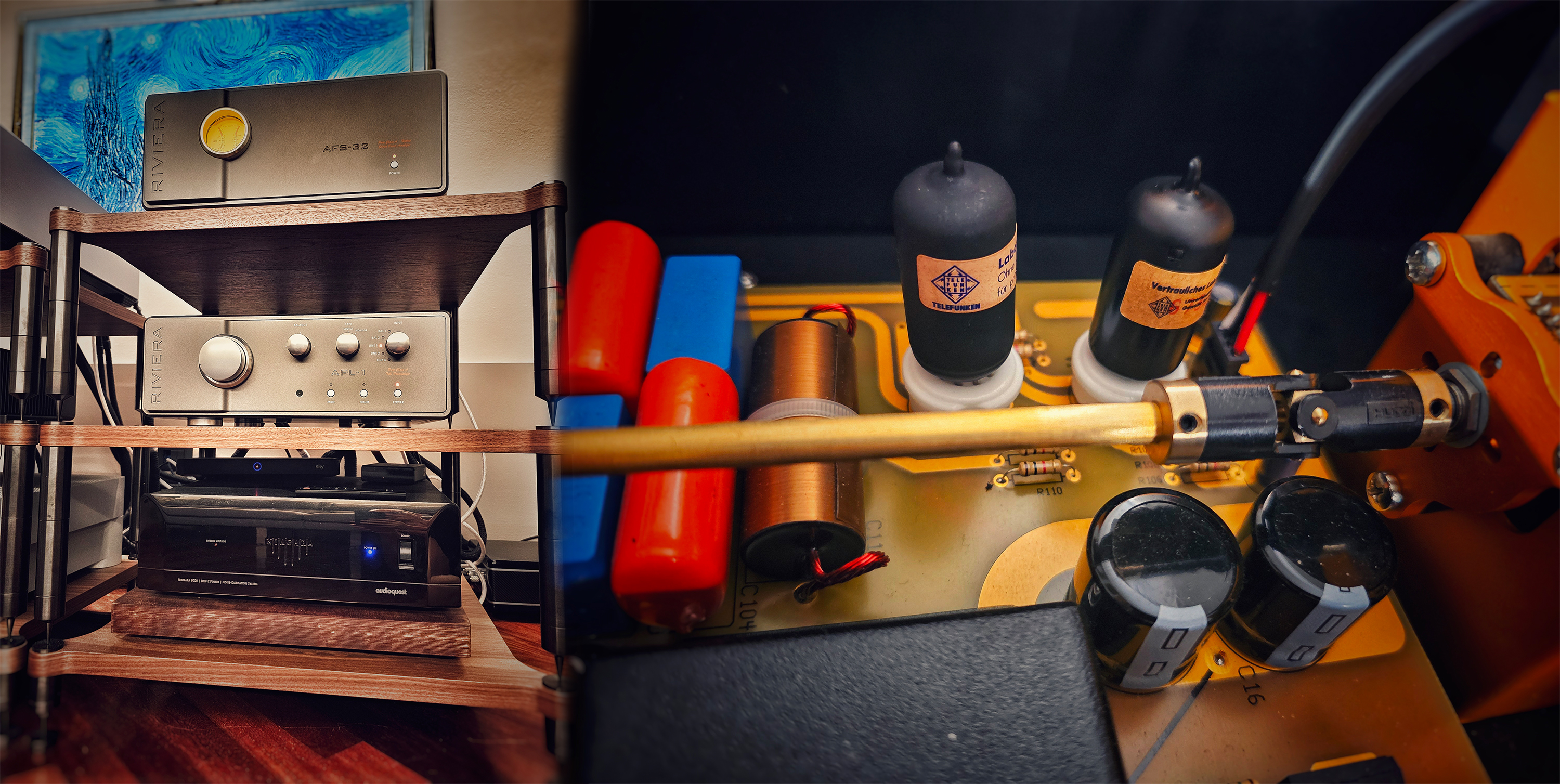
By opening the top lid of the APL-1 which I did multiple times during tube rolling, we are gratified by a spectacularly elegant arrangement. Everything lays out to minimize path lengths and separate sections which might interfere. All elements are selected and sized with utmost care, be it abundant PCB thickness with both composite and copper traces; various capacitor types and sizes where sometimes several kinds combine to achieve the desired musical effect; or the motorized volume control using a high-end ALPS potentiometer. Five independently regulated supplies feed the various sections. Voltage gain is via a pair of ECC82/12AU7 double triodes which Chiomenti obviously loves as it appears in several of his models including the AFS-32 and my AIC-10. Max voltage gain is 8dB. The AFS-32 is the most powerful Riviera Labs stereo amplifier with 32wpc/8Ω of pure Class A doubling into 4Ω. It again epitomizes Chiomenti's design credo to the letter: no global feedback, triode-based voltage gain, pi-filtered power supply. Current gain comes from a mix of Mosfet and BJT transistors (four per side) to set the sound signature common to all Riviera amps I've heard where suppleness and authority blend in tastefully captivating fashion.

Substantial mechanical construction (about 20kg for the pre, 32kg for the amp) and finishing achieved by a lengthy process including surface prep often used in the aerospace industry followed by up to six layers of paint are top notch. The amp's VU meter is a further classy touch, its amber background and dancing needles providing an almost mesmerizing effect especially in a darker room. The AFS-32 can be operated both balanced and unbalanced and delivers a standard 26.5dB of voltage gain. Combining a generous input transformer rated over 500VA to a massive amount of well-distributed capacitance totalling almost 0.2 Farads without current-limiting devices allows the AFS-32 to deliver gobs of instantaneous current which is at the root of its capability to drive difficult loads with aplomb. Maximum output power is notoriously misleading for how an amplifier will control a pair of loudspeakers playing very complex musical passages. On a scaled-down level next to the AFS-32, I did experience this after all with my AIC-10. The bigger sibling's extra power reserve felt constantly beyond reach even when I challenged it with my 82.5dB LS3/5a well past their comfort zone. Instead the ability to deliver explosive bursts of energy with no perceivable delay gave a very strong impression of effortlessness and dynamic realism which one might associate with gobs of power.










During my time with the APL-1 and AFS-32, I wanted to test several scenarios including the role of the preamplifier, headphone vs. speaker performance, the effect of tube rolling, balanced vs unbalanced etc. Given my 6+ years with the AIC-10, the most natural starting point was to add the APL-1 between my LampizatOr Horizon 360 DAC and AIC-10. Both DAC and integrated offer volume control and after some experimentation, I fixed the AIC-10 between 1 and 2 o'clock then trimmed the volume with the Horizon. This provided the most silent operation and most convenient way to integrate my subwoofer where the Horizon has a dedicated sub-out. With the APL-1 there now was a third device with gain regulation. First I tried balanced vs unbalanced between DAC and pre and decided for the latter when the unusually high 9V balanced Horizon output seemed to saturate the transformer-based input of the APL-1 unless first attenuated at the source. With the RCA connection, the best sound came from bypassing the Horizon volume control, setting the AIC-10 to the same fixed volume as before and using the APL-1 to control amplitude. This came as no surprise. The sound improvements were more focused images, a general sense of higher resolution even more apparent with quiet passages where dynamic nuances articulated better. With the stock JJ ECC 802S gold-pin tubes, the overall tonal balance was a tad cooler. Upon continued prolonged listening, I appreciated an increased bodily feeling of unwinding which automatically relaxed given the ever so slight yet appreciable reduction of strain in the musical outpouring.
Listening to "Paseabase el Rey Moro" from Begoña Olavide's Mudejar [MA Recordings 1997] showed from the very first sound of atmospheric background followed by ominously remote yet majestic percussion how enhanced resolution might make the experience of reproduced music more real and enveloping via decay structures, how the higher harmonics expand the space within which sounds propagate to seemingly create new space as in a cosmological beginning. When switching from speakers to headphones, the effect magnified and I noticed all my typical spontaneous reactions to a positive change in my system: listening to full albums, experiencing difficulty analyzing sound in favour of relaxed immersion, even falling asleep with headphones on. My next round was somehow complementary. This time I connected the AFS-32 power amplifier directly to the LampizatOr which basically replaced the AIC-10 with the AFS-32. I kept that connection unbalanced for consistency. This test had a different outcome. While the APL-1 + AIC-10 combo expressed itself as a better version of the AIC-10 by taking the qualities of the AIC-10 to the next level, the AFS-32 driven by the Horizon DAC presented a different personality. There was a sharper, bolder more incisive character at play. Instruments popped out of the background with more edged contrast for an immediacy and directness not heard before. The presentation became more exciting, percussive sounds especially gaining additional bite with some emphasis on the transient attack. Soundstage scale seemed to grow especially in width. The overall effect was a tighter fitter more muscular depiction still with the elegance of realism, making the AIC-10 sound slightly more relaxed and romantic by direct comparison.