SR: Does this mean that modern approaches to amplifier engineering like GaNfet Class D, advanced switching power supply, the use of CAD/CAE have not created better sound?
LC: My point is rather that the ingredients—the core knowledge and design criteria to achieve what in my view is the ne plus ultra in audio reproduction—were already available decades ago. Of course new tools like CAD/CAM make life easier. New parts are always welcome but we must find the right way to use them to get the best musical result, not just a better measurement or to be seen using the latest novelty. I appreciate that new approaches can bring very good results. But after some experiments, I decided not to adopt them in my own designs. Incidentally, the first "class D" circuits better called PWM amps were modelled in the mid 1960s if I recall correctly; and of course realized with tubes. I'd also like to point out that in some cases, very complex gain architectures using 'innovative' solutions have been proposed demonstrating great technical design skills. There I would only question the relevance of the 'problem' a designer tried to solve like achieving 0.0001% THD or a damping factor of 10'000 to undermine the need of the proposed complex design. In other words, the question is always the same: do we design hifi equipment to satisfy the human ear or some inanimate measuring gear?
SR: Speaking of output power, your current line covers from 10 watts in my AIC-10 to 100 watts in your flagship AFM-100, the 70-watt AFM-70 being the latest. Do you plan to further grow these power figures?
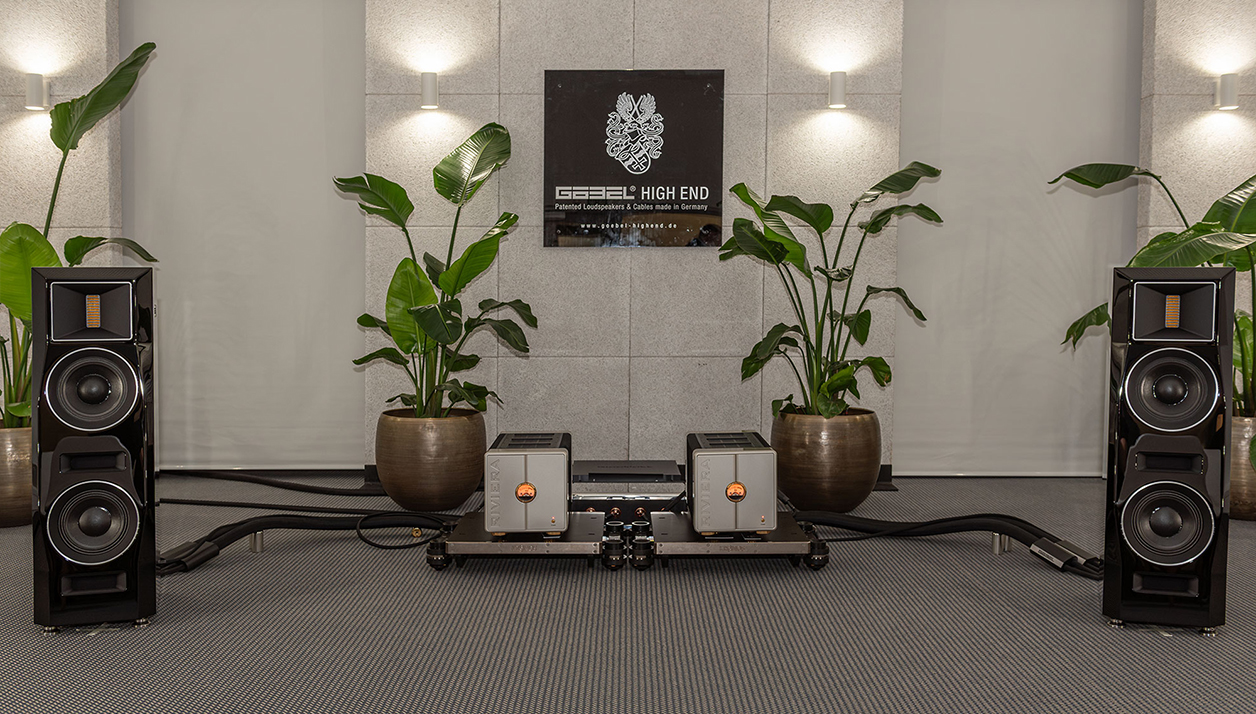 Munich High-End 2025 – photo from Hifistatement.net
LC: I think you know my personal preferences. My ideal audio system is built around high-efficiency speakers—min. 100dB/m/W— powered by a few watts of extremely high quality. Therefore, I could answer that I would like to extend the power range with an amplifier of 5 watts. But my preferences shared by my partner Silvio Delfino matter very little. The topic that interests me the most as a high-end electronics designer is quality, not quantity. My goal is to further improve the quality of Riviera Labs equipment, to exceed what we already achieved. Market demand would push me in the opposite direction (increasing output power) and I will do something but it is rather unlikely for us to produce amplifiers with ratings above 130-150W not because it's impossible or we aren't capable but because I believe that in a typical domestic environment with speakers of average efficiency, higher power ratings are simply not necessary. Furthermore, there would be significant physical limitations. To maintain our quality, the size, weight and cost would increase disproportionately, creating practical difficulties for both us in manufacturing and for the end user in their installation. Instead I can tell you that we have been working for some time on an amplifier concept where power is of little importance and everything is focused on quality in an attempt to take a further step forward from what we've done so far.












SR: Luca, thank you very much for the time you dedicated to this interview and for the passion and dedication you put into your products. Is there anything you want to add to close our conversation?
LC: Our aim at Riviera Labs is to manufacture electronics which are conceived for the human being. We strive to recreate as faithfully as possible—in the ear, brain and heart of our listeners—the feelings which exposure to live music would evoke. I wish for this and the next generations of audiophiles to recover the habit of attending live concerts on a regular basis. It makes our lives richer and our hobby more relevant to our personal happiness.

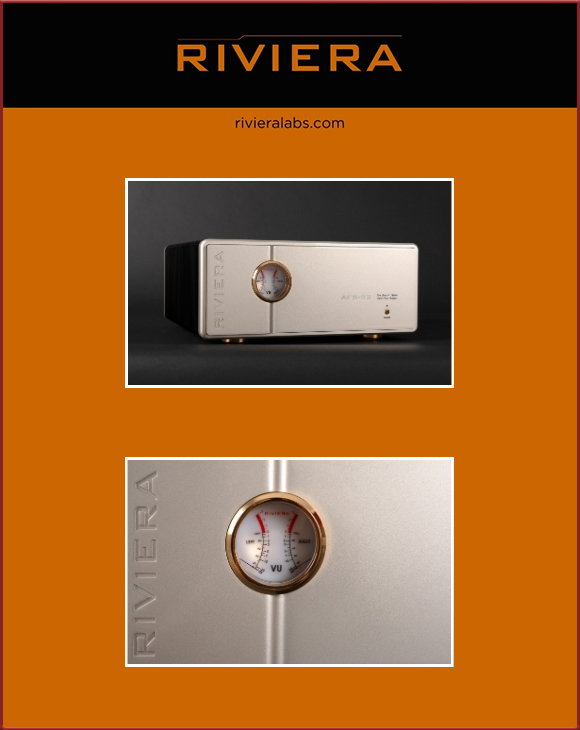
The APL-1 and AFS-32 were introduced at the 2024 Munich High-End show and currently occupy the middle of the Riviera Labs line-up. For the power amplifier, 'middle' means both cost and power. The APL-1 is a class A tube preamplifier with zero feedback of any kind. It is a faithful testimony of the fundamental design principles of Riviera, boasting a sophisticated double-pi power supply with anode filtering and stabilization. It uses several features trickled down from the top-line APL-01SE especially in the output section where custom transformers take care of both balanced and unbalanced outputs, ensuring that our cable choices don't affect the sound quality. In my tests I checked both balanced and RCA inputs and leaned slightly toward the latter especially in terms of smoothness and refinement. This was likely related to my DAC. The APL-1 offers two transformer-coupled balanced and three unbalanced inputs plus a tape loop. The frontal knobs control volume, source selection and channel balance. The mechanical design of both the APL-1 and AFS-32 is top notch. These beasts must be seen in the flesh to truly appreciate their craftmanship which exudes from every angle of their chassis. As a mechanical engineer specializing in hyper cars and motorsport applications, these details caught my attention. It is not only a matter of aesthetic appeal, robustness or durability. For fine hifi electronics, vibration and EMI control are strongly affected by the mechanical aspect of a machine to impact its ultimate sonic purity.