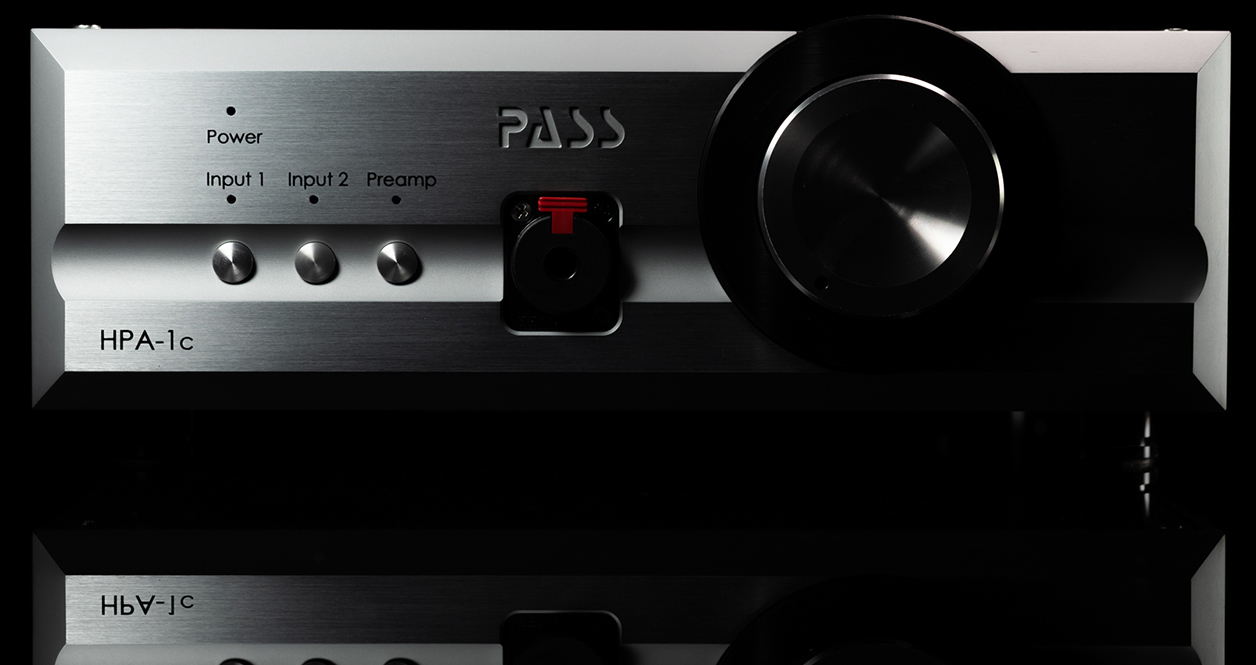
Remember my 1+2 question? Does the pursuit of ever shinier specs involve methods which are worse than the promised cure against higher THD and output Ω? At Pass Labs and sister brand FirstWatt, the design team has spent decades grappling with an alternate approach. Rather than massive open-loop gain generated by many cascaded stages to enable application of steep negative feedback, they pursue simpler circuits sufficiently well behaved to need no or just minimal corrective feedback. Whilst that won't generate the same shiny specs, this approach calculates a more practical matter. What numbers are actually relevant to the human ear/brain not oscilloscope? What impact does heavier electronic correction have on the listening experience? After all, we don't listen to specs but tunes. Nelson Pass has published many papers on the matter. For today's purposes, a simple 'yes' suffices. Yes, this approach does yield a gestalt different than the steep-feedback fully balanced class A specimens at my disposal. Enter slang by way of the tight-ass who knows not how to have fun; with the tight-arse who is very miserly with money; and with he who walks around as though with a stick up it. Mix up our three assets and presto, the primary distinction between the HPA-1c and those comparators. Whilst this occurred to varying degrees depending on exact contrast amp, it was about the same general flavour. Texturally and spatially, all were more miserly. On gait as the perception of moving through time from one musical bar to the next, all were more clipped and uptight. Think of a belt worn two holes too tight. Whilst it might squeeze and slim our silhouette, it also restricts our oxygen intake. If we focus on musical breath as subliminal ebb and flow, contraction and expansion; or subtext of a dancing fluid not metronomic pistons – we notice this difference.
My maximum revealers and revellers were the ribbon headphones. Their freely moving conductive aluminium strips unobstructed by magnets on either side suffer no energy storage. Their super-ventilated cups drive down chamber resonances by a demonstrable margin. To hear what electronics truly do requires comprehensive elimination of room effects which otherwise obscure and overlay. With headphones that's easier done than with speakers. Still, balanced-drive planarmagnetics and sealed dynamics battle airflow issues and internal reflections. Those inject timing blur. 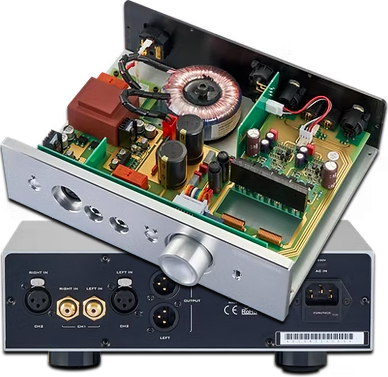 Direct sound mixed with delayed reflections is often called warmth. That's easily misattributed to electronics when our transducers and their environmental interactions are the real cause. To make this distinction properly requires extremely capable transducers; plus a well-treated room when using loudspeakers. In my headfi collection, the Serbian ribbons are the air-moving host with the most freedom from mechanical artifacts.
With them the HPA-1c sounded far quicker and more aspirated than generic class A notions of warmth and saturation might ever credit. A side effect of its gushier freer mien was lateral expanse. The HPA-1c had both ribbons and FiiO's currently top planarmagnetics sound positively huge to feel closer to loudspeakers than skull-locked headfi. This needed no DSP trickery, crossfeed or stereo expansion. As is well-observed on valve kit of widely adjustable negative feedback, whilst max values might tighten up speaker bass because they lower output impedance for superior woofer control, they also dry out textures, flatten dimensionality and stifle gushiness. With the rather small crossover-less transducers of headfi, higher Z-out is zero issue. That negates the Ω-lowering benefit of high feedback. Meanwhile on-ear staging always begins as an inevitable compromise versus freestanding speakers spaced 3-4 metres apart.
Given what for headfi was noticeably uncorked staging, I suspect that a primary contributor to that and the contextual billowing was minimal to no feedback. Keeping that path perfectly manicured for zero noise even with in-ear transducers of the kind Dawid tested must be a most mean trick. If it were otherwise, the majority of designers wouldn't need complicated multi-stage interlocked circuits with more than 100dB of feedback to net equivalent S/NR. Of course it also takes clients who don't shop for the maximum queue of zeros behind the decimal point before THD starts booking. Having neatly eliminated my 'shiny specs' specimens for their stiffer flatter more mechanical conduct—more techno than bel canto—let's zoom in on remaining differences against specific contenders, first Kinki's THR-1 still on my desktop. That A/B was far easier to make and different than expected. The class AB Kinki was thicker and meatier, the Pass more lithe and transparent. On resolution by way of inter-image separation, the HPA-1c had the lead. Ditto for being more light-filled, quick and luminous. The THR-1 played it heavier, chunkier and more grounded if also marginally fuzzier or softer on the rise of sounds.









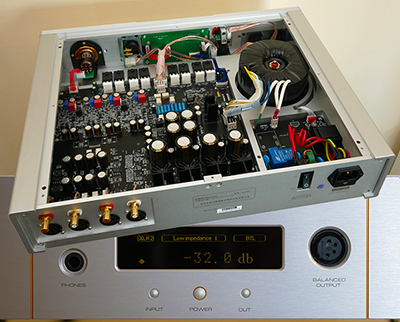 Next up was the Silver Fox with its octet of lateral Exicon Mosfets shown at left. Here headphones were the aune SR7000, FiiO FT7, HifiMan Susvara and Raal 1995 Magna. With 3.5Vrms source voltage I had a bit of extra headroom for the deafer loads; and two attenuator options. I could either run the everything-DSD1'024 DAC fully open and use the amps' manual volume controls; or run the latter wide open and trim the DAC's output with its remote control.
Should that make a difference other than convenience hanging off the end of 3-metre headphone cables far extending the reach of my arm?
Practice beats theory. I'd have to try to tell that tale. So I did and lived. Seriously though, I was surprised to see myself think that max gain for the amps and attenuation at the source had it. Did this maximize the amps' signal-to-noise ratio? No idea. That's theory again. I opted for convenience and higher contrast ratio so remote volume on the DAC. Win/win.
I was equally surprised to find myself back in the midst of the first season, just with a far narrower difference margin. Where some of the earlier sessions had reminded me of way-back class D which still overplayed the fully buttoned-up overdamped card to cast a clear personal preference and perception of different quality tiers, now I had equality. That meant a shared tier but still divergence. The HPA-1c again was the rhythmically freer so more spaced-out—as in room not shroom!—performer whose soundstage separation against backdrop silence was keener. Lateral expanse was slightly wider to also give more clearance "between the aisles" as it were.
The thing I can't explain is why the general imagery placed farther back like a kidney-shaped airline pillow than the more forehead projection of the Silver Fox. I tend to think of soundstaging as foremost dictated by our transducers so in-room placement and alignment with speakers; pad thickness, driver spacing and its aim with headphones. That the soundstage position within my skull would shift with these amplifiers defied my notion. More important because it defied an officially held not just personal belief whereby class A means warm, dense, fleshy even thick? This class A amp's resolving powers were still keener than the more powerful bridge-mode class AB challenger. Since the HPA-1c was blessedly free of being a tight arse of any persuasion, it allowed the music to unfurl and open up more. That made it still easier to get inside the tunes. The Silver Fox was a bit more interlocked for a tighter weave. If you ever put knitted woollens through the dryer, you know the difference. Where before you could see through the endlessly looped thread, afterwards not only was the shirt a size too small, its fine air gaps had disappeared. That connection of grippier interlocking and associated shrinkage distinctly applied to the in-head panorama. The Silver Fox put my tunes through the dryer just enough to notice.

With the DAC's stepped attenuator showing ~15dB of headroom even on Susvara/Magna, I had nothing to max out and embarrass the HPA-1c's power rating. If naught but its power rails and their noise floor changed over the 2016 version, this circuit certainly withstood the ravages of time rather gloriously. I shall call its particular mix of qualities organic very high resolution. It's routinely implied that an organic sound embeds enhancements or less-than-candid detailing whilst hi-res carries subtext of sterility exposed under a surgery's bright neon tubes. In how the HPA-1c mixes these attributes, we get very fine detailing under sunlight; and with all the windows open there's a virtual breeze coursing freely through the house for that quickened expansive sensation.
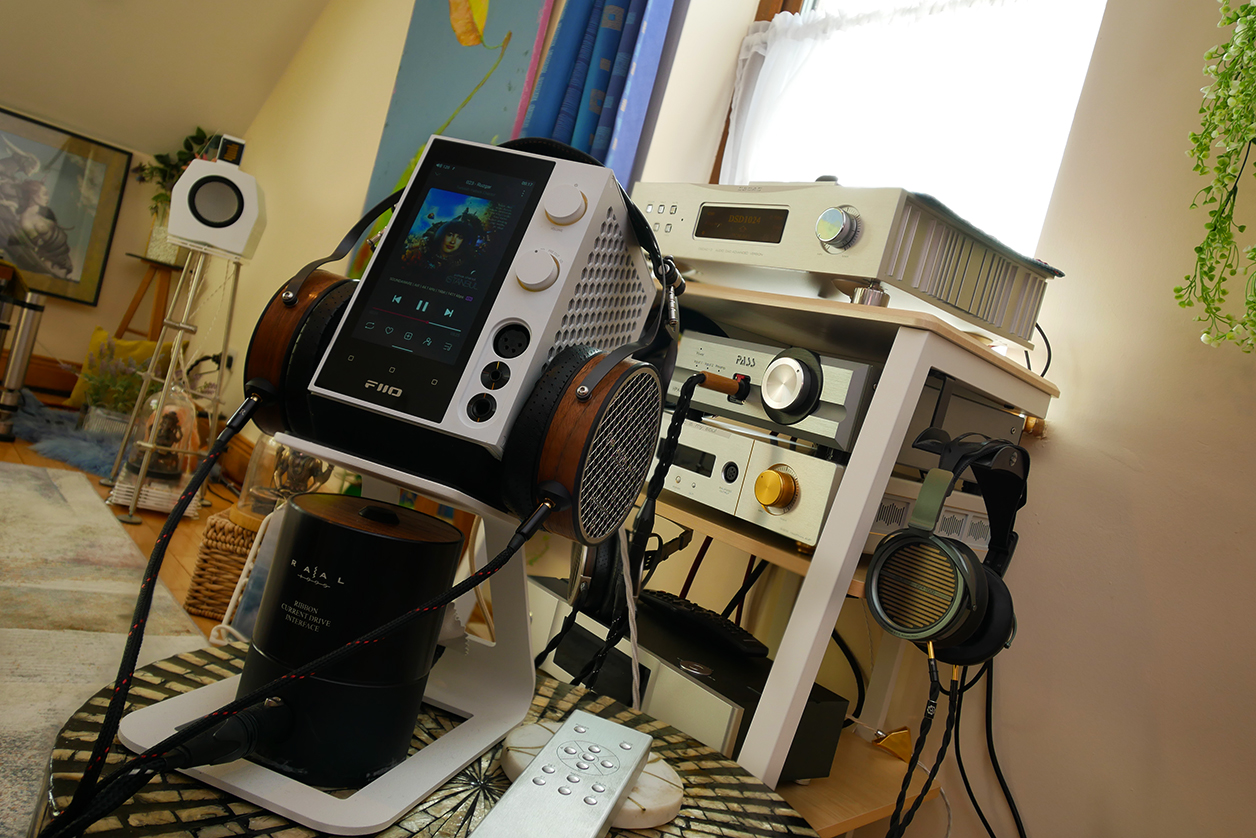
Whilst this is no approved technical review lingo, investigators are told to follow wherever the evidence leads. This is where the HPA-1c led my observations. It's how my mind processed them so I might communicate them. It's down to much of it being about feel or gestalt, not treble/mid/bass, tonal balance and amplitude response. How would the HPA-1c's take on high organic resolution compare to Enleum's AMP-23R as my best in-house headfi deck? At €6'500 that goes deeper into the red. By dispatching 25/45wpc into 8/4Ω speakers plus adding remote control and 6½wpc into 32Ω headphones, its functionality veers heavier into the black. With Dawid already having done the Susvara/23R dance, I'd focus on FiiO's FT7 planar.