Take 2. Whilst waiting for our 2-in-1 sample to fly from Warsaw to Shannon, I took stock of Dawid's pages. Though both they and my intro already covered it, given the lengthy interval since its launch, it seems fair to reiterate that balanced drive and headphones needing in excess of 3wpc/32Ω have become more common. Already aune's €400 discrete class A N7 delivers 6.5wpc/32Ω albeit off a switching wall wart then adds a metal remote. Schiit's American-made $499 Jotunheim 3 does 6wpc into 32Ω. Topping's A900 goes to 22 watts extreme. But just as this website hasn't turned talking-head YouTube but remains an old-fashioned read, the HPA-1c too hasn't changed with the times. Though it is priced entry-level for wearing a Pass badge, it's actually rather upscale in the context of challengers that have entered or come up in this sector since my first review 9 years ago. Think Laiv and Luxsin, Eversolo and FiiO, Matrix and Gustard. Even in the automotive sector, Tesla now battle China in the flowing shapes of BYD cars; Starbucks are out-franchised by domestic brand Luckin Coffee. The Middle Kingdom's turn from Communism to party-managed Capitalism still changes our world order. That said, I note a few possibly substantial differences. 1/ only a few pricier headphone amplifiers run discrete 'speaker-grade' output transistors. Aside from the HPA-1c, the big Burson models come to mind. Most use far smaller output devices if not IC. 2/ the vast majority of class A head amps priced well below the Pass would seem to exploit copious amounts of NFB often in multiple embedded loops to achieve sterling specs; and tend to operate balanced for further distortion cancellation. Does 1 + 2 = another class or type of sound? From Schiit, "unlike high-measuring amps that only get that way with 120dB of negative feedback, Jotunheim 3 has just 10dB of global feedback… There's also an inner loop running at only ~20dB. The result is top-of-class performance without stacked nested opamp shenanigans." Such opamps could be chip-based or discrete by the way. But the word "shenanigans" shows that its author Jason Stoddard considers such circuits inferior and groomed foremost for shiny specs to play to the measure-don't-listen crowd at ASR.
Then Dawid's 'safe' tuning caught my attention. It reminds me of "it's not a sprint but marathon". Hifi tuning for a sprint can take liberties since we'll be done after a few tunes. If it leaves us fatigued, we expected no less. We ran as fast as we could; listened as loud as circumstances allowed. The same goes for hot-sauce freaks. Indigestion, acid reflux and a burn on the loo are side effects they happily book to indulge their pleasure. Marathon tunings meanwhile expect very long listening sessions. Now even minor annoyances add up to shorter listening times. What are potential annoyances? In nearly every reviewer's hierarchy, the top offender is probably treble brightness followed by unnaturally crisp transients, skeletal haggardness and pancake flatness. Unlike in the gym, lean, thin, flat and hard tend not to play very well in the average listening lounge. Now a safe tuning is one which avoids the most common reasons why people turn off a hifi too soon. One of those implied but not yet mentioned specifically is having to listen loud to get satisfaction. Loudness not only exhausts. It must be managed relative to neighbours and co-dwellers. If a system satisfies at low SPL, social concerns shrink and our hearing apparatus taxes less. What qualities do we think make low-volume listening more pleasurable?






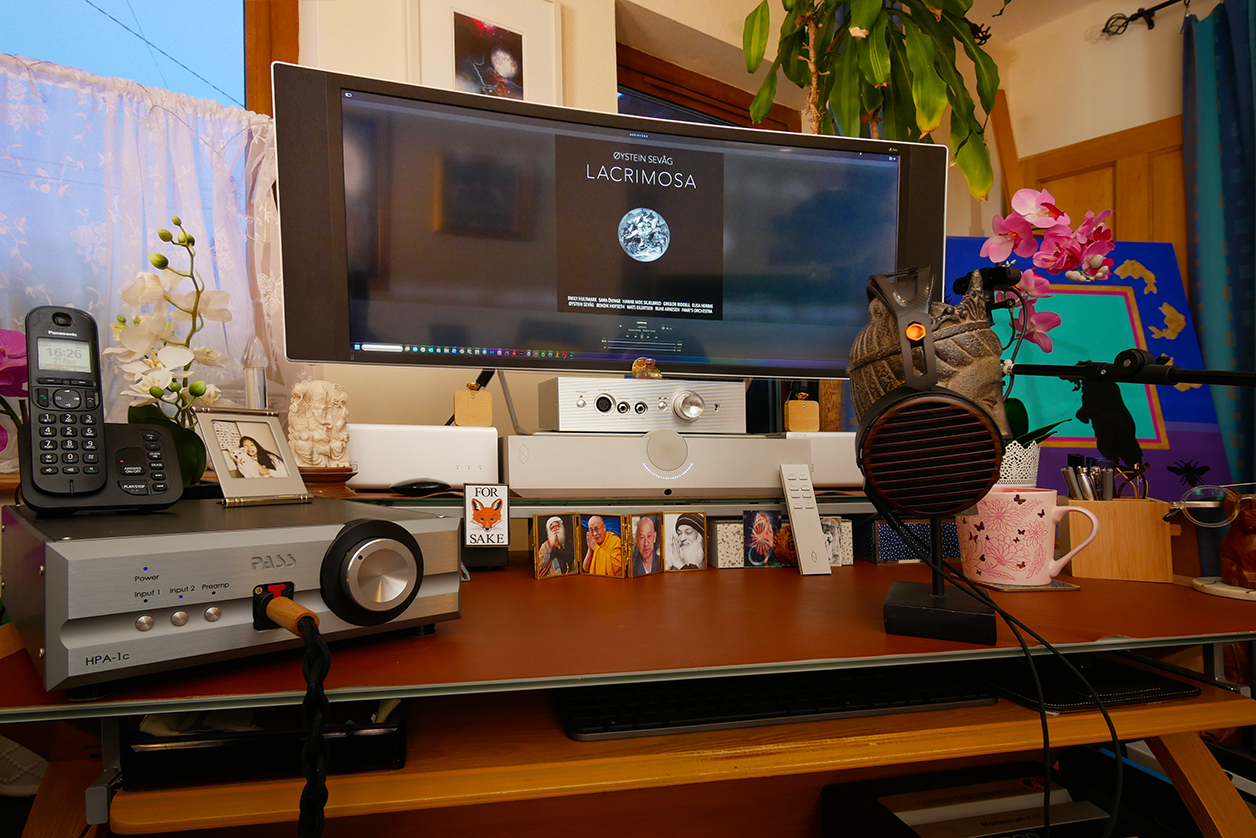
You'll probably mention the very qualities Dawid's comments highlighted for the HPA-1c. Et voilà, his safe tuning. Aside from my own safe load bets of FiiO FT7 and Final D8000 planars, FiiO FT3, aune AR5000 and SR7000 dynamics, I had Raal 1995 Magna and Immanis twin and triple ribbons. Like Dawid's Suvara, those like to see ~3wpc/32Ω then draw up to 3A. To fatten my gain goose for a cheery Thanksgiving, I had an iFi iDSD Pro Signature DAC. Its fixed RCA spit out 6Vrms so three times the norm. That could boost the HPA-1c's loudness capabilities should those headphones and my ears be thirstier. Cheap tricks. After 23 year on this beat, I have a few. I also had a Cen.Grand DSDAC 1.0 Deluxe [€6.3K] with 3.5/6.2Vrms RCA/XLR outputs and its companion 20wpc/30Ω Silver Fox head amp [€4.5K] with four pairs of lateral Exicon Mosfets. It's my upstairs headfi system. Though the Chinese class A/B amp is wildly more powerful due to bridged mode, it prices equivalent and uses speaker-grade output transistors. That made it my closest oranges-to-oranges comparator followed far lower on the cost index by Kinki Studio's class A/B THR-1. That likewise exploits lateral Exicon Mosfets for 5.5wpc/32Ω as does the 6.5wpc/32Ω Enleum AMP-23R in my main listening lounge. But it's on my desktop where the Pass first touched down fed from a COS Engineering D1 with its analog attenuator bypassed. That drove FiiO's flagship planar followed by…
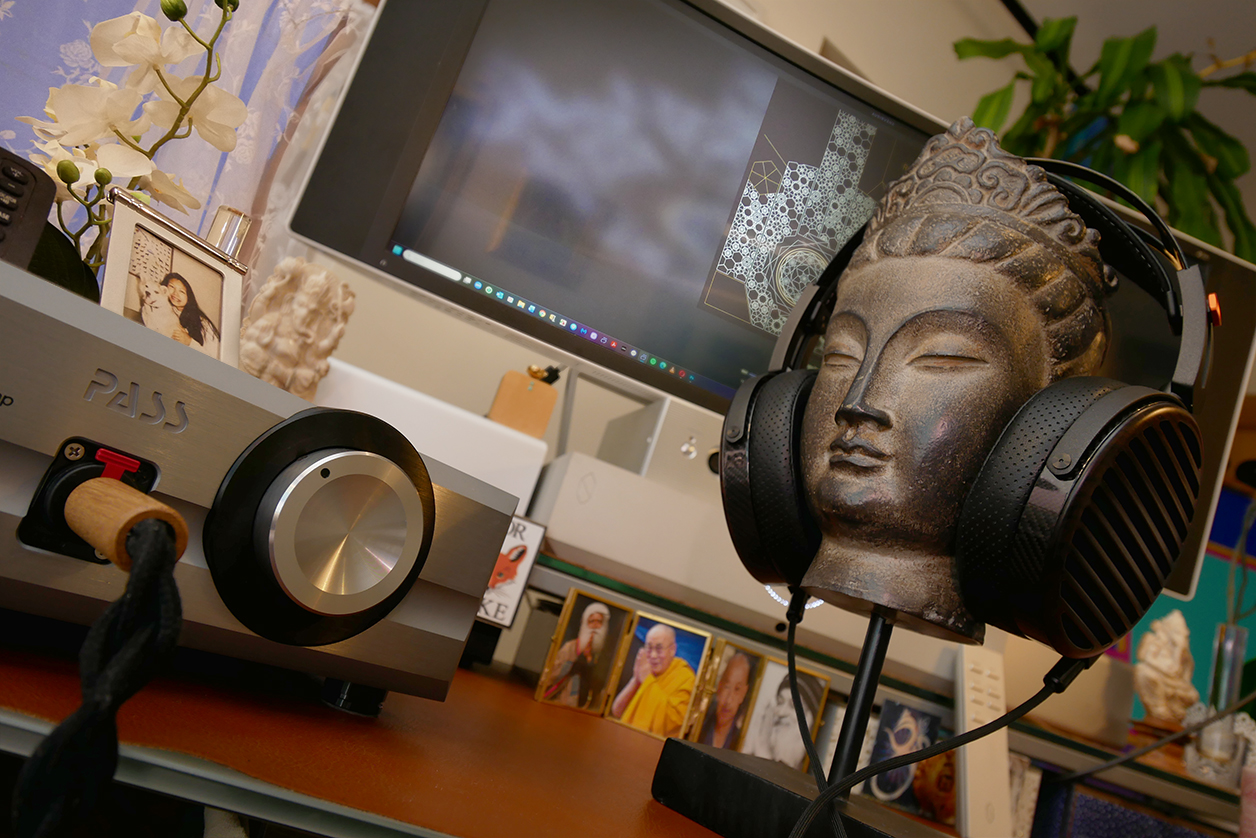 With FiiO's FT7 planar, 10:30 on the volume netted high playback SPL.
… Raal 1995's Immanis. Those ribbons needed four more hours—from 10:30 to 2:30 on the dial—for equivalent high SPL, no cheap tricks required. A bog-standard 2Vrms source was perfectly sufficient.
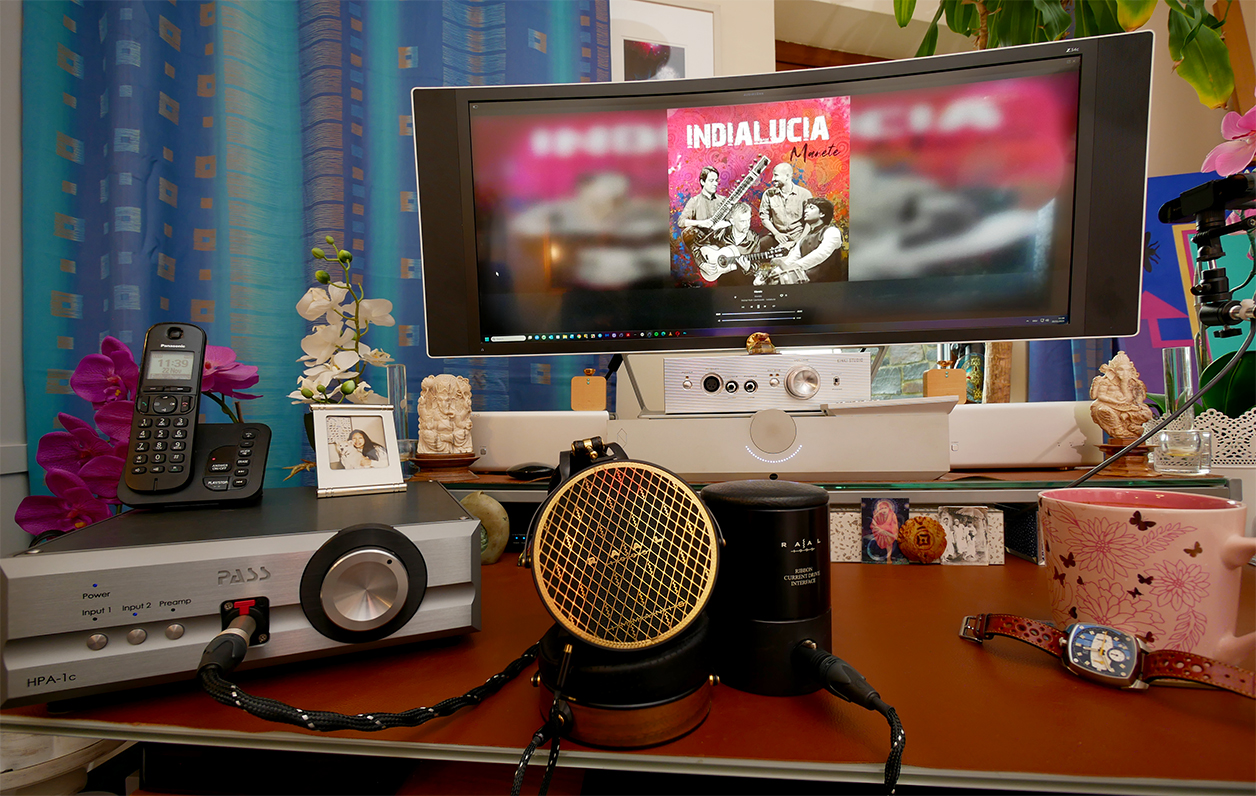
For a free trick in Qobuz or Spotify, try the 2025 single "Manete" by Flamenco/Carnatic fusion group Indialucía. What a happy rollicking tune. If that doesn't make you smile, you're already in Elysium.