
 In this system, four front-end components usually seated in a passive Furutech power block with piezo-active compound aka nano-crystal² formula swapped over to the OnFilter and back. Here I even had a 3-metre LessLoss cord with 20A plug to roll Vlad's industrial type for elimination purposes. But even with that cord, the PDU still sounded bright and hard. That's not where LessLoss ever play. So my jury deliberation was brief. The gizmo difference between Furutech and OnFilter had shown a 40-70mVpp range versus 12.7-17mVpp. Once again Vlad's black box won on measured EMI reduction. Yet there was no sonic payback, only setback. What should a fair conclusion be?
There's no doubt over OnFilter's EMI suppression effectiveness. In my worst scenario according to the gizmo's lossy reading with no 'audiophile-approved' power distribution in play, the OnFilter made short work of a generic computer-shoppe power strip with surge suppression. On that level, Vlad's industrial approach with zero engineered intention to produce any sound improvement actually did. Hello? To my hobbyist mind, this begs a question. Is there a critical mass of EMI pollution beyond which standard hifi power supplies like those of my desktop kit can't effectively cope? If EMI exposure isn't extreme, do hifi's better power supplies already handle all sonically critical ripple suppression and smoothing? If so, it rewrites the job description Vladimir Kraz must impose on his own product if he wants demonstrable sonic gains. For our sector there's more to it than the type EMI filtering he already practices.











 To conclude, OnFilter's design brief of rigorous EMI suppression proved out even with the provided layman's measuring tool's lack of precision and scope. Vladimir Kraz's approach clearly works. Sign here then take it with you. Given what the gizmo measured in my office, I can't even imagine the voltage spikes a server farm or data centre dumps onto the AC. There PDU protection could well be mandatory just so things function properly. I'd also want such EMI suppression in my office now that the gizmo read me the riot act. In my well-curated systems whose power distribution I already figured sorted, I heard no reason to want a PDU. Au contraire. The better my systems, the more intrusive it became. The tough question is, how should Vlad upgrade it so that for already tweaked rigs it just adds peace of mind; or does that plus improve sonics? If it hardens and brightens the sound, serious audiophiles shall sleep soundly with no peace of mind. At the very least, the PDU ought to combine protection with sonic invisibility. At best it should better the sound. In my two ambitious installations, it failed the invisibility test and made things worse. But it did improve my simpler office setup.
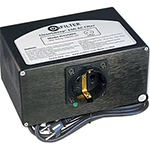 Considering OnFilter's friendly pricing, I see my 1-of-3 results as a good start. To become relevant to critical listeners with already better systems like mine or beyond, Vladimir himself must become a critical listener. Better yet, build a network of trusted beta testers who can provide the necessary feedback. After all, there's no real shortcut to experience. It must be earned by putting in the time. And you only do that when you're passionate about better sound in the first place. That won't be faked. How my review feedback should modify as we move away from my very rural sparsely populated location to a densely packed inner city with its commercial and industrial installations plus endless big apartment blocks putting far higher strains on shared utility power; I couldn't say. For such users the PDU's current EMI filtering might well outshine any potential side effects from OnFilter's industrial focus in lieu of actual experience with high-performance hifi. Two steps forward and half a step back are a solid 1½ steps forward. Then even 1½ steps back would still move us forward. Since there's more to audiophile AC distribution than potent EMI filtering which at present is all OnFilter are on about, the PDU's suitability should come down to the level of EMI we unknowingly expose our hifi kit to; and how successful or not its power supplies cope. Now it seems sensible to start with OnFilter's smaller CleanSweep at left then plug into that an outlet multiplier which adds other benefits like my audio-specific Furutech and Vibex clearly did.
 This photo of the Shannon river further inland from my digs is from the website 'Irish Central' here.
Then again I don't live in a metropolis, city, town or even village. I'm between two tiny villages. It could make me an outlier on what should be considered normal for EMI exposure in 2025. As you take away from this review, keep that in mind. To tie the knot with the beginning, "playing what if, should you find not much subjective sound difference or any, would that render the product useless in your opinion even it gives your system nice clean power? After all, it wasn't supposed to affect sound to begin with." It's what Vlad asked going in. Yet better sound is what most audiophiles are all about. If something has no sonic benefits, it misses our communal boat. Now we must believe that "clean EMI-free power is as healthy for your audio system as clean safe water is for our bodies". That's a peculiar position to take when elsewhere Vladimir invokes irrational audiophile mythology. It calls out unfounded beliefs. In the absence of audiophile proof as better sound, calling EMI-free power better demands belief. It's not backed up by actual experience. Measured gizmo proof of very real EMI suppression does not make a dent in this remaining a belief if we can't hear benefits. Then we must take 'better' on faith value. We can't hear it but believe it anyway. How is that different from irrational myths? Of course all bets are off if as I did in two out of three cases, what we do hear is sound not as good as before. And once more to perhaps suggest a different approach, when a brand reaching out to audiophiles states that its equipment isn't supposed to affect the sound, why chase us in the first place? Our sort goes in for things that improve the sound. Most of us don't bother otherwise. I also have no answer for OnFilter's website lacking a web shop for convenient direct sales; or pages dedicated to audiophiles if we're intended buyers. On the other hand, OnFilter + audiophilia = early days. Thus far they focused on industrial clients. Unless my review discourages them, going forward this could change. In which case, welcome to the audiophile jungle, Vlad. Just don't forget the mosquito repellent…
OnFilter reply: "First, I appreciate your thorough test of our PDU from the audiophile perspective. We had plenty of feedback from our customers but as a professional, yours carries more weight. I see that we diverge on the subject of DC bias. That's absolutely fine. I'm not driven by an agenda, only by facts i.e. measurements. I sent you photos of my measurements (which you didn't post) showing only 1mV (0.001V) of DC in our office outlet where we have a lot of equipment. When early in the game the subject of possible incorporation of DC blockers came up, I decided to see whether the problem is real and measure its severity. My measurements repeatedly showed quite insignificant DC voltage not presenting any 'inconvenience' to the equipment. So I opted not to burden our products and customers with the additional cost trying to solve a problem that doesn't exist. After all, measuring DC on power lines is the easiest and very inexpensive measurement that anyone can do. Should there be irrefutable evidence of DC voltage of significance in the field, I would gladly change my mind and add DC blocking into our filters. Transformer buzzes etc. could be caused by a number of things, DC not being the main one.
"I appreciate your posting my input on technical items. I hope this is helpful to curious audiophiles. I'm in full agreement that our box is not up to expected aesthetics of high-end audiophiles. It wasn't meant to be. A factory or data centre would balk at paying a lot of money for what could be called "furniture" – beautiful, a pleasure to look at but adding absolutely no functionality. This is one of the things we need to look into for this market. On the other hand, a functional product which calls for no attention and has no controls doesn't need to be a centre piece of the audiophile setup. The money that would otherwise be paid on embellishments could find a better return in improving room acoustics for example. FYI, we use heavy-duty industrial-grade outlets for the PDU, the sturdiest to market. This is why you felt a "bite". These outlets will hold steady under stress, vibrations, pull, oxidation and whatever else is found in factory and field conditions. The display can be easily turned on/off by momentarily pressing the only button on its surface. It is in the User's Guide. Yes, I am in the same boat. User's Guides are a nuisance.
"Now we're coming to the 'big' one – sound quality. A blast from the past. Back in my younger days in the place one would be unwise to visit today, there was a stereo revolution. The government decided to manufacture stereo equipment for the masses. Having my audio engineering degree from St. Petersburg, a lot of friends and people I hadn't heard from before were calling me about why now their records sounded really crappy? The answer, of course, was that the old mono "government" gear mutilated the sound, masking a lot of artifacts. Now with better systems people could hear all the cracks and pops, shoddy recording and pressing quality and other unpleasantries. The short of it, the improved sound systems produced sound that was subjectively worse than with the old crippled gear while objectively being more accurate. So which sound is the right one? Is it the most faithful or most pleasant? Which one is the reference?
"This is not to argue with you at all. This is for me to understand the direction. I hear from some experienced users that with our filters (PDU included) they hear better and more spatial lows. Some others say the opposite so brighter highs. I hope you understand my conundrum. Which way does the weather vane point? Two people sharing a bottle of wine may have very different opinions and write different reviews about it. To add to that, subjective comparison is inherently flawed in the case of power equipment. What I remember from the Psychoacoustics course in my audio engineering study is that human ability to retain sound quality lasts only 20-40 seconds. Longer than that becomes pure imagination, vivid and very convincing but imagination nonetheless. Drastic sound imperfections can be remembered for much longer of course but this isn't what we are dealing with here. While it is possible with proper setup to compare, say speakers by instantly switching them; powering down a system, rearranging cords and powering it all up is a task of several minutes so meaningless for true comparisons no matter how convincing it may be. In short, I take your points about impact on sound quality. Now I must understand the direction. Should the sound be faithful or pleasing and what is the reference. My preference is faithful and any pleasing adjustments can be done individually on the setup level. Any subjective impact of technology has roots in engineering and this is where I'm trying to figure it out. Thanks again for reviewing our PDU and much appreciation for your professional opinion. Best regards." Vladimir Kraz