"Some fine points in no particular order. The link to the video is of course for our ground filter though our PDUs have the same ground filtering built in, a unique patented feature. Audiophile or not, clean ground is important. Our PDU is neither heavy nor expensive. We don't sell products by the pound but by decibels of attenuation. The PDU is US$997, the filter $599. It's not silkscreen on the front panel but laser etching, a minor thing. We ship our PDU to data centres. For them cosmetics isn't why they buy them. Noise attenuation is. I'm torn on the subjective listening test. If I'm to draw an analogy, it's like using some medication off label; not for what it was intended but hopefully it still helps. We sell on performance not extravagant linguistics. Ultimately, clean EMI-free power is as healthy for your audio system as clean safe water is for our bodies. I just returned from California's Costa Mesa hifi show. One very inquisitive visitor brought with him this little gadget. It measures EMI on power lines in a very rudimentary though still instructive way. It showed 50 x EMI reduction for our filter, 2 x for a $6'000 Shunyata per his report after visiting their room. I can procure this gadget and send it along for some objective data. We use metrology-grade instrumentation and oscilloscopes to conduct such tests ourselves but for your purposes, this gadget is far better suited. Playing what if, should you find not much subjective sound difference or any, would that render the product useless in your opinion even it gives your system nice clean power? After all, it wasn't supposed to affect sound to begin with."
Was our man uneasy with a sonic assessment? I had to be sure before proceeding. "The service I can render is to evaluate your product—looks, design, price, features—exactly as an audiophile plus 23-year critic in this sector. Since you mean to learn how to best serve it, such feedback is key. That industrial clients have different buying triggers than many home users will be obvious to most of my readers. If I can't hear a difference, I'll of course say so. Being honest is part of my job. But I'm happy to include the TriField gadget for the objective angle and my own edification." Vlad replied: "Because I expected none to surprise me, I did hear some improvements in Martin's Munich room but am eager to hear opinions from much more trained ears. I'm quite ready to 'roll with the punches' as I'm perfectly aware of all the weaknesses our gear has for this particular market. I'm quite sure that you'll discover at least as many. Our boxes are basic industrial stuff with no attempt at beautification. The outlets and plugs are heavy industrial grade. We use medical-grade cables for a standalone filter to conform with regulations. Our power cords are industrial and there are many other things like the C20 power inlet again for regulatory requirements when C14/C13 sockets only rate up to 15 amperes." Feeling confident that Vlad and I were on the same page now, rules of engagement clear, this gig was a go.










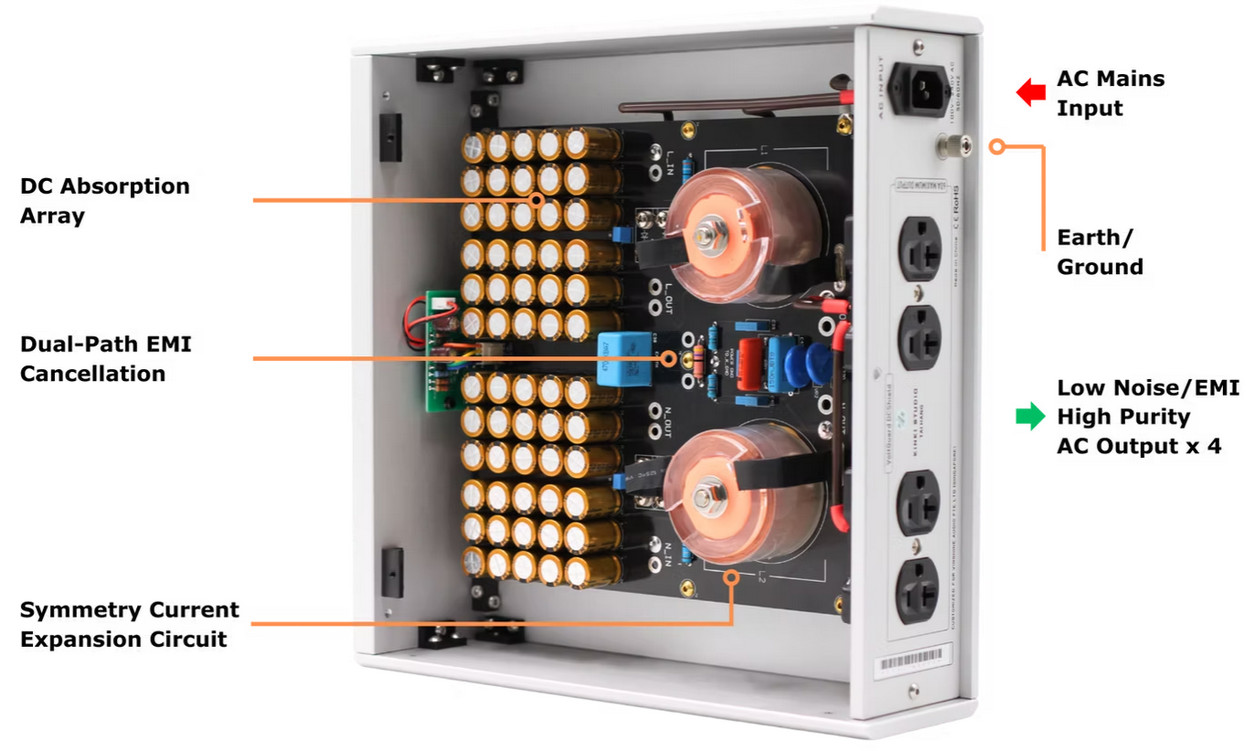
Amongst common EMI culprits, Vlad lists switch-mode power in everything from phone chargers and televisions to household appliances, computers and LED lights; variable frequency motors which operate on pulses and work in aircon, refrigerators, washer, dryers, dishwashers and pumps; and our own or neighbouring solar panels with their DC/AC inverters. Despite situating very rural, my house hosts Vlad's entire gamut of EMI offenders: water and sewage pumps; solar panels; all the usual kitchen and utility-room white goods; sundry household and hifi appliances with SMPS. Would his filter alter their influence on my playback? I couldn't track potential longevity benefits where we might expect that electronics less stressed last longer. I'd not test surge protection unless an actual incident struck. I'd generate gizmo readings then listen. What if things limited themselves to surge protection and potentially longer component life? Such presumptive benefits feed peace of mind like health and motor insurance. Their true utility we wish to never tap but we still buy them in the hope that they'll pay out should we need them (and in most jurisdictions, neither cover is optional). To the right buyers, OnFilter's 6-outlet PDU and 2-outlet filter should buy what in HighEnd terms seems cost-effective health and life insurance for valuable hifi hardware. That would be true even with zero sonic benefits. What of Vlad's views on power-line DC offset? "AC power to a house outlet comes from a transformer on the street that converts high AC voltage to in your case ~240VAC. Transformers are incapable of passing DC voltage. If any would be added after the transformer, it easily dissipates on a very low resistance of that transformer's secondary winding. Could DC generate somewhere past the transformer in your house? Switch-mode power supplies and pulse-driven motors offer nonlinear loads which distort the power voltage's sinewave but the result is still symmetrical, i.e. Vdc=0. It's possible to have minuscule residual DC voltage but nothing that would have any significant power to affect the linearity of transformers. DC voltage on the AC line is just one part of the irrational audio mythology."
Here OnFilter diverge from Puritan Audio Labs, Isol-8, Vibex, iFi, GigaWatt, Holton and Kinki [above] which among others offer DC blockers. Over the years I've had multiple occasions of noisy audio transformers which shut up once fronted by DC blockers. So I use them for quieter electronics and a lower system noise floor. It may be irrational but real not imaginary results make that okay. "There are only two realistic ways to remove DC bias if present: a capacitor in series and a transformer. Both increase output impedance, causing intermodulation and other distortion. Why would some parts of electronics buzz? It can be a real phenomenon. Inductors may buzz for two main reasons. Their core having a construction or assembly defect allow it to vibrate instead of staying put is one. Another is if a transformer or inductor winding is loose. Wires could vibrate especially under high current. In our designs such things are considered from the very beginning and put in our internal specification and specification to our suppliers. Also, surge and lighting protection aren't the same. Here's a brief note but in short, lightning has ~million times more energy than a typical surge you'd encounter in a house. Sometimes a surge protector can help with low-to-moderate lightning but I wouldn't bet on it. It's much more prudent to have lightning protection at the electrical entrance to the building or distribution panel where you have your circuit breakers. Being a pulse (milliseconds vs. typical surge of microseconds), lightning may cause voltage ringing in house wiring if the suppression is at the end of the branch not unlike a tuning fork when you tap on it. This would transfer a whole lot of energy into just about anything in the house. If the lightning pulse is stopped at the entrance, whatever ringing may happen will be at the power company's end, not as much in your home's electrical wiring. There are plenty of quite inexpensive lightning protection devices installed in distribution boxes which double as surge protection against the 'outside'. Just keep in mind that a whole lot of transients are originated inside the house by motors and alike."