Praying purists who hope to condemn this IC-based circuit for behaving crisp, controlled, articulate and pertly damped from embedded superbly measuring high negative feedback would have their prayers answered. Rather than fault this tuning however, a pragmatist quickly sees its virtue. S/he realizes how it's an ideal backdrop against which to inject some of xfeed's bloomier attributes with their subtly phasey billowing action which accompanies the centre fill's broader spaciousness. With 'effect' and 'crossfeed' active each at its own dose, the neighbouring 'bypass' control on the touch screen allows for instant A/B. To fine-tune those further, we can turn on/off 'effect' and 'crossfeed' individually to progress from pure to lightly processed then more processed whilst deciding what best suits us. If we began in deep triode's humid climate, we'd not tolerate anything but 'bypass'. Now we wouldn't benefit from selective DSP's spaciousness tweaking. Clarifying this makes for the perfect starting point to explore. Throwing in my off-site DSD256 resampling option, I did just that. I soon heard that whilst crossfeed + stereo width have some DSD flavour, they produce more 'actual' spaciousness with less loss of focus and don't dim the treble. That in fact became my preference: PCM upsampled to 352.8/384 in Audirvana Studio to which I added some stereo width + 'popular' xfeed. But the point isn't what I liked. The point is that these tuning shifts are subtle enough to remain benign rather than devolve into cheap tricks; yet are sufficiently keen to make a difference unlike the digital filter options. In short, you season to taste. These games aren't about the frequency response as are the basic tone controls and far more surgical EQ curves. These games are about the snappy-to-elastic values of textures; and the sharp-to-soft shifts in focus. They alter the musical feel by giving it more forward lean or repose; and influence the perception of audible space where PCM-vs-DSD parallels enter. If one doesn't overdo this, the primary effect is that of expander. The central headstage gets wider and the musical progression through time feels more buoyant so less like a military parade. I thought it rather trick to start out with opamps then graft onto them selective 'discrete' behaviours including thermal dissipation. Only those who demand to spend a lot more to feel good about themselves would cry wolf.
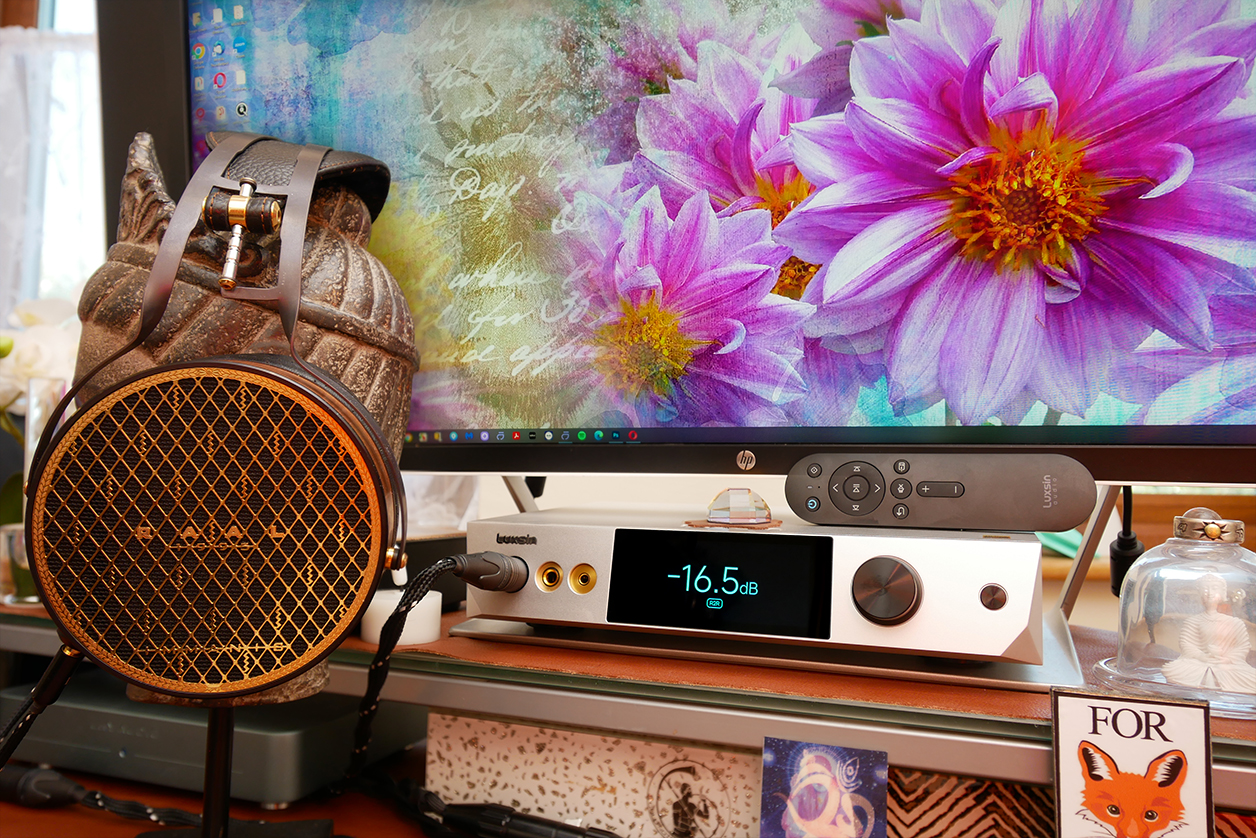
Incidentally, the remote's top right button kills or brings up the display. If we set the display to go to sleep in 30 seconds, we ca check on it whenever we like by IR without having to first change the volume or an input. I liked having control over that. What's more, Luxsin's OS has a memory function so that even after a hard shutdown with its power cord unplugged, the deck remembers our last settings of input, volume and sub-menu choices. For my first define-by-contrast session, I now drafted into service aune's pure class A S17Pro Evo amp. At €799 it's another bargain from the Middle Kingdom but lacks the X9's DAC and expanded functions so isn't head-on comparable. Still, juxtaposing a true discrete if far simpler amp under €1K to an opamp circuit with loaded tuning options and DAC for slightly north of €1K did make sense on sheer sonics. To level the playing field, I used the X9's analog outputs into the aune to share the same DAC section, Luxsin's attenuator bypassed. The aune only received 'direct' signal so all of the X9's tuning options bypassed. The X9 ran in both bypass then my favourite tuning. That after all is part of its appeal which the Evo lacks. Pressing advantages is their whole rationale. Calling it unfair isn't how the world works.











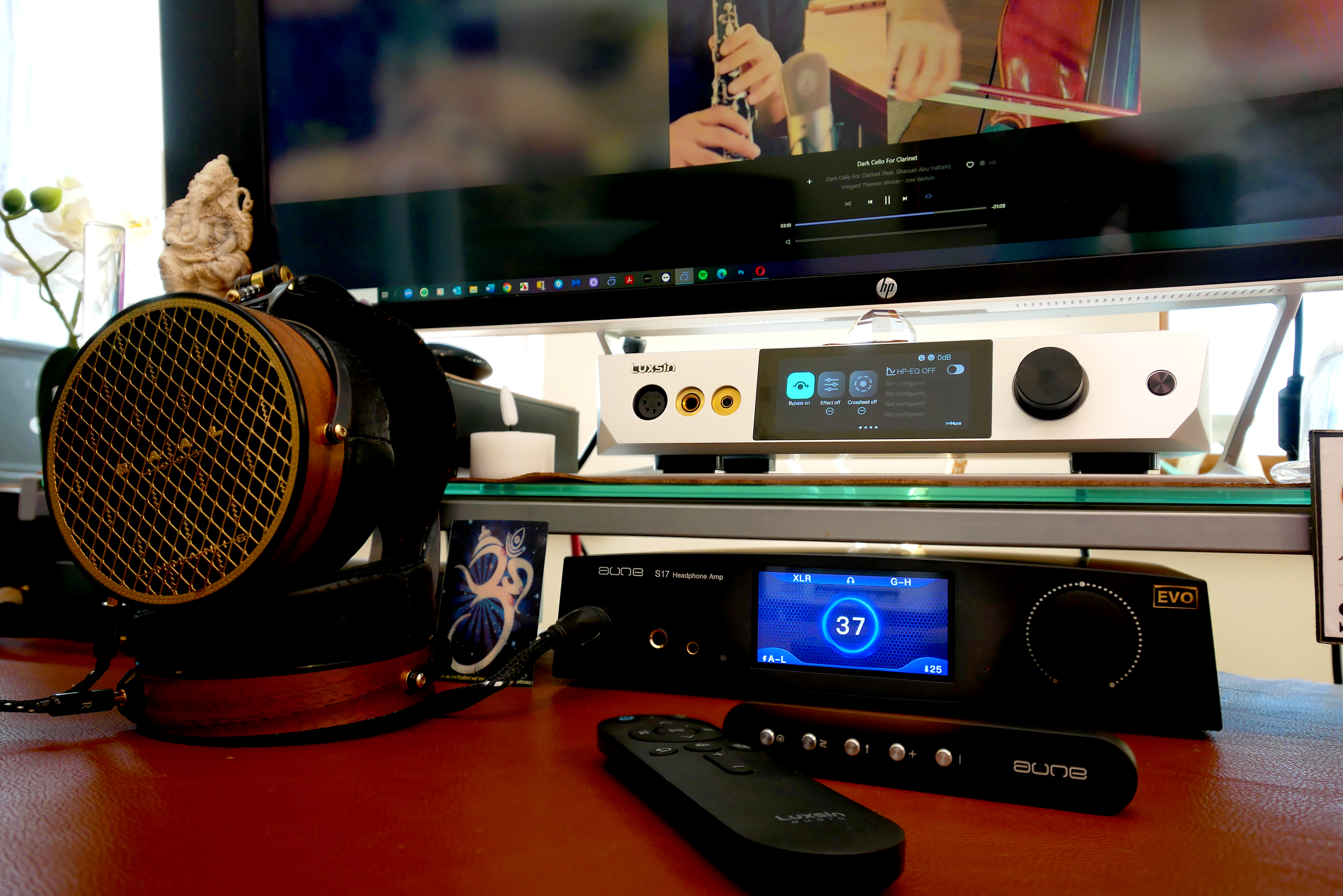
And did the world have a field day. Whilst the aune clearly sounded warmer, richer and juicier when compared to the Luxsin in purist hence drier bypass, the tables turned when I added my custom seasoning. Now the X9 pulled roughly even on that class A density and chunkiness but without its simultaneous textural softening. I could mimic the latter more closely with crossfeed set to 'relax' but for my tastes that offset the Luxsin's advantage. With my DSP of xfeed + stereo width I had my favoured balance between dry damped articulation that was set inside a heavier richer milieu. Cheating man's class A without the heat? Not far off indeed. It's sadly all too easy for such statements to devolve into ugly class warfare and mode-of-operation superiority claims. We best skip it after having taken the general hint. The next photo makes another point. Luxsin's angled display is ideally cut for the desktop where a flat version like aune's doesn't look up at us. On raw gain the Evo certainly had more reserves to become a safer bet for Susvara headbangers. With that HifiMan in the house, I next checked whether the X9 had enough for my more civilized needs.
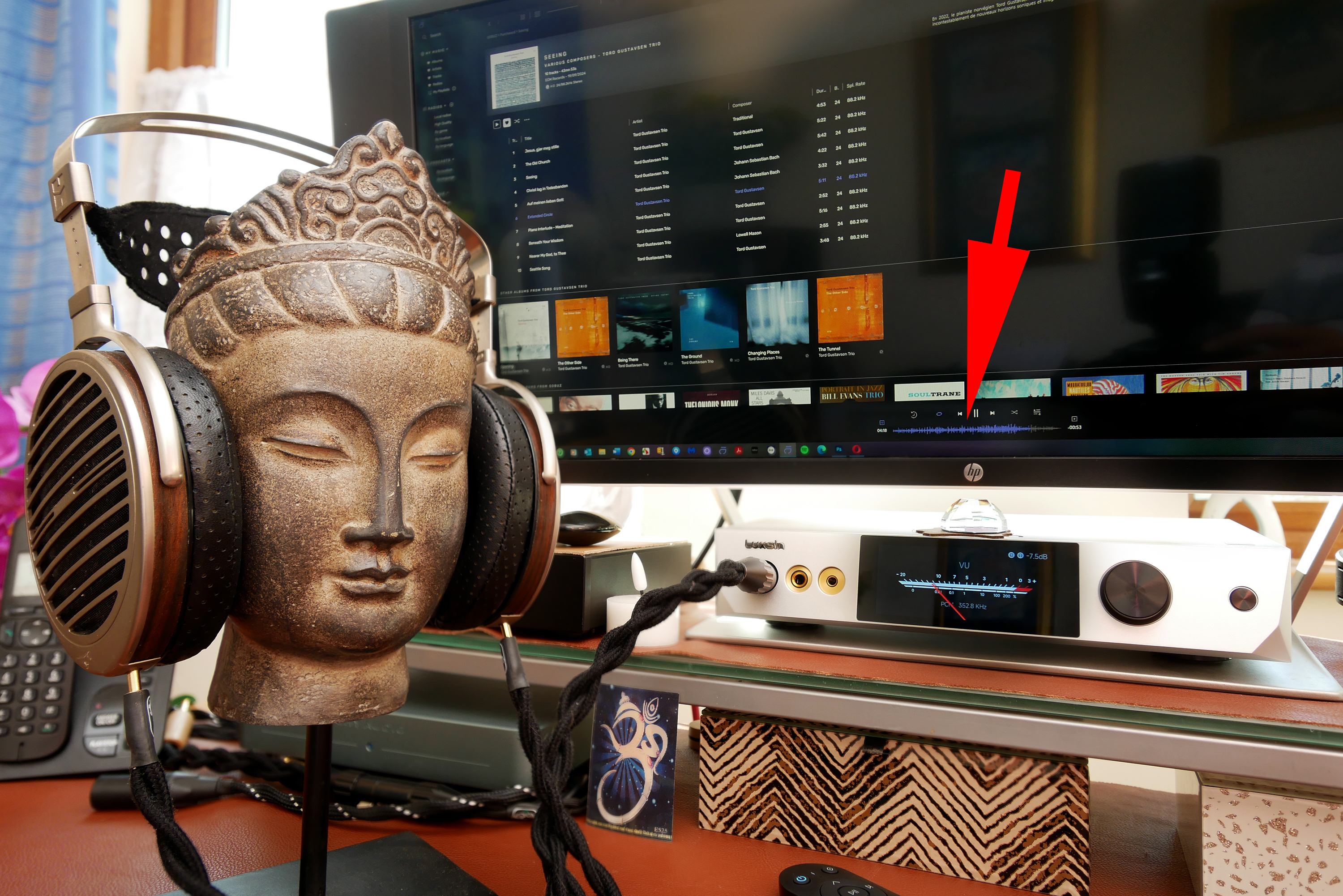
Use the mouse-over loupe or right-click to open at full size in a new tab to look at where my arrow points. It shows the recorded dynamic range of a track on the Tord Gustavsen Trio's Seeing album on ECM which deflected Luxsin's VU needle between -20 and -10dB. To get my desired playback loudness required -7.5dB on the X9's attenuator. That's within spitting distance of max. Once I switched to a YouTube blogger, I could retreat to -15dB for the same level. Gain sufficiency or shortness depends not just on the load but also recorded levels. Heavily compressed fare is louder, period. For my SPL needs the Luxsin was Susvara compliant regardless. Bangers could run out of steam. I've no way of knowing what some people do to their hearing.
With that caveat out of the way and likely the Tungsten load as well, I believe that most potential shoppers should view the X9 as a drive-everything deck if they can tap its XLR4. That too is a new democratization of this hobby. It used to be that extreme loads required deep pockets for monster amps. Today 4W/32Ω as generic Susvara aim is available from a growing number of decks which are rather more within reach. Happy days. On that note let's leave my deep-pocket cans behind and focus on loads more likely to be owned by an X9 candidate. Hello €799 Meze 109 Pro. Luxsin's 4.4mm socket called it 32Ω, again close to the published 40Ω. Now Susvara SPL on the Seeing tracks meant -31.5dB. Fat city?