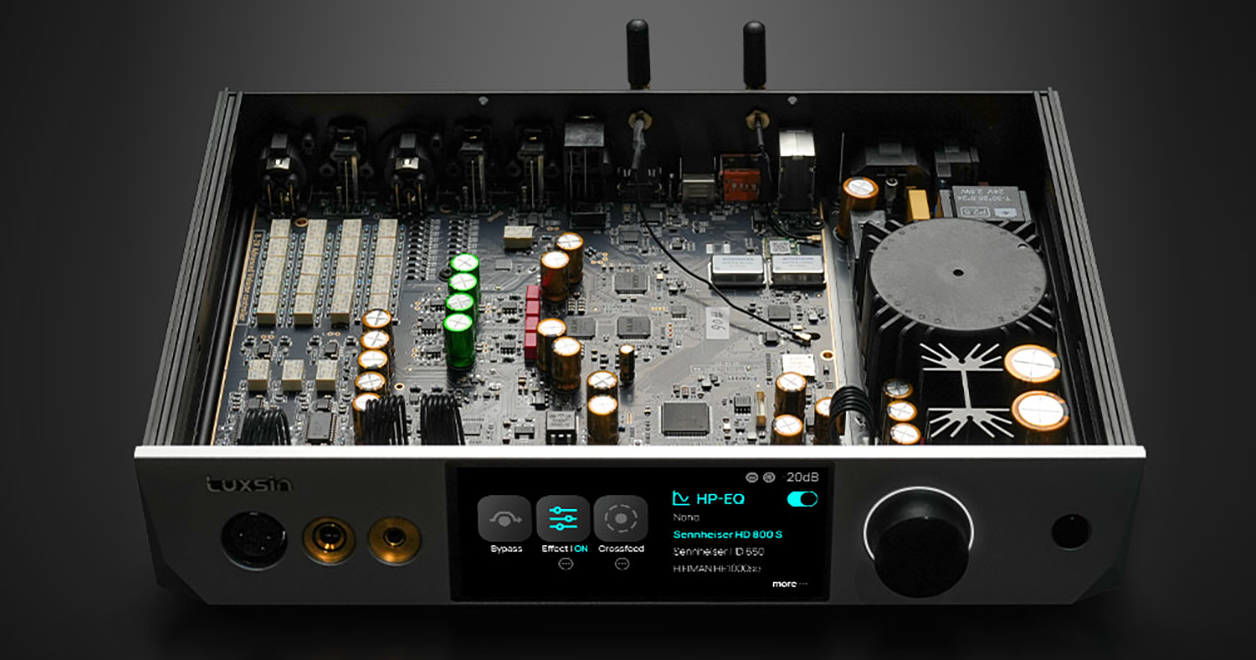
Let's first unpack Luxsin's tech resources, patents, service systems and robust R&D capabilities compliments of working under the Zidoo umbrella. Roon announced opra in early November 2024. That acronym is short for Open Profiles for Revealing Audio, "a community-driven repository of headphone EQ profiles". Luxsin already built in an equivalent feature from day one, no Roon license required. Add crossfeed with width/depth settings and advanced display options. It's obvious that unlike old brands with far fewer to no real in-house IT resources, Luxsin are fluent in the very latest information technology. But there's more distance to the old: celebrating EQ to change the sound to our liking. During audiophilia's reign of an idealistic absolute sound, that very notion was heresy. It led to the strict removal of tone even balance controls since any meddling with the recorded signal was seen to oppose high fidelity like extra-marital sex. Digital-domain room correction was a far later phenomenon and not one embraced by old-school purists to this day. With no room to contend with, altering a headphone's factory tuning with surgical EQ or cross-channel injection is an altogether different way of thinking about high fidelity. From fidelity to the recorded signal—enjoy but don't touch—it's moved to altering the sound to our preference. Call it fidelity to personal pleasure. High hedonism? Whatever it's called, it completely changes the game of a rigid absolute sound. It squarely refutes it. It might demand far younger engineering teams who don't struggle with outdated 20th-century notions but start afresh outside them. Freedom opens doors. To successfully pass them requires know-how that's up to date. It's how ambition, vision and ability meet. Voilà, the resources of the Zidoo Group in action. It's how this old-school reviewer reads these tea leaves from afar. I was thus curious whether my resident headphones would show up on the X9's HP-EQ list. Time to take a walk on the wild side and practice my sound? Here we remember that Harman curves aren't promoted as absolute sound either but what most people in their controlled auditions preferred; a golden mean of sorts.

Back on tech, the X9 runs an "automotive-grade" real-time OS which Wikipedia defines as processing time-sensitive data, here presumably to control distortion and latency when complex processing like on-the-fly amplitude correction and crossfeed run simultaneously. Writing effective operating-system code is an aspect of newer engineering which became necessary when hifi and high-power computing first intersected then overlaid. Modern network streamers are computers. Since Luxsin position themselves in desktop headfi where headphone listeners might use smartphone sources to expect the latest in constantly updated features, we appreciate the need for considerable IP to stay ahead of that curve. It's nothing that comes natural to pre-digital legacy brands; if it comes to them at all.
Perhaps it's why Sino brands Eversolo, FiiO, Luxsin and Shanling seem at the forefront of exciting product intros in this niche. Lower labour/production costs keep pricing in check. China's younger domestic hifi scene isn't stuck in the West's past. Plus, China is probably the most smartphone-intense country in the world, giving their engineers fresh out of university a better grip on the latest consumer trends whilst the general culture within which they work merely reinforces it. Enough now of reading tea leaves. Time to get hands on. With its 2/3rd not full-size dims, my tape measure promised that the X9 would neatly fit beneath/between the stand of my 34" HP computer display to bump off my resident €3'249 iFi Pro iDSD Signature. For headphones I had a spread from affordable to not so Meze 109 Pro, aune SR7000, Final D8000, HifiMan Susvara and Raal 1995 Immanis for open/sealed dynamics, planarmagnetics and true ribbons. Being a stationary listener, I'm very light on IEM. Given the X9's size and weight, I don't think that most users would run 100dB+ in-ears.












Some basic xfeed tech. Both ears of a speaker listener hear both channels. The left ear hears the right channel slightly delayed in time and reduced in loudness by our head's shadow; and vice versa. It's this time-shifted data which our ear/brain processes into the 3D illusion we call stereo. Virtually all headphones other than open baffles hard-isolate their channels. That gives rise to the soundstage locked inside the skull which detractors of headfi vehemently object to. For them it's too different. Hence already in the 70s Siegfried Linkwitz proposed counter-channel injection to simulate a more 'speaker-like' experience from listening with headphones. Fast forward to 2024. Italian engineer Cesare Mattoli of Audma exploits a digital delay line to create from 150μs – 640μs of user-adjustable delay for his crossfeed to reflect typical ear-to-ear distances of 14-18cm. His second adjustment is the amplitude of the injected counter-channel signal which regardless is cut by 3dB at 6kHz to compensate the head-related transfer function; and by 3dB/200Hz to avoid over-emphasizing the bass where recorded music tends to have equal content in both channels due to the omni-directional nature of low bass. Whilst the concept of crossfeed is half a century old, implementations vary broadly on how much counter-channel signal to inject across what exact bandwidth; and how much timbre and phase-shift effects that causes. But as it does for its library of EQ curves, the X9 makes xfeed purely optional. Purists can bypass it and feel holier than thou.
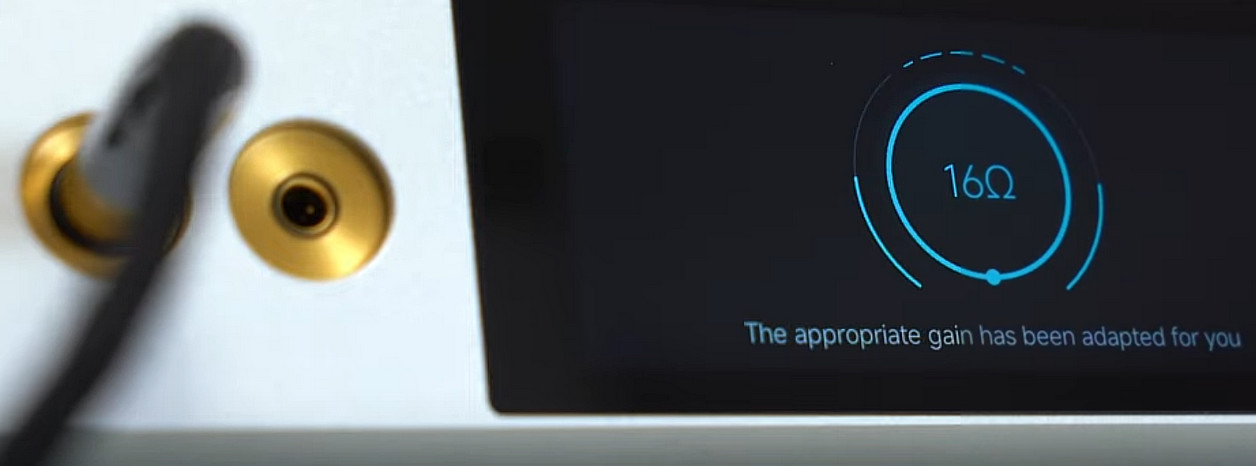 Screen capture from this video.
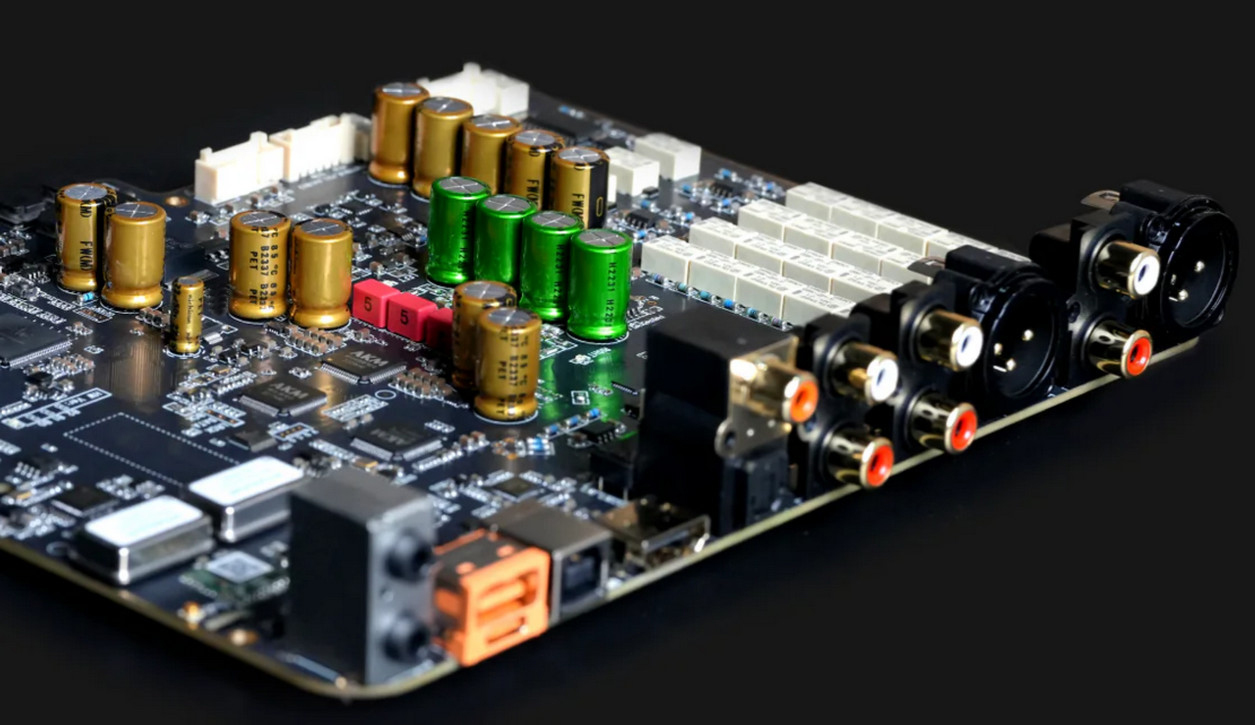
Holy-rollers might simply walk because Luxsin don't drive on the posh discrete train. Their D/A conversion is on-chip. So is their headphone gain and I/V stage. Anyone who insists that only discrete circuits are kosher will consume their musical calories elsewhere. It's the chipper types who'll stick around. None of my in-house discretniks—Enleum AMP-23R, aune S17Pro Evo, Kinki Studio THR-1—even include a DAC never mind xfeed, an EQ library, automatic Ω detection or a touch screen. My COS H1 does include a DAC but no extra processing. My FiiO R7 has a DAC and very basic EQ but activating the latter without any adjustments already colours the sound. On options, my residents' menus are frugal. That of Luxsin's X9 is like the bound bible of a Chinese eatery with its 100s of dishes. Yet it costs a fraction of the Enleum, still less than half of the COS. The Kinki prices equivalent but even lacks remote control, never mind all else. On specs, the X9 is an iridescently colourful bird of paradise whilst my rest, FiiO excepted, are a flock of wet grey sea gulls. The Luxsin is a different critter, period. It confirms my earlier claim of exciting products. Well before handling or hearing it, I thought the X9 exciting. It's precisely why I solicited this assignment.
How would it meet anticipations?