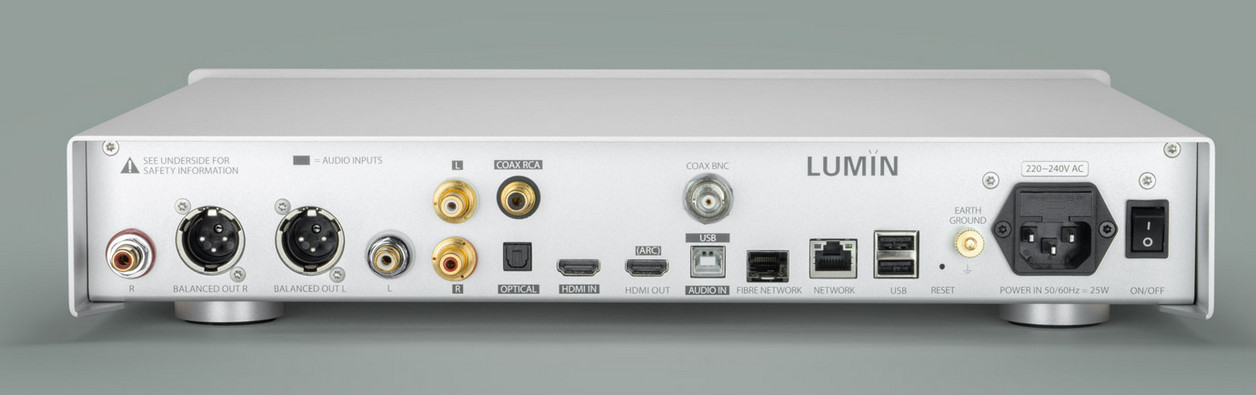
 While on the subject of video which I won't revisit later, I don't have a system suitable for thoroughly testing such capabilities but I did give it a try in our simple two-channel home theatre. I plugged a 4K Amazon firestick into our TV which then leashed to the Mini's HDMI ARC port whilst the latter's analogue outs fed power-direct inputs of a Pioneer integrated driving a pair of Zu speakers. All worked as advertised and we had sound in sync with video. I definitely preferred the sound quality of the Mini over that of the firestick plugged straight into the Pioneer. Considering the massive price difference between the two, anything less would have been quite disappointing. Returning to the back panel we find a single set of RCA analogue inputs followed by both balanced and unbalanced analogue outputs to provide quite a comprehensive feature set exceeded only by
  Eversolo's most ambitious DMP A10. While talking features, I can't forget one of the most distinctive characteristics of Lumin electronics. That is the embedded lossless Leedh digital attenuation algorithm. I won't attempt to explain the math behind it so point you to our colleague Joel Chevassus' explanations going back to the very first Leedh processing in a Lumin streamer. On my end I'll focus solely on the sonic impact as we now transition to the listening section of this review.
 The Mini offers so many combinations of functions that after spending a few weeks getting familiar across many recordings, I eventually had to select a short list of tracks I used consistently to assess all permutations I tried out. I will spare you a track-by-track recount of my listening journey to keep the length of this review manageable but here are the tracks I used for assessment. I biased this playlist towards extremely well-recorded music rather than my usually more eclectic fare. I was trying to identify subtle differences over multiple setups and that's a lot easier done with high-quality tracks. For the same reason all critical listening was exclusively over the Enleum AMP-23R as my most dynamic and transparent amplifier on hand. Mussorgsky's "Gnomus" from Pictures at an Exhibition under Fritz Reiner directing the Chicago Symphony orchestra throws a wide and deep soundstage with great dynamics and superb orchestral colours. It's a perfect example of a golden-era master tape painstakingly digitized and cleaned up for modern consumption. It's also very convenient for comparisons as it's available on Tidal and I own a DSD download as well as a CD.
 Saint-Saens' Danse Macabre with Kent Nagano directing the Orchestre Symphonique de Montréal is a great example of a modern symphonic recording with beautiful instrumental textures and a huge soundstage where instruments are clearly separated. Although there are plenty of great recordings to choose from when it comes to this piece, Nagano's is a beautifully crafted gem.
 The "Cinema Paradiso Love Theme" cover by Pat Metheny and Charlie Haden on their Beyond the Missouri Sky album is a must because all good playlists should include a close-mic'd guitar and this is an extremely high-quality recording that should give the impression of the musicians standing right in front of you.
"Ain't no sunshine" from Eva Cassidy's Nightbird is a classic you'll hear at every show but it's classic for a reason. This track is both intimate and emotional, with sound quality rarely achieved on live recordings. I own it on CD, vinyl reissue and it's on Tidal, allowing for broad comparisons.
Ray Lamontagne's "Born to Love" is another superbly recorded ballad where you should be able to easily locate the acoustic guitar, electric guitar, drums and supporting vocalists all across a wide and deep soundstage. If it doesn't pull at your heartstrings, nothing will. If you do Tidal, here is a playlist of other tracks I use a lot.









With the stage set, I'll start using the P1 Mini as a streamer and DAC which is likely how most people will use it. The unit I received was brand new and out of the box sounded bright and dynamically flat. So I fed it a very diverse diet of music on repeat for over a week before I spent any quality time. The Mini did change considerably after a few hundred hours and any prospective buyer should really invest the time to run it in for some weeks before passing judgement. In a nutshell then, the P1 Mini is absolutely delightful as a streaming DAC so extremely easy to love because it was expertly voiced to be an instant pleaser. The soundstage is wide and deep, imaging realistic and three-dimensional against a dark background, resolution excellent without ever sounding forced or artificial, bass deep and sonorous with just enough plumpness to help speakers sound more endowed than they truly are. Tone is slightly warm as is typical for Lumin but the midrange is a bit more open and pushed forward than strictly neutral. That's a good thing as it allows the listener to be drawn into the heart of the music and enjoy the wealth of details and textures the P1 Mini reveals. The Mini is not neutral like a Mola Mola Tambaqui, not as snappy as a Holo Cyan2 nor has it the ultimate timbral colours and textures of the LTA Aero but comes very close to all of them in a way that makes you simply want to listen to more music. It's non-fatiguing yet never seems to gloss over details. This is a very mature design meant to simplify the enjoyment of music. I usually associate this level of relaxation, tone and dynamics with R2R DACs, not a pair of ESS Sabre chips to prove once again that know-how and implementation always trump any given tech platform.
Switching to fibre-optic LAN yielded more refinement than expected over my regular Audioquest Ethernet cable. Since my LHY Audio SW6 switch includes an SFP optical port like the Mini, I purchased a pair of SFP LC modules and 10-meter optical cable as recommended by Lumin to check on any audible differences that may arise from electrically decoupling the Mini from the network. Those turned out to be subtle yet meaningful. Overall the already quiet background got even quieter, small textural detail became more audible and a very fine layer of upper-midrange glare I hadn't even noticed left. The effect was very similar to what you hear with a high-quality USB noise filter; or to invoke bird-watching as another hobby of mine, switching from very good Nikon binoculars to Svarovskis. The birds are still birds but their colours more vibrant, they look more 3D and it's a lot easier to differentiate the finest feathers. That's what switching to optical networking does. If you don't try it you won't miss it but once you try and listen in, the differences take the P1 Mini another rung up the refinement ladder. A LHY Audio FMC, a pair of LC modules and 10m cable will set you back about $600. If you already own a decent power cord and pair of interconnects, moving to optical is likely the most meaningful upgrade available for the P1 Mini.