
Country of Origin

Reviewer: Frederic Beudot
Digital Source: Aurender A10 streamer, Denafrips Pontus DAC, LHY SW6 Ethernet switch, Jay's Audio CDT2 Mk2, Holo Audio Cyan 2 [on loan], Mola Mola Tambaqui [in for review]
Analog Source: VPI Scout 1.1, Zu-DL103 MkII, Genesis Phono Gold
Amplifier: Triode Labs 2A3i, Enleum Amp 23R
Speakers: Ocellia Calliope .21 Twin Signature, Rogers LS 3/5a, Zu Essence
Cables: Zu Varial, Ocellia RCA cables, Zu Event mkII speaker cables, Absolute Fidelity custom XLR to RCA interconnects
Power Cords: Zu Mother, Ocellia power cables, Absolute Fidelity power cable
Powerline conditioning: Isotek Nova
Sundry accessories: Isolpads under electronics, GIK Audio room treatment
Room size: 18'x14'x10' (music room)
Review component retail: €5'000
"Hello Frederic, thanks for today's call. Attached are the information sheets we spoke of. After you've had time to digest, please let me know what looks best to you. The P1 Mini is a true 'new category' trailblazer whereas the U2 is an updated more conventional streamer/renderer. Both enable advanced isolated USB technology, X1 system femto clocking, advanced resolution processing and support Ethernet and optical-fibre networking. The P1 Mini is more versatile and our newest product. It's a full system streamer, preamplifier, audio/video hub, renderer and DAC with additional component inputs to utilize the dual-mono DACs beyond the streamer itself. The analog RCA inputs allow for a turntable to be plugged in whose signal then is digitized so the Leedh algorithm for lossless volume can be applied at the output stage. Let us know which model best suits your interests."
"Hello Mark, I really like what Lumin have created with the P1 Mini but thinking about my system, I don't have any video connected which would negate one of the key differentiators for the P1 Mini. But if you're comfortable with the fact that I can't get into its video aspects, I'm perfectly fine to do the P1 Mini instead of the U2. I do have a turntable."
And that's how my stateside contributor and Lumin's US distributor Mark Gurvey—who used to do Esoteric to have a penchant for top digital and recently signed Leema—arrived at today's gig. Just like regular shoppers, reviewers and the folks who supply us with loaners do their own due diligence to insure that room size, ancillaries, the writer's approach, expectations and experience all match a given assignment. Being WiFi allergic to refuse tablet remotes for example had disqualified me from reviewing Lumin products and their proprietary app. But recently the company completed Audirvana certification. That's now put me back into the hardwired Lumin picture with its brilliant Leedh volume code to decommission a classic preamp. Now one can access any Lumin deck through Audirvana whilst using a hardwired PC/Mac and its keyboard and mouse to access and navigate local and cloud-hosted libraries. The vast majority not bedevilled by radiation-induced headaches of course uses a smartphone or tablet to control their server or streamer. And that's also how Frederic evaluated the P1 Mini; with the Lumin App. – Ed.









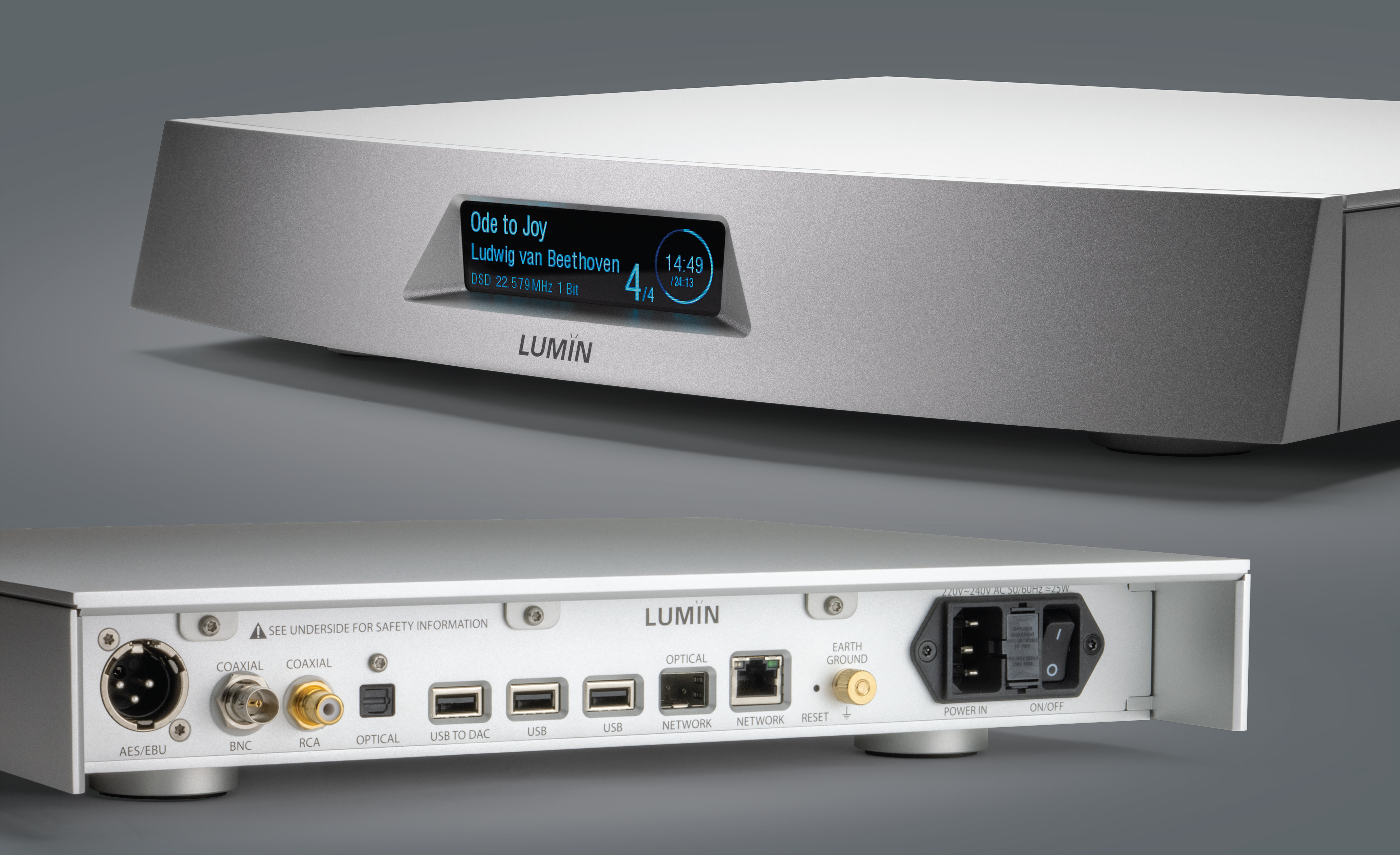
When almost three years ago Lumin introduced their P1 streamer cum DAC cum preamp with HDMI pass-thru, it garnered immediately praise despite its steep $10K tag. That's because it managed to pool the best of Lumin into a single stylish package that favourably compared to most three-box stacks one could conjure up for the same price. Today Lumin repeat the challenge with their P1 Mini but cut price in half to come in right at $5'000. It's still generous money to be sure but more achievable for many looking at the convenience of a one-box solution. Although each of the P1 Mini's functions is quite competitive on its own as we'll discover, the Mini is really meant to become the command centre of a streamlined system so plugged directly into either self-powered speakers or a power amp, thus significantly reducing box and cable counts. Most of Lumin's cost savings stem from switching from a complex milled enclosure to a smaller bent sheet-metal box; reducing the size and complexity of the power supply; eliminating balanced analogue inputs to simplify the input circuitry; and replacing Lumin's trademark balanced output stage with Lundahl transformers with an active module built with chips. Those are fairly substantial changes but Lumin's engineering talent shows in their ability to significantly reduce costs by introducing small omissions yet preserving the core of the big P1's functionality and ethos.

Despite the simplification and weight loss imposed on the Mini's case, it retains Lumin's understated elegance which I find simply beautiful. It's purely a matter of taste so your views may diverge but I'll take Lumin's simple fascia with dimmable screen big enough to display the relevant playback info and volume setting over the intrusive touchscreens one finds on the front of HiFi Rose's and Eversolo's latest. My streamer sits six feet away from me so a touch screen has no value but a sharp and simple dimmable display with a functional remote are on the top of my wish list. The good news is that Lumin did not cheap out on the remote and retained the gorgeous metal and plexiglass affair that usually comes with their far more expensive gear. Call me crazy for wasting words on a magic wand but when so many brands think a reprogrammed plastic Apple remote sufficient, I must acknowledge Lumin's effort which really stands out. Wrapping up the fascia are two knobs controlling volume and source as well as a standby button which doubles as visual confirmation that the Mini is on the network. The back is where we find the real action. Starting on the right we find the power mains, AC inlet and grounding post followed by two USB ports which can connect an external drive and provide USB out to an external DAC. That's actually a major enhancement over the P1 which only includes one USB A port, forcing us to choose either use. Further to the left is a fairly complete bank of digital inputs comprising network and optical fibre, USB B to tap the internal Lumin DAC, coax on BNC and RCA, Toslink and two HDMI, one of them ARC enabled for seamless integration into a video system. It's important to note that those are true HDMI ports, not I²S over HDMI so can't connect a CD player or DDC into the P1 Mini. The only other connectivity option omitted is AES/EBU. For that you'll need to upgrade to the full-size P1.