With requested mileage clocked, Charlie upgraded to FiiO's 12V/4A iFi/SilentPower supply whilst the R7 reverted to regular wall power off its stock internal SMPS. Charlie's RCA outputs wired into the Cen.Grand's analog inputs. By switching the DSDAC1.0 Deluxe between RCA/preamp mode to HDMI/DAC mode whilst adjusting the volume—2V vs 6V outputs—I had quick repeatable A/B involving zero rewiring. That pitted €1'450 + €299 against €5'990 to make for a Theseus vs Minotaur story whose discrepancy grows taller with each retelling. Here it simply entails no pub or rehash. This is the original 1st-person account at the contestants' actual sizes. As John Darko would say, no DAC got bludgeoned during the making of this review. No floor got wiped even if the one in my kitchen could have stood it. As is its nature, the Chinese DAC resampled all incoming PCM to DSD1'028 on the fly. The Norwegian treated it natively as PCM. If you've made enough such comparisons, from that alone you could expect a shift in gestalt as the reason why other brands like APL, Meitner, Nagra, Playback Design and PS Audio promote DSD and Mark Levinson processes PCM with his proprietary C-Wave algorithm. Most of these native non-PCM converters are on record for completely disregarding the incoming signal clock. As we learnt, so does Charlie; for standard S/PDIF over coax and Toslink. How any of it factored in this match is anyone's guess. My ears only knew the final result, not the math leading to it.
The final result was parity but not similitude. The money lenders in the audiophile temple had a bad day. Why borrow if you can cash out? Divergence had three facets: transients; space; density. For expediency's sake, I'll refer to the decks as PCM and DSD. DSD was softer on the leading edge so a bit sweeter. It had more connective tissue or fades between/around images. Like a slightly more reverberant acoustic, that created higher density. This particularly invested the lower mid/upper bass region with a bit more weightiness. Mounting this horse from the other side, PCM felt keener. When the musical match grew denser, it separated out better and became more specific. Less connective tissue and a terser transitional region then created more emphasis on clarity and quickness. Breaking this down applied attention zoom. Stepping back, the bigger perspective was parity. DSD didn't register as superior in any way. The overall balance didn't shift, only the relative weighting of these ingredients.





Being a curious cat of six lives and two itchy ears, I'd briefly checked status during break-in. Whilst I didn't track progress, a few snapshots versus later serious listening told me that virgin, Charlie sounded plainly more lightweight; like a small amp being dominated by a burlier chunkier specimen in my far bigger DAC. In the end that gap had really closed. Pre-conditioning wasn't imaginary. Because it happened inaudibly, it also wasn't a matter to which I simply got used. That said, I still had to determine how much difference USB vs 'discrete' power made. Going up against my priciest converter, I simply kicked off with iFi's power supply for a best-case scenario. For upstairs, the money lenders were already off chasing more promising prospects. Trying to sell punters on a perception upgrade would be far too much work. Whilst tastes differ, for most paying 3.5 times more for a shift in personality which without ongoing comparator quickly recedes from notice just has no legs. And yes, featurization too matters. There my big DAC squashed the small one. But back to the previous page and for raw performance, Charlie was collecting deceit receipts; big time.
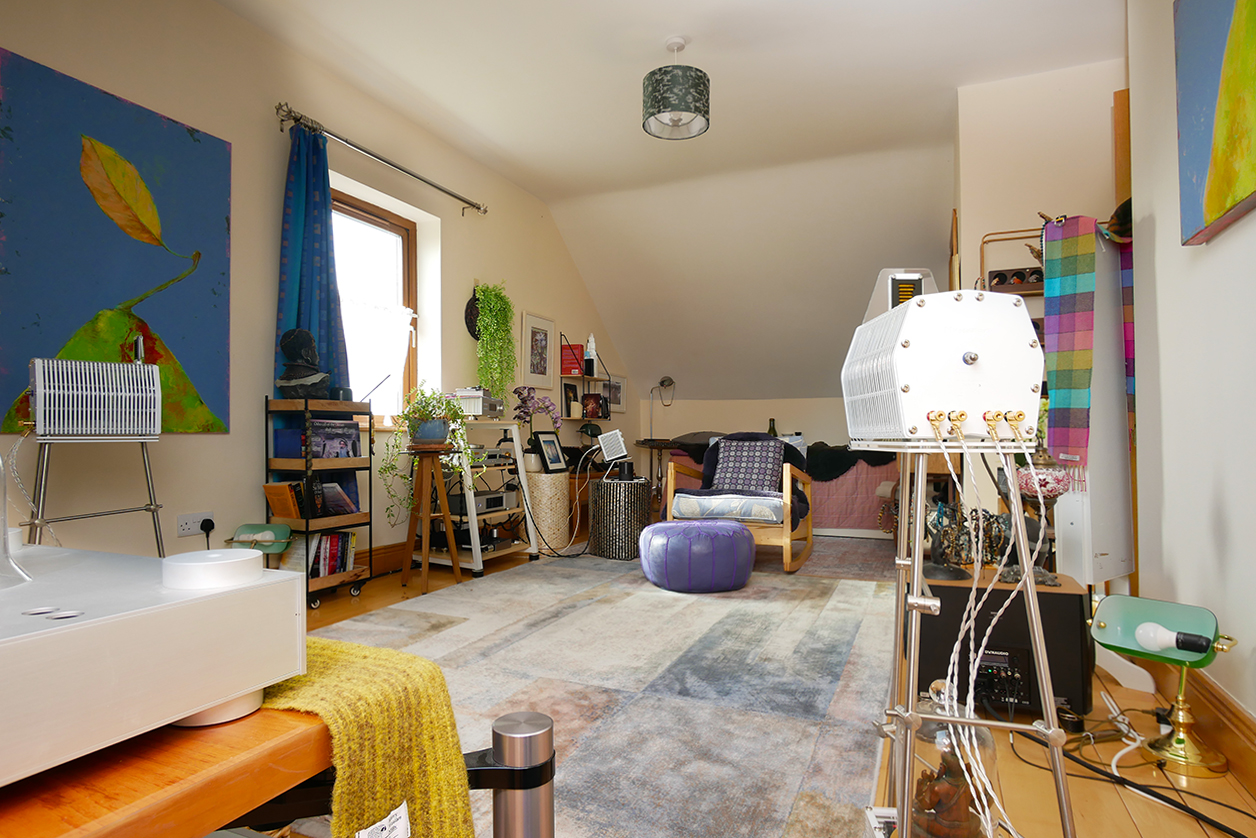
My next stop was the desktop. Being used to 12V/XLR converter outputs, 83dB speakers and amps in low 11.6dB gain, I obviously had to set the amps to 22dB standard gain when using an autoformer passive preamp fed a maximal 2 volts. For my usual SPL that left about 10dB of attenuation unused; plus 3dB of passive step-up gain should I need it for tracks recorded so low as to barely flicker. All my nearfield loudness needs were met. Time for Charlie to collect more receipts?