Country of Origin

Reviewer: Srajan Ebaen
Financial interests: click here
Main system: Sources: Retina 5K 27" iMac (i5, 256GB SSD, 40GB RAM, Sonoma 14), 4TB external SSD with Thunderbolt 3, Audirvana Studio, Qobuz Sublime, Singxer SU-6 USB bridge, LHY Audio SW-8 & SW-6 switch, Sonnet Pasithea, COS Engineering D1, Laiv Audio Harmony; Active filter: Lifesaver Audio Gradient Box 2; Power amplifiers: Kinki Studio EX-B7 monos & Gold Note monos on subwoofer; Headamp: Enleum AMP-23R; Phones: Raal 1995 Immanis; Loudspeakers: Qualio IQ [on loan] Cables: Exact Express Flame, Furutech; Power delivery: 2 x Kinki/Vinshine Tai Hang on amps and source stack, Furutech DPS-4.1 between wall and conditioners; Equipment rack: Artesanía Audio Exoteryc double-wide 3-tier with optional glass shelves, Exoteryc amp stands; Sundry accessories: Acoustic System resonators, AudioQuest FogLifters; Room: 6 x 8m with open door behind listening seat; Room treatment: 2 x PSI Audio AVAA C214 active bass traps
2nd system: Source: FiiO R7 into Soundaware D300Ref SD transport to Cen.Grand DSDAC 1.0 Deluxe with POW; Preamp/filter: Lifesaver Audio Gradient Box 2; Amplifier: Kinki Studio EX-M7; Loudspeakers: ModalAkustik MusikBoxx + Dynaudio S18 sub; Cable loom: Exact Express Earth; Power delivery: Vibex Granada/Alhambra, Akiko Audio Corelli Corundum & Castello Solo; Equipment rack: Hifistay Mythology Transform X-Frame [on extended loan]; Sundry accessories: Furutech cable lifts, Furutech NFC Clear Lines; Room: ~3.5 x 8m
2nd headfi system: DAC: Cen.Grand DSDAC 1.0 Deluxe with POW; Headamp: Cen.Grand Silver Fox; Headphones: Raal 1995 Magna, HifiMan Susvara
Desktop system: Source: HP Z2 work station Win11/64; USB bridge: Singxer SU-2; DAC/headamp: iFi iDSD Pro Signature; Amps: Topping B200; Speakers: Virtual Hifi Viper; Headphones: Final D-8000, aune SR7000
Upstairs headfi system: FiiO R7; Headphones: Meze 109 Pro, Fiio FT3
2-channel video system: Source: Oppo BDP-105; All-in-One: Gold Note IS-1000 Deluxe; Loudspeakers: Zu Soul VI; Subwoofer: Zu Submission; Power delivery: Furutech eTP-8, Room: ~6x4m
Review component retail: €1'450
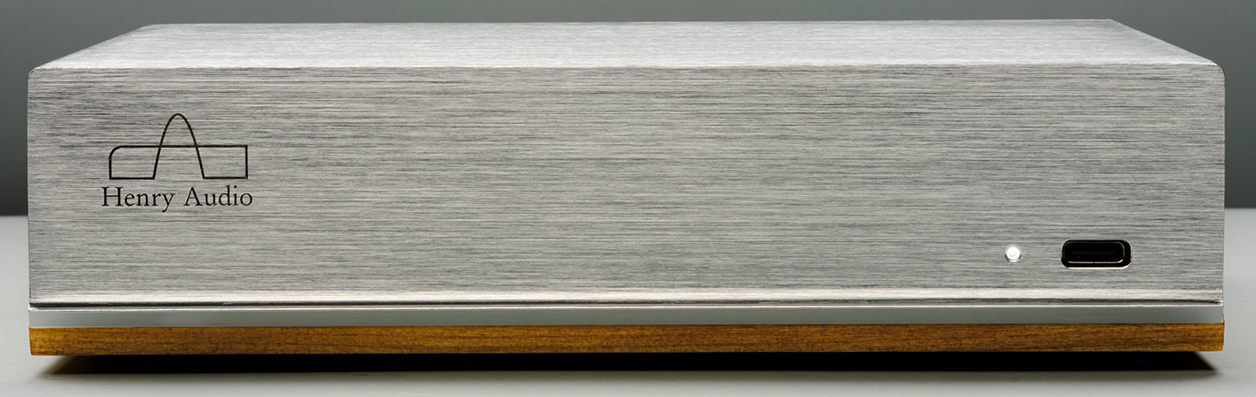
Good-times Charlie or Hooray Henry¹? 10 years ago Glen Wagenknecht reviewed the $250 Henry Audio USB DAC 128Mk2 in these pages. 'twas based on AKM4430 silicon and Golledge crystals – er, oscillators. Our man in Canada's Great White North concluded that "it may be Spartan but definitely delivers the sonics. For $250 it's not just a high price/performance ratio but borders on insane." Now our man in the other Great White North, Børge Strand-Bergesen of Norway, is back with a bigger badder bolder Henry dubbed DA 256 like a quad-DSD District Attorney. 128 x 2 for cutting twice as good a figure? On cutting a cheque we're nearly sextupling to €1'450. Let's hope for plenty of sonic sex whilst leaving the 'tupling' to our accountant. Of course in 2025's scene, the new ask doesn't even knock on HighEnd's door, much less is allowed to enter. But it is made in the land of the Autobahn, Mercs and Beemers, Porsches and Audis; by sh-Elektronik of Radeburg just outside hi-tech Dresden. And it's not a stick shift so auto-switches between USB, coax and twin Toslink depending on which input senses signal. Input selection displays via colour-shifting frontal LED so yellow for coax, cyan for Toslink 1, magenta for Toslink 2, red for USB-B rear, blue for USB-C front. To confirm sample rate, one must press the 'prog' rear switch then look at the frontal LED which now uses the same colours to indicate from 44.1kHz to 192kHz data lock. I doubt that this feature will get used a lot.
_________________________
¹ In UK slang it's roughly equivalent to 'toff' for an upper-middle class or upper class man who exudes loud-mouthed arrogance and an air of superiority, often flaunting his public school upbringing.
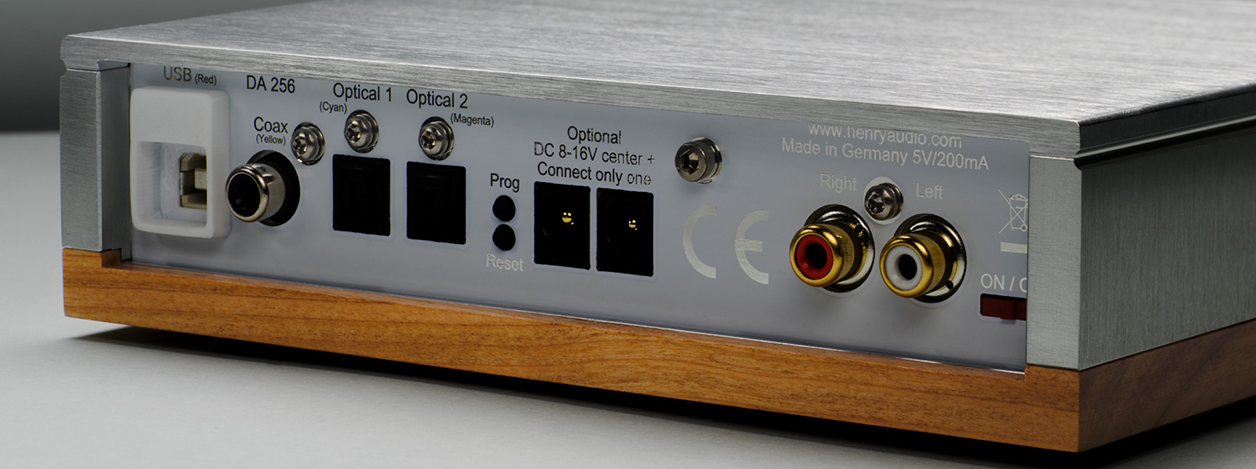 2.1mm or 2.5mm center pins for the optional PSU ports.
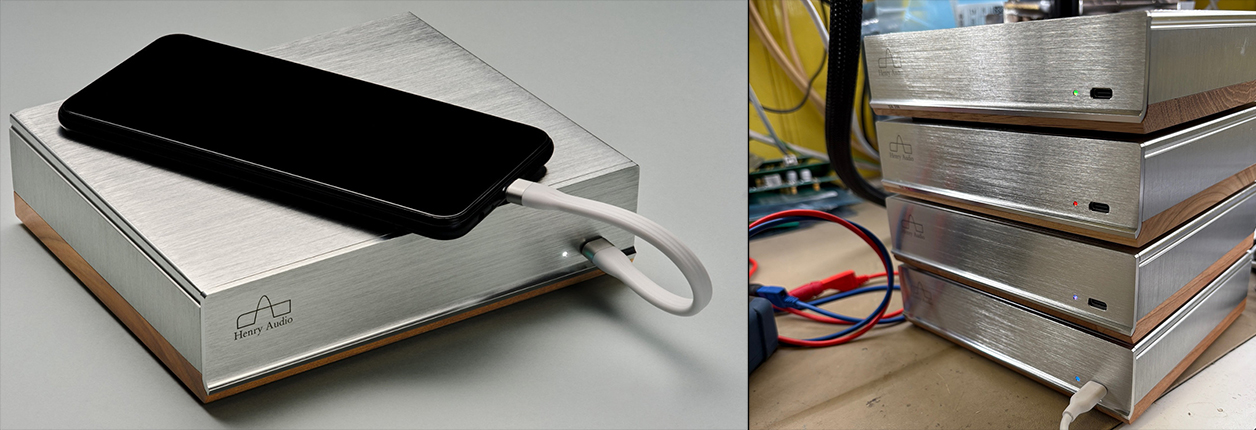
It outputs on just RCA and powers either off USB's 5V leg at just 200mA or an external 8-16V supply that we source if so inclined. The frontal USB input winks lustily at a smartphone. Our Henry is completely open source with a published schematic and source code. On the schematic's second page is a marker for "Boenicke Version control". Bored hifi gumshoes might see a path to Sven's AIO? That includes the world's first true down-pitching 432Hz mode by running a custom clock at marginally lower speed though standard 440Hz tuning is also available. Our Norse Henry is no berserker giant but a physically modest chap of just 17.3×13.4×4.7cm who weighs barely more than 1kg. But he's a keen fashionista in thick battleship aluminium on a solid-wood plinth conceptualized by Suzanne Arnesen of K8 Industridesign. Unlike Denmark, Norway's industry isn't exactly overrun with hifi brands but most of us will have heard of Doxa, Electrocompaniet, Hegel, Ø Audio, Seas, Skogrand Cables and Tandberg. Henry Audio too sits on that list. To learn more would mean Børge translating his schematic. Unlike musical notation, it's nothing I've ever learnt to read. And what's the background or rationale for his open-source approach? From an October 2024 press release, "with the DA 256 we are reaching out to users who love the convenience of digital but miss some of the warmth and realism of old-school analogue vinyl. We do this without losing that higher level of detail which allows you to hear what the performers and recording engineers intended².”
______________________
² This phrasing always reminds me of disgraced MQA claiming that they knew what the performers and recording engineers intended. Unless one is a time-travelling mind reader or was physically present to witness performers and engineers sign off – there's no way for anyone to know what someone else intended. As the Irish would say, it's seafóid (not to be confused with seafood or sangfroid)!








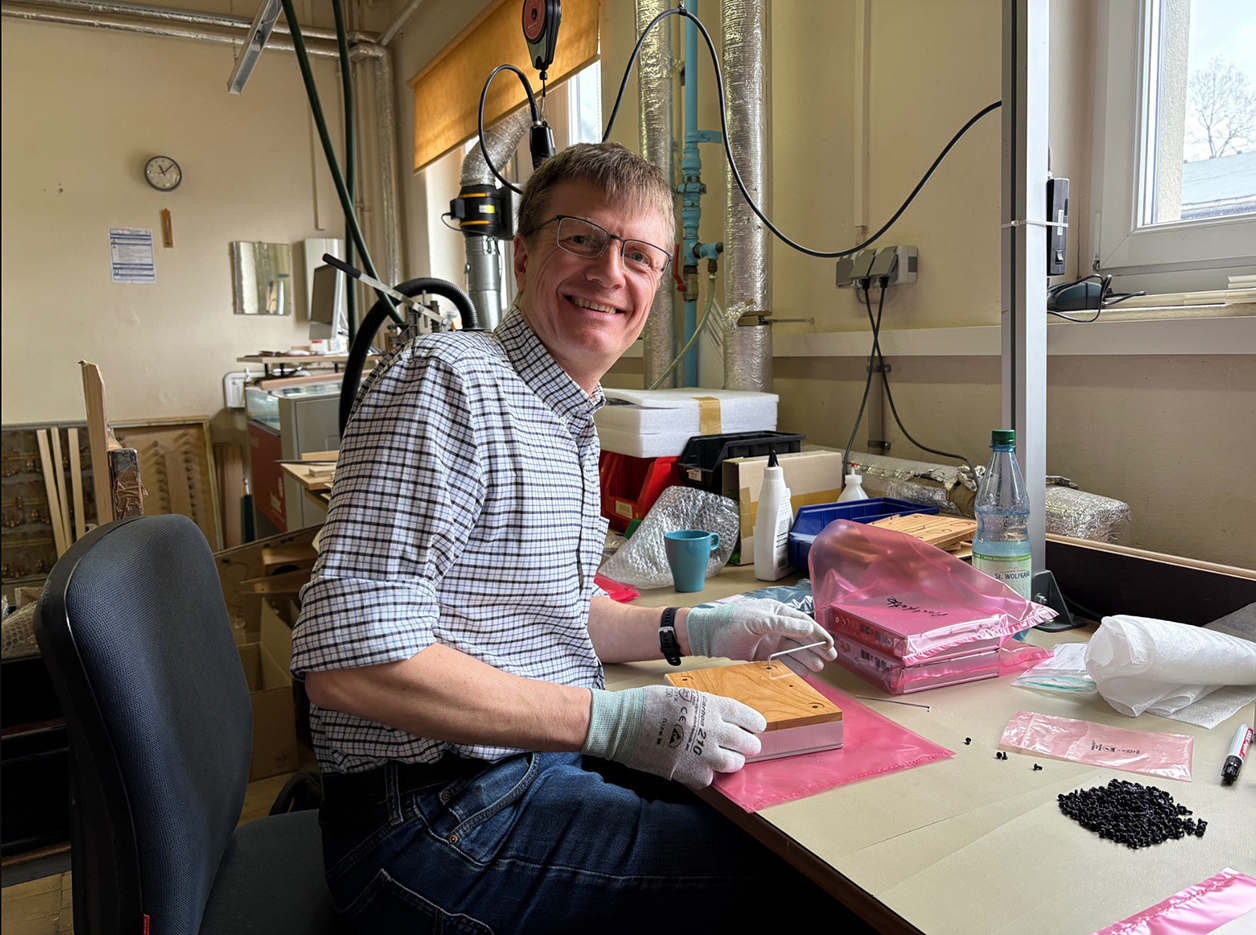 The wood cuttings and saw-dust exhaust in the background suggest that Børge makes the Cherry plinths in his own workshop.
When Ivette and I lived in Taos, New Mexico, if we wanted a local burrito with red and green chili sauce, we'd order "Christmas". With Henry the possible pin-prick colours go even further so perhaps Christmas and New Year's? When topped by a generic smartphone, we appreciate the deck's compact dims. We also appreciate its purist roots which pursue lowest possible noise with negligible power draw. It's an approach I previously encountered with the flying Dutchman, Cees Ruijtenberg of Metrum and Sonnet. To improve the performance of his converters, one spec he chased was lower power draw. The implication was that all else being equal, a smaller power supply is quieter than a big one. Again, this Henry gets by on 5V/0.2A; a DAC of modest appetites. No matter whether we power it over USB or standalone, our power supply will be external so not share the same enclosure. This also omits a noisy display, remote control, input selector knob and the twice-of-everything balanced thing if we want that done right. Minimalist without being hairshirt might nail this concept? Where I do call hairshirt is Børge's September 5th facts sheet³. It lacked an output voltage spec and all mention of conversion silicon—chip-based, FPGA, other—op-amp/discrete circuitry or whether the DAC can do native DSD64. Some potential buyers parting with 1.5G might want to know? Learning whether this deck puts out the industry-standard 2Vrms, twice that or half can be decisive. Foregone conclusion of the light show must be NOS mode since the colour scheme accounts for six different sample rates. If everything upsampled to 176.4/192kHz, two colours would do. From the photos I thought that the DA 256 perhaps suggested a Nordic kin to Japan's Sparkler Audio which continues the legacy of 47labs? Børge's FB pages mention interest in dealers and distributors to suggest that this DAC won't just trade factory direct but will eventually offer dealer demos in select locations.
__________________________
³ A Forbes promo on the DA 256 mentions 44.1/48kHz-family Golledge crystal oscillators, Texas Instruments 32/384-capable 5142P ΔΣ DAC, Atmel AVR32 MCU and "power regulation and decoupling tech originally developed for ultra-high-performance military instrumentation" based on ultra low-noise (9Vrms) Analog Devices ADP151 3.3V regulators. I recently talked with another designer who mentioned Norwegian regulator tech quieter even than batteries. Might it have been this?
On more of Henry's minimalism, forget all about flying higher than 192kHz. Chuck AES/EBU and I²S as this conveyance's 4th and 5th wheel. Ever heard of three-wheelers or motorcycles? They drive just fine. Cancel volume control to perform that elsewhere. And for Odin's sake, stop trying to impress others with the size, weight and b(il)ling of your sonic kit. When it comes to hi-rez trends, digital filter options and smartphone apps, this clearly isn't a Hooray Henry braggard but easy-going good-time Charlie. Børge will tell us about his chap's higher circuit education before I comment on how it all adds up in the listening seat. Having long since divorced active preamps in favour of variable DACs—iFi iDSD Pro Signature with 12V class A outputs through an analog pot; Sonnet Pasithea with 4V outputs tied to variable reference voltage of its R2R ladders; Cen.Grand DSDAC 1.0 Deluxe with 6V outputs preceded by Muses analog R2R ladder on a chip—I'd follow the DA 256 with a purist autoformer volume control from Manchester's Lifesaver Audio called icOn4. "The DAC's technology started as a DIY project. It outperformed the commercial USB audio solutions back in the day. I joined the project and incrementally improved it since. It's been many years ago that you needed any kind of DIY experience to use one. It's become a perfectly solid and boxed electronics product where the PCB never sees the light of day except with perhaps one in a thousand users. But that user will have a field day. We can schedule a talk where I can share far more information. Or I can send you both emotional copy written by a friend who was instrumental in developing it; and the history and background written in engineering lingo by yours truly." To avoid losses in translation, I requested the written materials. "Some decks currently store in Dresden. Those are not burnt in but do need burn-in! We have two options: 1) I order you one from Germany with DHL, no listening for the first week. 2/ I burn one in from the Norwegian stockpile then send it across customs borders to you." With digital not needing to make sound to run in, option N°1 it was. Being already in the EU, we'd skip VAT and import hassles. Easy does it. Charlie not Henry. Going forward, let's go with Charlie. It's juicier than DA 256.