
Country of Origin

Reviewer: Srajan Ebaen
Financial interests: click here
Main system: Sources: Retina 5K 27" iMac (i5, 256GB SSD, 40GB RAM, Sonoma 14), 4TB external SSD with Thunderbolt 3, Audirvana Studio, Qobuz Sublime, Singxer SU-6 USB bridge, LHY Audio SW-8 & SW-6 switch, Sonnet Pasithea, Laiv Audio Harmony; Active filter: Lifesaver Audio Gradient Box 2; Power amplifiers: Vinshine Audio x Kinki Studio Dazzle & Gold Note PA-10 Evo in mono on subwoofer; Headamp: Enleum AMP-23R; Phones: Raal 1995 Immanis; Loudspeakers: Qualio IQ [on loan] Cables: Exact Express Flame, Furutech; Power delivery: 2 x Kinki/Vinshine Tai Hang on amps and source stack, Furutech DPS-4.1 between wall and conditioners; Equipment rack: Artesanía Audio Exoteryc double-wide 3-tier with optional glass shelves, Exoteryc amp stands; Sundry accessories: Acoustic System resonators, AudioQuest FogLifters; Room: 6 x 8m with open door behind listening seat; Room treatment: 2 x PSI Audio AVAA C214 active bass traps
2nd system: Source: FiiO R7 into Soundaware D300Ref SD transport to Cen.Grand DSDAC 1.0 Deluxe with POW; Preamp: Hattor ARP-S; Active analog xover: Lifesaver Audio Gradient Box II; Amplifier: Kinki Studio EX-B7 monos; Loudspeakers: ModalAkustik MusibBoxx; Subwoofer: Zu Method; Cable loom: Exact Express Earth; Power delivery: Vibex Granada/Alhambra, Akiko Audio Corelli Corundum & Castello Solo; Equipment rack: Hifistay Mythology Transform X-Frame [on extended loan]; Sundry accessories: Furutech cable lifts, Furutech NFC Clear Lines; Room: ~3.5 x 8m
2nd headfi system: DAC: Cen.Grand DSDAC 1.0 Deluxe with POW; Headamp: Cen.Grand Silver Fox; Headphones: Raal 1995 Magna, HifiMan Susvara
Desktop system: Source: HP Z2 work station Win11/64; USB bridge: LHY UIP; DAC + Head/preamp: Audalytic DR70 + HP70 both on LHY LPS-80 Dual; Speaker amps: Topping B200 monos; Loudspeakers: Virtual Hifi Viper; Headphones: Final D-8000, aune SR7000, FiiO FT7
Upstairs headfi system: FiiO R7; Headphones: Meze 109 Pro, Fiio FT3
2nd upstairs speaker system: Source: FiiO R7; DAC/pre: COS D1; Amplifier: Kinki Studio EX-M7; Loudspeakers: Virtual Hifi Cobra [on loan]
2-channel video system: Source: Oppo BDP-105; All-in-One: Gold Note IS-1000 Deluxe; Loudspeakers: Zu Soul VI; Subwoofer: Dynaudio 18S; Power delivery: Furutech eTP-8, Room: ~6x4m
Review component retail: €4'500/6'900 in RCA/XLR versions
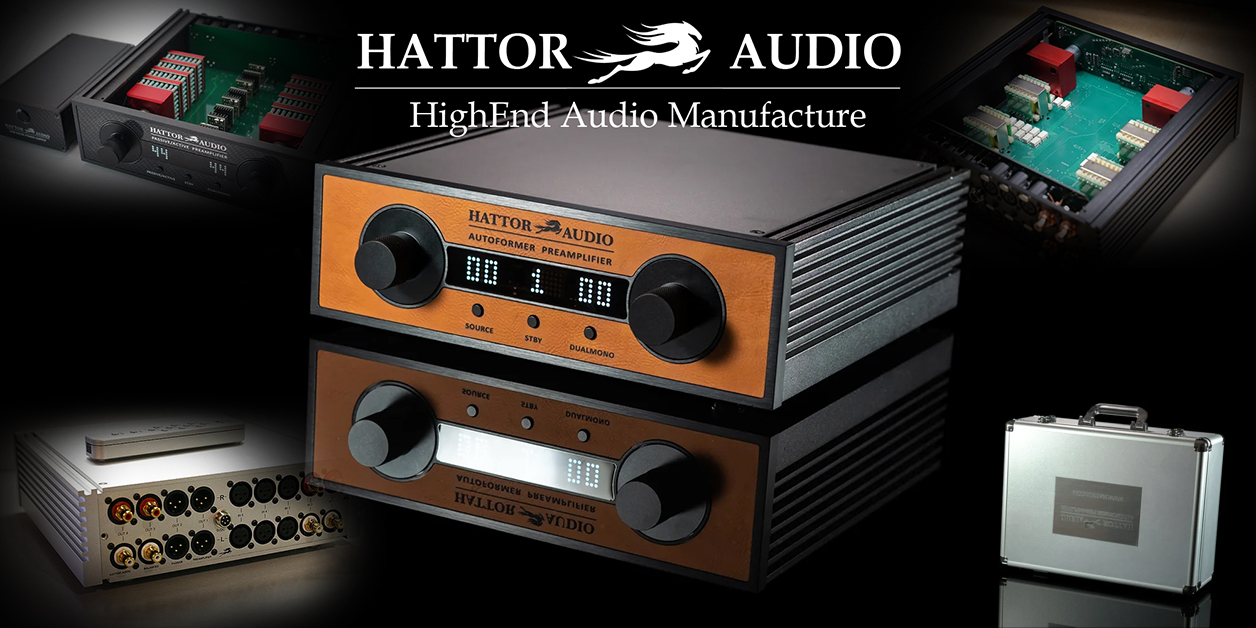 Hattor are well versed in classic resistive and magnetic attenuation. Upper left shows a balanced example of the former, a latter example on the right.
 Harp. It's a musical instrument dating back to antiquity. It's what Christian angels are said to play on their clouds. It's also the heraldic emblem of the Irish Leinster province's flag. Meanwhile 'to harp on' is idiomatic for incessant talking or complaining on a matter in most annoying fashion. We imagine that Xantippe, wife of Athens' famous Socrates, was a harpist extraordinaire. Today shall quietly harp on the virtues of uniquely active passivity then insert a space between 'H' and 'ARP'. Hello Hattor Audio's Autoformer Reference Preamp in its silver edition. It represents a niche within a niche within a niche. The first niche is the standalone preamp genre. In our age of variable hi-gain sources with digital even analog volume, it's become somewhat of a functional anachronism. Within that diminishing genre lives the outlier of the passive preamp. It's been classically executed by resistor relays or pots and possibly includes i/o buffers for fixed impedance. Living underground beneath that small tribe are the AVC/TVC exotica shorthand for autoformer/transformer volume controls. Their iron cores possibly augmented by cobalt or high-nickel permalloy explain their alternate moniker of passive-magnetic preamps. They work like a phono step-up in reverse. Rather than step up voltage, they reduce it. Discrete secondary windings with transformers or a multi-tapped primary for autoformers apply precisely stepped ratios to switch into the signal path. Et voilà, our incoming source signal in need of attenuation transforms into a lower voltage of higher current before hitting our fixed-gain downstream hardware. Best of breed offers 1dB-or-smaller step sizes and noiselessly switches between them whilst adding remote control without clunky stepper motors; then offers balance control to offset left/right-channel magnetics. Manual operation by 26-step ELNA switch would require no auxiliary voltage but then omit a remote, display with five dim levels and active input switching. If we want creature features, our otherwise passive volume controller needs a small power supply. It could be a low-rent wall wart or a premium linear sort. The latter kind gets us at today's candidate from ex-Warsaw designer Arek Kallas famous in DIY/OEM circles for his top-quality Khozmo attenuators. Under Hattor Audio he offers turnkey kit whilst having resettled his family to Spain for more fun in the sun.
The special appeal with magnetic volume controls is that they do not burn off signal voltage by resistors. An AVC transforms signal voltage into current. It doesn't throw away as heat electrical energy our source gear generated. Since current-to-voltage transformation progresses logarithmically, the more attenuation we invoke, the more current we create. This might explain why AVC/TVC don't incur the same kind of tonal bleaching which other approaches do when we throttle back SPL. Already with signal cables it's a common observation that copper and silver can sound markedly different. The slightly higher conductivity of silver probably has little or nothing to do with it. Siltech's chief engineer Edwin long ago conducted an experiment to challenge popular assumptions that the higher output impedance of tube output transformers causes poor bass control. Using his signature ultra-pure silver wiring, he duplicated the copper transformer to identical spec. Poor bass control eliminated. His explanation? Ferrous impurities in copper windings magnetize during use. His hyper-pure silver is free of them. Problem solved. This anecdotal segue could be relevant today when our version of the ARP replaces Arek's standard copper-wound 61-step attenuation iron with silver. Armchair engineers filled with book knowledge predict no possible sonic difference under identical specs by simply changing the windings' metallic composition. Of course identical specs are a given when the job at hand is precisely administered signal attenuation which relies on the exact same step-down ratios. Without a copper mate for comparison, I have to sidestep this discussion to consider the silver ARP purely on its own merit.








But not so regular Warsaw contributor Dawid Grzyb. He not only reviewed the copper version last year but then tackled this very silver sample. Me requesting it was directly due to his award-ending review. It lit my curiosity to ask Arek Kallas whether his travelling loaner might stop over in Ireland, realm of the Celtic harp and endless harping on the superiority of Guinness. For the silver/copper A/B we have Dawid's impressions below. Mine will be for pure silver like my (cough) aristocratic hair. For completeness sake, Arek also offers a 9dB tube-buffer section based on 6SN7 or ECC82 which the ARP's output can plug into; even the option to outfit his resistor passives with an active buffer stage executed with OPA2134 or discrete Staccato opamps. Add cosmetic trim choices plus RCA/XLR customization for our desired mix of i/o including HT bypass and personalization levels are plentiful. Yet ARP's signal path is very simple: an input relay; some windings around an 80% permalloy core; an output socket; and wiring to connect it all. True, that little is undeniably more than naught when a direct DAC⇒amp connection can avoid it altogether. But despite logic's appeal of less is more, sometimes less is less. How the antiquated concept of magnetic volume control can retain its contemporary appeal and relevance I reconfirmed last year when I reviewed the €60'000 Lumen TVC from Akustika Eterna and subsequently reinstated my resident AVC in the main system. Thankfully today's subject asks 8½ times less in balanced silver, 17 times less in balanced copper than the exorbitant Lumen. That makes it €6'990 or €3'500 in direct math. €4'500 nabs RCA-only silver by eliminating two autoformers. Either way, the case work measures 50x40x12cm WxDxH and weighs 6kg fully loaded. 56 attenuation steps are in 1dB increments, five in 5dB. Incidentally, McIntosh are famous for using multi-tapped output autoformers for impedance matching on even their transistor amplifiers.
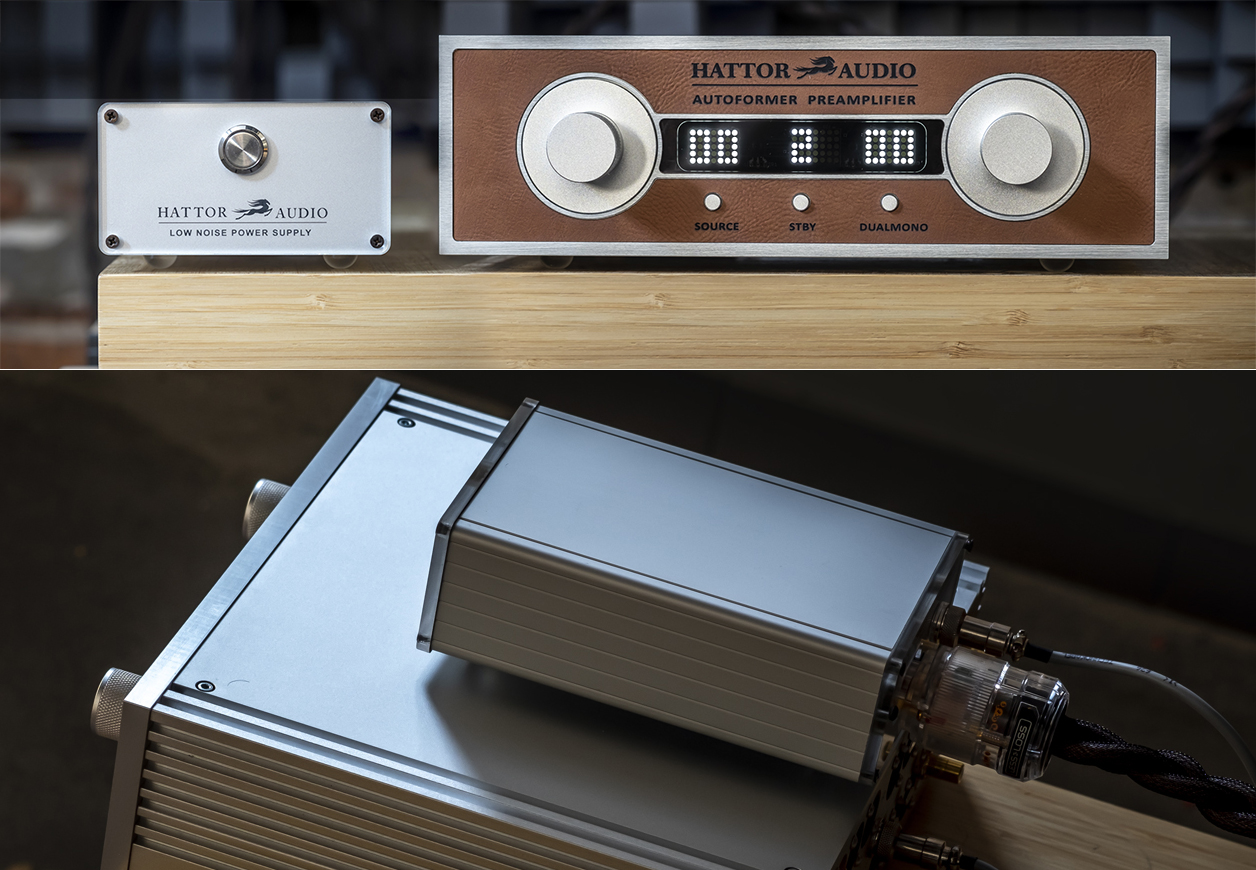
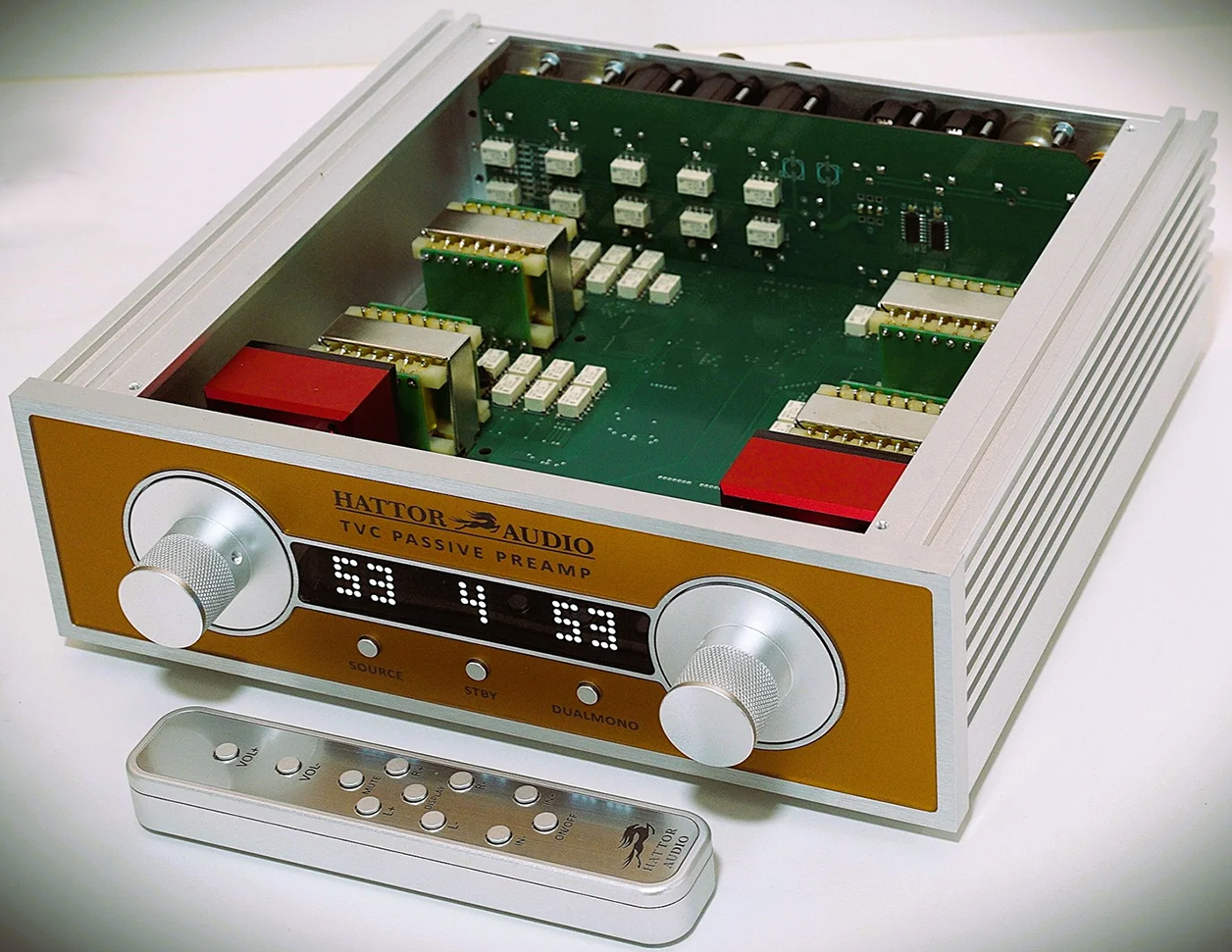 The 'dual mono' knob determines whether the l/r attenuators operate clutched or individually. The remote adds mute and display off. This is the copper version.
From Dawid. In my original ARP review, I wrote that "the Trilogy 915R makes my system spatially expansive, quick, impactful, tonally saturated, breathing and tangible. As such it beautifully complements the matching 995R monos and significantly boosts their performance. Without prior exposure to passive AVC, I'd have foreseen the 915R running circles around the ARP. I'd have expected the passive to sound drier, leaner and plainly inferior, with a prohibitively large price gap only reinforcing that bias. Four years later, experience shifted my views. I'm reminded that the Lifesaver Audio icOn 4Pro loaner AVC had been a monster of a visually inconspicuous financially sane box you could confidently put up against any classic heavyweight on the market no matter how large or dear and smile knowing it would hold its ground. The ARP proved to be another such nifty little devil with large pointy horns. At just 30/61 on the dial, it already delivered stout SPL. While it was spatially more specific, sunny, somewhat leaner and tonally a touch cooler than the 915R, it staged like mad, remained exceptionally smooth and stayed generous on colour. All fundamentals were firmly in place. Grain, fragility, nervousness and pallor never entered the picture." The more the original ARP clashed with the Trilogy 915R, the clearer it became that the latter could at best match but not surpass it. Despite opposite tunings, I ultimately judged them equals, a conclusion many €30K preamp buyers would struggle with but which reinforced my view that AVC performance can really transcend price. The 915R isn't inherently warm, dark or romantic though next to the ARP could seem so. This tiny box noticeably elevated my system's resolution, openness, directness, agility, radiance, bass control and reach followed by higher energy, intensity and presence. By contrast the 915R sounded more voluptuous, soft and relaxed, with meatier outlines and a slightly diffused somewhat withdrawn spatial presentation. Leaner, shinier and more elastic, the ARP favoured spring over autumn hues yet retained a wide colour gamut and convincing texture, never sounding artificial or leaving tonal gaps. If it were an amplifier, it'd clearly belong to the fast honest engagement-first school like FirstWatt's SIT4 and Enleum's AMP-23R.