Status quo. Just before the Hattor arrived, my main system had undergone a change. SPL Audio's Crossover Mk2 replaced my prior Lifesaver Audio Gradient Box II which now runs in the bigger of the two upstairs systems. By exploiting discrete proprietary opamps on elevated ±60V rails—chip-based even competing discrete opamps run on ±15V—this pure analogue active filter increased my dynamic range. This was a most unexpected but welcome side effect of what otherwise is simply lossless frequency division into a speaker high pass and subwoofer low pass. Now two Ncore 500-based Nord Acoustic monos with Rev. D input buffers drive the twin 15" woofers of the sound|kaos RiPol sub. Remote volume control attenuates the reference voltage on the DAC's split R2R ladders. The Hattor would insert between its XLR outputs and the Crossover's XLR inputs. Functionally it wasn't needed. But that was of no concern. My question was, would benign signal-conditioning effects factor? To circle that same wagon, the upstairs system runs Cen.Grand's DSDAC 1.0 Deluxe in variable mode into the Gradient Box II. Its 70Hz high pass meets Kinki Studio EX-B7 monos driving ModalAkustik MusikBoxx monitors. Its 70Hz low pass sees a Zu Audio 15-inch sealed Method subwoofer. My final listening station would be the desktop. Here the Hattor would swap in for Audalytic's HP70 head/preamp to bridge the matching DR70 DAC and Topping B200 monos driving Virtual Hifi Viper monitors. I had a best-laid plan; and a resident cat should mice appear.

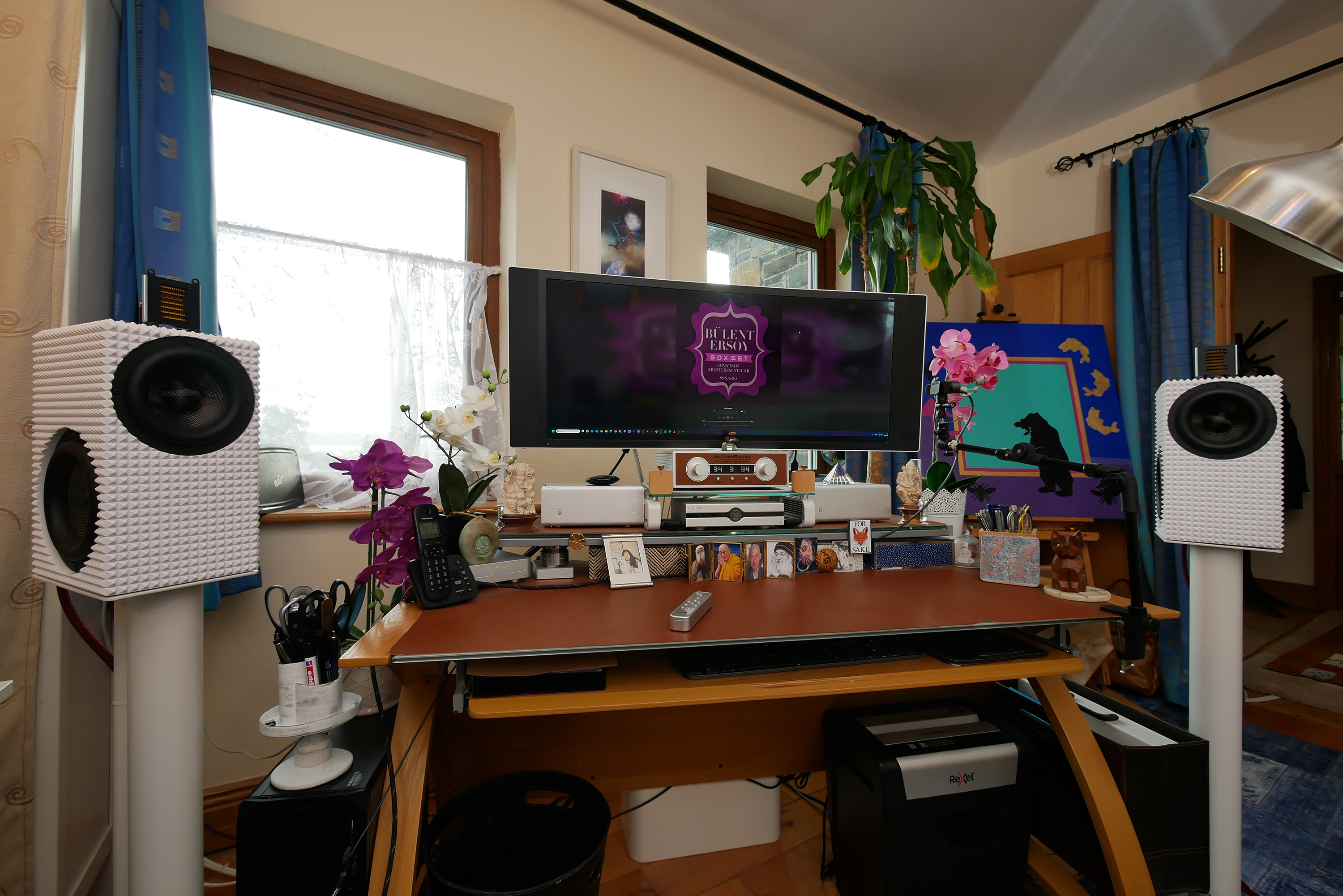
 As it happened, the mice came out to play because the cat was asleep beneath the covers. My main systems were otherwise engaged so my sequence had to change. The first passive visitation hit my desktop where the €399 DAC streamed native DSD256 by having Audirvana Studio use its r8brain algorithm to 'remaster' PCM on the fly. Arek's leather trim rather harmonized with my leather desk mat I thought. I really liked fading out the display's brightness to barely on. The photo op ran top lumen to register across the distance. Onto tunes. A personal guilty pleasure is Bülent Ersoy, Turkey's contrary trans diva of the Arabeseque whose vocal powers could shame a hard-working microphone. I'm told her style is long out of fashion. When I mentioned my appreciation of it to a very cultured Turkish hifi maker in Istanbul, he merely raised his eyebrows with a dismissive gone-to-seed type comment. I didn't argue with my host. I understood. Michael Jackson too looked and acted increasingly bizarre. Despite mediocre recording quality—pretty much true across the board for Bülent Ersoy—give these two tracks a try. Find out where on the Ottoman metric you fall. Of this 8-disc set, I've ear-marked only a few tracks; but when in the right mood, those really do me. What a voice. What commensurate control. What soaring intensity. Whilst undeniably theatrical, it's what I queue and cue up for. If somehow that highly concentrated carefully shaped energy remains bottled up and doesn't emerge like a wish-granting desert djinn from the playback hardware, it's all for naught.










I'm pleased to note that as Dawid observed and my prior AVC exposure anticipated, this silvery autoformer preamp uncorked an energy drink. Cheers. It's ultra transparent but unlike an invisible ghost or perfectly clean glass, a quickening of energy transmission gives away its presence. With my low-gain Topping amps and inefficient 83dB speakers, I still sat at -25dB. This already harvested the concept's Ω transformation and associated current flow. One can seem passive—unobtrusive, non-interfering—then turn 'barely there' on its head by endowing presence with grander gravitas. It's hard to describe using accepted lingo. I heard it as more musical tension, higher energetic rapport, deeper insistence, freer artistic willfulness. Already in this nearfield system, the ARP Silver did something though weighing it on the usual audiophile scales could be as elusive as figuring out why I'm so strangely attracted to this type music. Also as reported by Dawid, I noticed a firmer more emphatic foundation when the right material contained such data. Improvements in bass diction and intelligibility are probably the last things anyone associates with passive preamps. But really, a quality AVC is no ordinary passive. Different rules apply. Key amongst them is the presumption of compromised drive and all that branches out from it. Uproot that altogether. It's a weed which won't grow here. It's really the usual connotations we associate with drive which apply. Strange but true!