First a few words from Cees Ruijtenberg, designer of my 'before' Acelec Model 1 speaker. The fullness of his comments lives here. "… writing this email was triggered by your upcoming review on the new DMAX loudspeaker. It's a matter of coincidence that in recent months I was actively working on developing a coherent two-way speaker myself… With coherent I mean specific properties we saw in the past with certain conventional speakers like Thiel and Vandersteen and digital variants like Kii and others which use DSP. It's of course all about their time-domain behaviour often accompanied by a mechanical tweeter offset so that housing reflections have negative effects. In addition there's the need to apply 1st-order filters. Another problem is human sensitivity in the middle frequencies where the transition from mid/woofer to tweeter is quite audible. That undermines the recorded spatiality. My experience is that despite DSP's ability to correct time-domain errors, it doesn't completely unfold recorded spatiality during playback. So I understand enthusiasts who choose so-called widebanders for their imaging and coherence. Alas, I'm somewhat less satisfied when it comes to large widebanders because of their colourations while the problem of smaller types is their limited linear excursion. I therefore went looking for a fairly small mid/woofer having larger linear excursion coupled to good bandwidth without negative breakup effects. I wanted a driver with useful bandwidth towards 10kHz augmented by a small tweeter that reaches at least 30kHz whilst coming in at a high ~6-8kHz…" These graphs show the measured behaviour of this Cees monitor.

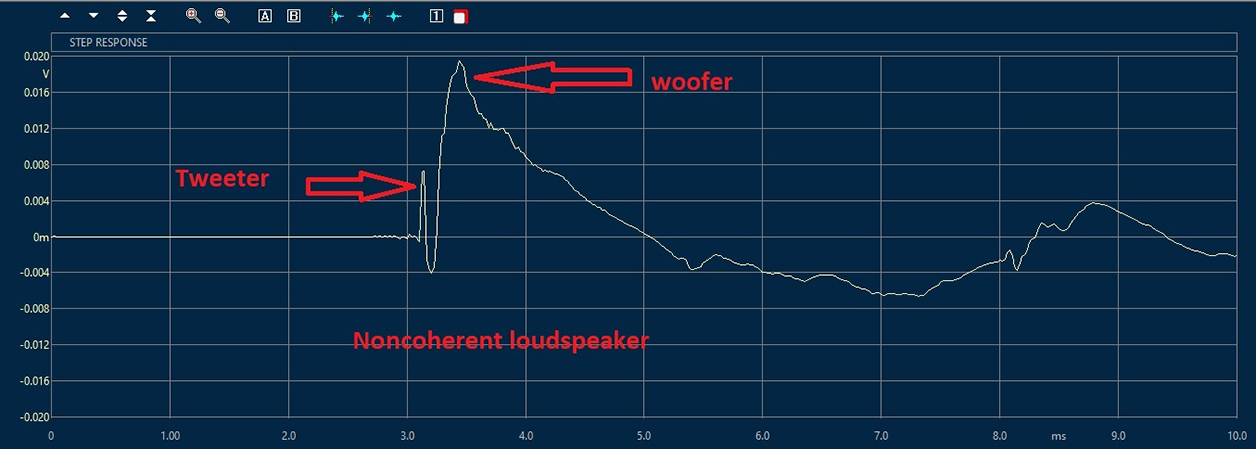
"Incidentally, not all models with filterless mid/woofers are time-coherent which can be seen in the below step response where tweeter and woofer rise separately clearly delayed in time."









As we unpack the key quality of Andrew's latest design, keep these comments in mind. Having received the standard €1'990/pr version with single analogue XLR, each PH61 connected to a balanced output of my iFi Pro iDSD Signature DAC. Et voilà, volume control in the analog domain. On my tweaked desktop, that DAC is preceded by a Singxer SU-2 USB bridge which outputs AES/EBU to the DAC; and a LHY masterclock which syncs both the Singxer and Fi. Minimalists could chuck both and go USB direct from PC to DAC to DMAX speakers. Being a mid-level audiophile extremist chasing percentage points, I hear clear benefits with an extra galvanic moat between Win10/64 computer with Audirvana Studio and my DAC. If you don't believe in digital-domain tweaks or don't listen as attentively – erase in your mind's eye everything on my desktop but the central iFi DAC. Hello minimalist hifi footprint of one USB DAC plus a pair of off-desk so stand-mounted active monitors. Simple does it. This starts with absolutely no hum so zero noise. Sadly that's far from a given with active speakers. Yet just sitting there powered on, these DMAX play dead. With the small power LED on the rear, there's no audible or visual sign that the PH61 is 'on' until we hit 'play'. Bravo. After all, anything but the signal is distortion. That includes self noise. Andrew clearly paid attention to core basics which many no-feedback SET fans brush over by cheerfully accepting tube hum and power-supply surf. With these active monitors, we don't have to. With any true not pretend hi-rez machine, we really shouldn't in the first place. It's antithetical to the whole pursuit of hearing deeper into the recorded substance.
To explain my before/after shift, remember this hifi truism. Whenever we raise our playback SPL, our sonic imagery gets bigger. With it, density and chewiness increase. Sooner or later we could hit the proverbial gummed-up wall-of-sound effect. With the DMAX, that panorama refused to ever get crowded, period. With no frequency-domain brightening, I had a sense of more 'white'. Multi-paralleled events didn't bleed together. The audiophile-approved term is separation. In this context it'd be the wrong word should it connote wholeness splitting out into parts. Au contraire. The superior timing of Andrew's apparently classic but really most unconventional 2-way avoided common if subtle brain confusion whilst sorting out high-density constantly changing data. It's as though within a seamless soundstage of many layers rolling out depth like a red celebrity carpet, individual images now had more breathing room. Greater standalone individuality coexisted with togetherness of one shared acoustic space. The upshot was greater clarity and intelligibility so ease. Now replace ease with obviousness. Whenever anything is obvious, there's no strain, doubt or debate about it. It simply is. More of this is-ness was the core business of our Slovakian oakies. They did the 'black' of chewy density and 'white' of teased-out clarity; at once. Whilst that might read like a generic description of any hifi system, compared to my far costlier passive Acelec in their rubber-bonded aluminium housings with premium ScanSpeak and Mundorf drivers, the potency of these qualities coexisting without diminishing each other was higher. But here's the kicker. Most if not all of that happened inside my brain. Sound never exists per se. Our brain registers it then creates our very own intensely personal perception. Even so, many people discuss sound as a separate quantifiable entity 'out there'. It's listeners who account for and observe their own state—emotional, mental, physical plus training and experience—and how those aspects modulate their listening experiences who more readily notice when hifi systems get easier on the brain. If one isn't yet so sensitized, this entire paragraph reads like esoteric poppycock. What measurement guru has yet quantified easier on the brain? If it can't be measured, it doesn't exist. To be sure, a speaker's impulse response is easily measured. There's simply widespread dissent over what it means. I'll now offer what I think it means. As always, you're invited to disagree, even vehemently if so inclined.