
Overtones and speaking with one voice. The 2nd-16th harmonic occur over the span of four octaves above a fundamental. Unless we talk low bass, most tones in a two-way speaker split between mid/woofer for the fundamental and tweeter for the higher overtones. Any time delay between our two drivers splatters what should be one singular tonal rise that has all harmonics line up coincidentally. The more complex our music, the more different tones occur simultaneously so the more profound the temporal splatter. Once we 'upgrade' from a 2-way to a 3- or 4-way, more drivers share in many a tone's overtone stack. What should be one clean leading edge instead looks confused like Cees' noncoherent graph. We get multiple rises sometimes in opposite directions clustered closely together. What should be one sound becomes multiple sounds. If that's all we know, our brain has long since adjusted. Without us noticing, it simply performs constant biological signal processing in the background. We don't know better so don't notice that our transients don't line up. It's only when we suddenly meet a time-coherent speaker like the PH61 that the time-confused gig is suddenly up. Being so tied to transient fidelity, its quality is at first most easily heard on percussive so staccato sounds. That's because even without ever playing back music, we know percussive sounds from daily life. Be it a fallen key, slammed car door, anything shattering like a dropped glass, clattering cutlery, a banging toilet seat… we know the startle factor of sonic attacks unmolested by playback's nonlinear time delays. When playback equivalents like drum hits, rim shots, crash cymbal strikes, triangle flares, picked strings and such suddenly mimic real-life noises for immediacy and speed, our brain recognizes that sameness and accepts it as more authentic. As more and more such sounds happen simultaneously, cleaner more on-time attacks separate better. Our brain has an easier time registering them and their precise locations. Complexity gets more intelligible, our bio interpolation works less. We experience higher resolution as less distortion in time and greater ease. Hello superior soundstaging, too. Without actual experience and the contrast it creates, users of conventional time-confused speakers simply have no means of appreciating the difference. Sorry, pretty theory or wishful thinking won't make it so. Widebander fans already have their own unfiltered time-correct experience, just not with the PH61's bandwidth and linearity from so compact a cab; and certainly not for this coin. Now we get to the Slovakian's next attraction and its advance over the SuperCube.
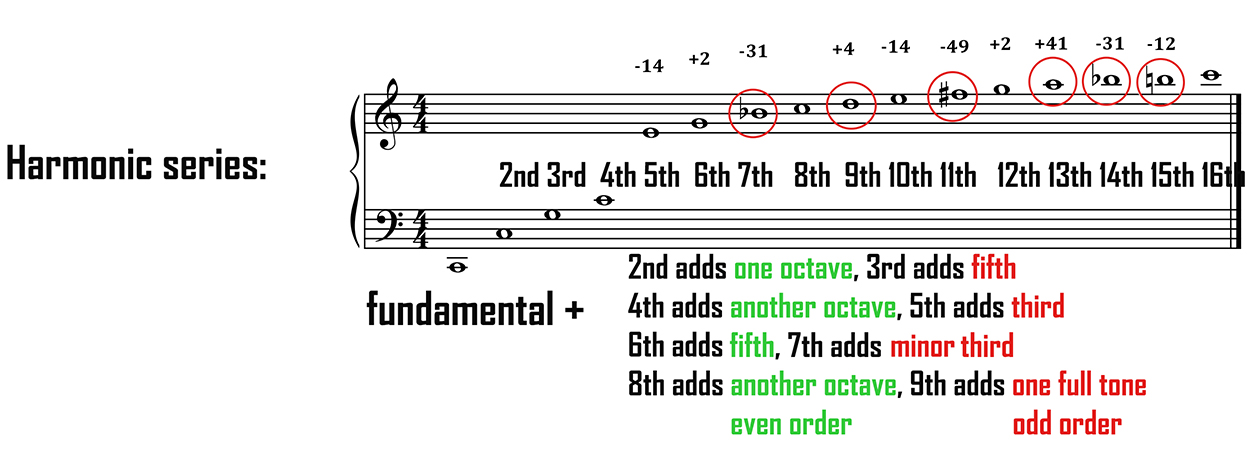
This harmonic series also shows why the odd-order harmonics get dissonant far sooner than the high even-order product during playback-incurred THD.
'B' for boffo, bandwidth and bass. A superior larger mid/woofer plus tweeter give the PH61 obviously more extension on either end than the single-driver Cube. This is particularly noteworthy on a piano's lower left-hand reach, big drums and synths on depth-mining electronica. Turn up the wick just slightly past background fill and be astonished by how meaty and solid a piano will materialize in front of you. It's clearly no plastic synthesizer emulating a concert grand. The sealed nature and dimensions of the PH61 make such density and reach impossible in classic passive execution. Andrew clearly exploits the Purifi driver's innate reserves with DSP amplitude compensation to downshift what the limited cubic volume would otherwise enforce as roll-off. This even involves the power region for his tasty bit, albeit without exacting the usual payment in 'warmth' which to my ears is typically imprecision and fuzziness. Here we get extra density without its standard shadow of warmth. That's a really neat trick like gaining a few pounds of sheer muscle mass, no fat in sight. To be sure, my comments derive from the desktop as the designer intended. Nearfield, baby! Here the PH61 is a mastering engineer's hear-all precision tool with a subtle but very effective bass tuning that counteracts high resolution's potential whitishness—think data overload from absence of usual temporal blur—with just the right injection of black for density and substance.











From my dusty bag of cheap old tricks I now pull a personal favourite: the transfer of headfi qualities onto a speaker system. Today most people's first exposure to playback is via earbuds or on-ear headphones. Typically this means no crossover. All the sound comes off one cone, dome or thin film. If we expose newer generations of listeners to time-coherent sound during what for audiophilia are their formative years, why should they subsequently embrace time-confused speaker sound? Just because it goes louder and bigger? If this strikes you as a raw deal, a speaker like the DMAX PH61 becomes a logical next step. It projects the headfi gestalt out of the skull into free space in front of us. It's the resolution, transparency and speed headphone fans already know and love simply turned inside out to scale up 3D soundstaging which headfi can't do. My ears call Raal 1995's triple-ribbon Immanis headphone the ultimate skull candy and final destination for what I want from a speaker system. Andrew Startsev's PH61 already is that; for my desktop. Once I factor in the €2K/pr sticker of my basic loaner set, amps included, that statement shines up like a supernova. Sure, only sound obsessives will consider that expense reasonable for "computer speakers". But then you're reading 6moons not Walmart's PC Specials of the Week insert. Before you complain that my setup still needed a €2K+ USB DAC with variable outputs, reach for the €2'590/pr advanced DMAX version. That gets you digital i/o to eliminate my external DAC. Andrew has us both covered. Apparently the standard version is also available with an RCA instead of XLR input. Wagon. Circled.
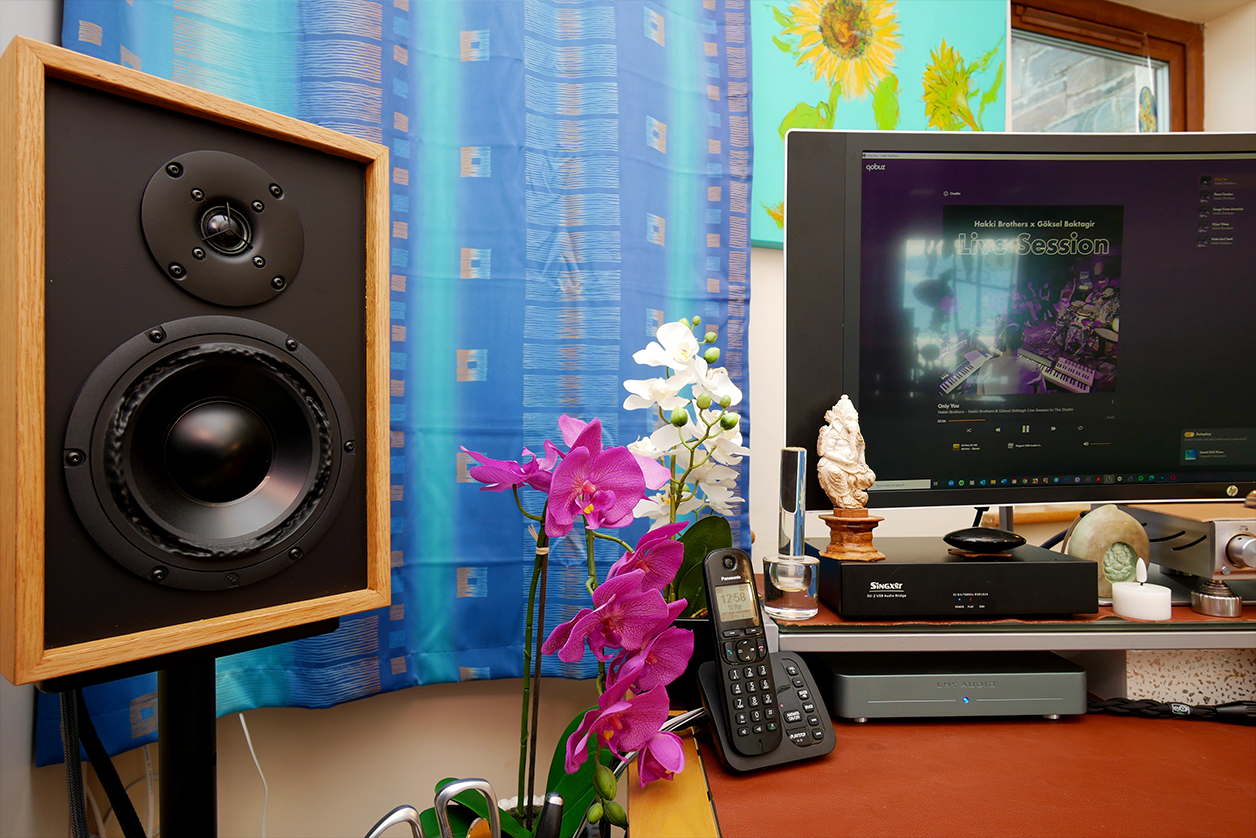
In keeping with Andrew's studio roots, the PH61 is a most explicit speaker. Its level of superior reveal just isn't from any forward treble, lean sinewy demeanour or overdamped butt-clenched rigidity. It's from an absence of common time-domain blur. It obviously couldn't be a warm fulsome speaker in any classic sense. That's a different, thicker and vaguer aesthetic altogether. Yet our DMAX manages more weightiness and gravitas than we'd expect from a still compact truth-or-dare design. That's back at Andrew's 'tasty' element which counters his 'without taste' assessment of the smaller SuperCube. It's a crafty bit of very tastefully done tuning which doesn't pay in the usual compromise coin of losses in clarity and enunciation. When I looked really close like a diamond inspector, my pair's veneer wrap around the exposed front edges betrayed minor imperfections. But they were too subtle to fuss over other than say, Sonus faber this ain't. But then it never claimed otherwise. it's a love child of small-volume hand labour and a former recording-studio engineer branching out. This isn't sex as a box but a serious solution of addressing speakerdom's notorious yet rarely diagnosed malaise of time confusion. If you insist that's not a real thing, sleep on. Sweet dreams. If you've awoken to the fact that very subtle time-domain errors matter because addressing them makes a demonstrable difference; if you fit Andrew's nearfield user profile – then his latest fully active DMAX is a real stumper, stunner and must-hear affair. The same coin could buy a KEF LS50 type with curves, colours, cachet and cred. Most shoppers not trusting their own ears or eyeing resale value will head that way. Fair enough. The DMAX PH61 is a whispered insider's insider tip. Those for whom it was made, they already know who they are. They just needed to learn that this speaker exists. Now they have. My job is done. For me it was love at first listen. When that happens, you stop talking to play tunes, landline unplugged, cell phone out in the car. That's me. So, over and out?
Not before leaving you with one final comment for good measure. The DMAX PH61 is a quite uncompromising purist speaker disguised in modest attire. It achieves its sonic purity not with esoteric audiophile-sanctioned widebanders of artisanal production driven by exotic direct-heated triodes or single-ended NOS transistors. It achieves its sonic purity with A/D conversion, a class D amp of unknown provenance—or in SE guise with an affordable OEM Hypex plate amp—and a serious amount of proprietary DSP. To diehard purists, all of it smacks of satanic worship or at best, serious compromise barely fit for beginners or only the ignorant. That's what makes this speaker great. It gets to the Ritz in Rome not by private helicopter or chauffeured Bentley but 3rd-class bus. Yet arrive it most certainly does; in a top-floor if one-bed suite overlooking the Tiber. What a view. The end.
