"Only Germans and Swiss obsess about punctuality. Being slightly late is far more fashionable and chill." It's definitely true. Phase shift from passive filters and time delay from multiple voice coils not being vertically aligned ring no alarm bells with most speaker designers and their buyers. For every Richard Vandersteen whose alarm goes off, hundreds claim that the time delays of normal multi-way speakers are far too small to factor. One reason why single-driver widebanders enjoy a niche following is absence of filter-induced phase shift. Certain listeners are rather more time sensitive than others. That they are the massive minority is another matter. 'Know thyself' may have been ancient Greek but it's still key. Here's how Andrew explains his approach. "Any transducer's moving mass has inertia reflected in its impulse response. A driver diaphragm can't instantly reach the excursion which the signal pulse demands. It also cannot stop instantly to cross zero with oscillations. Those equal a time delay and as a result, a frequency-response distortion. Since the shape of the impulse response isn't symmetrical, the phase response of the system too will be nonlinear. This causes distortion of timbre balance and spatial localization where the sound becomes flat and attached to the speakers. Unless drive units had zero mass like a plasma tweeter, these distortions cannot be mechanically corrected but DSP can address them. The common disadvantage is to use DSP only for amplitude corrections. That's a fairly basic job which leads to ever greater phase distortion.

"As a rule, such systems sacrifice spatial precision. Our main challenge at DMAX was how to address this phase response when there is no unilateral method to calculate the short FIR filter needed to linearize both frequency and time response with 100% accuracy. We have come up with a solution which approximates that goal with only a small error. The total impulse response is a delta function plus fading error signal not exceeding -40dB in level. Such a filter cancels driver inertia not mechanically but the acoustic result looks as though it did. Although our tech is best suited for linearizing these parameters in widebanders, it can be successfully adapted to multi-ways. Due to the use of a specialized DSP processor, the FIR filter calculates with just 5ms latency." With ±22ms the accepted end stops for lip sync, the PH61 easily qualifies as video approved. On the desktop for which it is made, that's a consideration from podcasts to news casts, YouTube to Netflix. Given this background against my familiarity with the Super Cube, I expected the PH61 to equal it on transparency by way of the same ultra-low distortion; add LF reach; then introduce deliberate response tuning beyond flat-lined linearity to fulfil the 'tasty' part of its design brief. As we see next, the Hypex Fusion option adds socketry and features over the XLR-only standard amp.
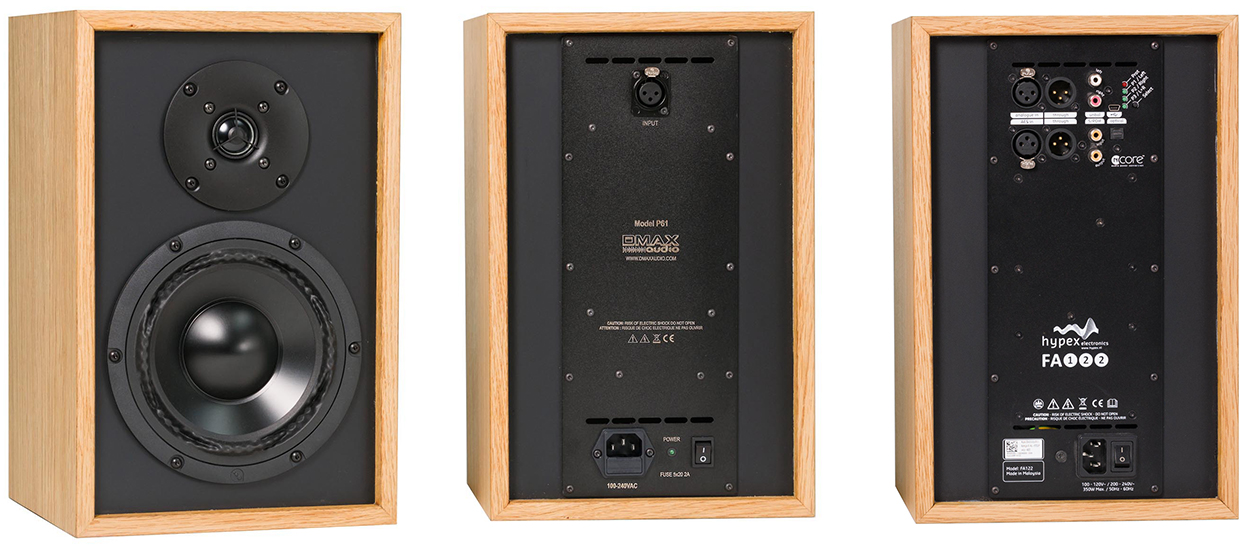 With standard or Hypex amp.










Wherever we find ourselves today always depends on where we've been yesterday. Like pearls in a necklace, the string of time binds our past, present and future. To appreciate my DMAX comments, you must know the context they slotted into. With a picture worth a few words, here goes my before requiring external amps …
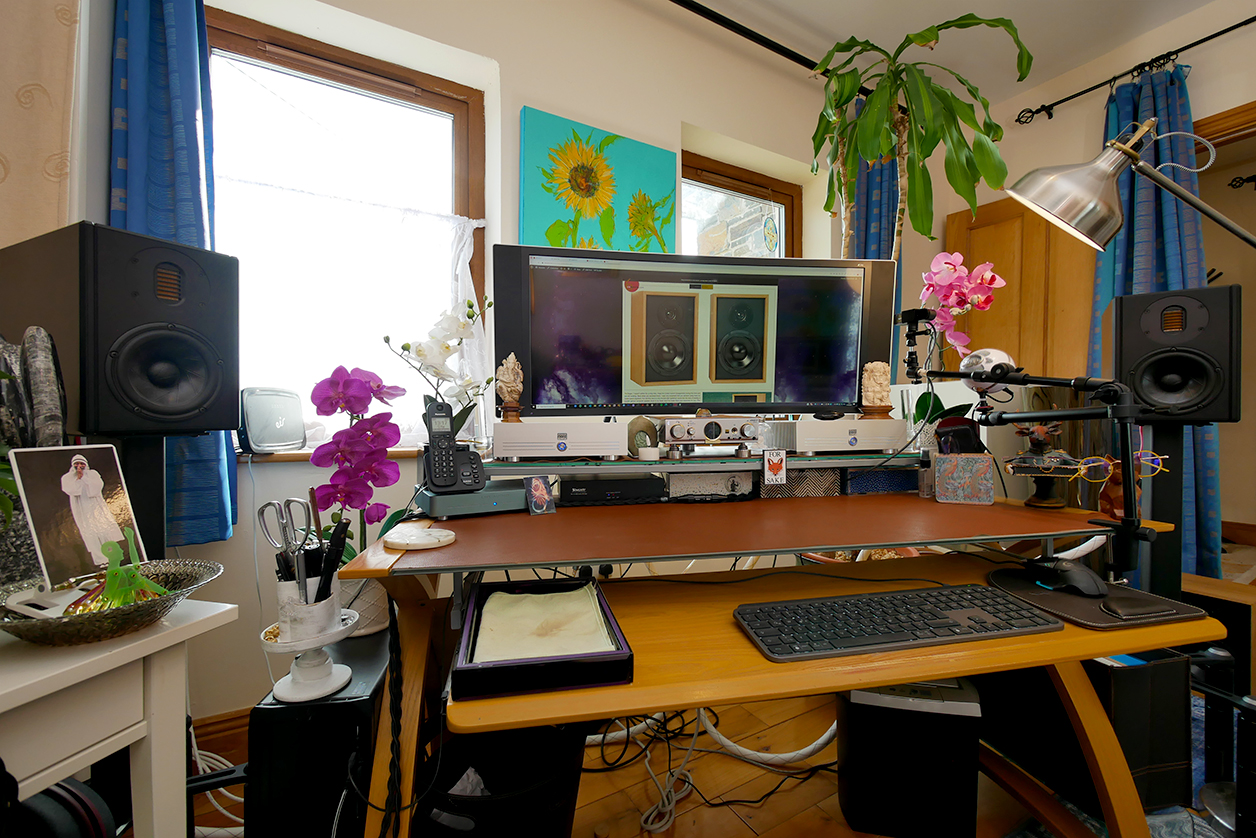
… and after which decommissioned the same nCore amps. As we'll get to, the slight shift of white balance in this second photo is deliberate.