Before diving into specifics, it's worth outlining what to realistically expect from dipole bass. A large part of its behaviour ties to how oppositely polarized front and rear waves interact and result in sidewall cancellation, hence such speakers must not be glued to the front wall. Give them space to breathe and they repay handsomely. This passage from my Voxativ Alberich² review explains it: "RiPol subs really are their own thing. So used are we to bass boom, bloat, smear and drag as by-products of ports and room talk that we accept them as vital parts of the picture without knowing any different. Alberich² shows us what that picture looks like when these pollutants are absent. Only by subtraction do we hear that these non-essentials often framed by politically correct words such as meatiness are in fact proper troublemakers that shouldn't be there. Without prior exposure to dipole bass, at first Alberich²'s subs may seem too linear and missing something. Whilst that's not the case, there's a learning curve. Past introductory courtesies we acknowledge that their output is very fit, highly articulated, precise, dynamic and very fast. Now this bass no longer seems dry and off but colour-wise spot on, wondrously elastic, responsive, meticulous, enormously powerful, majestic, very clean and simply gorgeous. So inhale, exhale, enjoy the sensation then return to ported bass. Oops, it's more challenging and difficult than we'd like. Too late, we should've read the label first. This RiPol thing is some seriously potent highly addictive stuff. It honestly doesn't take much to get hooked." Should you wonder why I brought up the Voxativ bass bins, their RiPol concept folds an open baffle into an enclosure of sorts but still exploits the figure-8 radiation's lateral cancellation zones and at its core behaves more like an air-motion converter than conventional pressure generator. In short, on bass it operates very much like a classic open-baffle design such as the MOB3. That simply doesn't fold its baffle and stacks wo substantially larger woofers per channel. This is precisely why the lay of the land described above applies and accurately reflects how the Dutch handle LF duties. If I had to use one word to describe it in relation to such tasks, monster fits best—and very much in the best possible sense of the word.
Upon experiencing MOB3 bass quality, going back to ported bass feels very much like punishment. While this is a very large speaker, once it starts playing the imposing profile quickly fades. In my room on my electronics, it produced lows to die for yet that doesn't quite capture the point. Experiencing rumble in the 30Hz region with minimal impact on the usual room modes to keep everything above it clean, intelligible and spatially unconstrained is a kind of shift to genuinely change one's perspective. I of course already knew how this presents to be fully aware where my daily speakers draw the line. Those new to the dipole principle however will likely feel puzzled. The MOB3 is a perfect example for how radically dipole bass alters perception and, once heard, can't be unheard. When I mentioned earlier that keeping up with it is anything but easy, this is what I meant. By my standards, to outclass a speaker like this on bass quality, conventional ported designs just won't do. We really need another dipole. To state the obvious, anything attempting to go toe to toe with the MOB3 would realistically need at least twin 15-inch woofers per channel. That's a very tall order. To be clear, this isn't about excess bass in the slightest. Even compact conventionally vented speakers can dish it. What sets the MOB3 apart is how. Its substantial woofer arsenal combined with fairly high sensitivity behaves with striking ease as if there were no sensible ceiling where it would begin to dynamically compress. It just goes and goes. Cue up something bass-heavy, turn up the volume as you please and notice that its cones on stiff suspensions barely move—almost as if shifting the floor beneath your feet was what they were built for. That said, the MOB3's bass in my room never overpowered the upper bandwidth. If anything, it came across as immensely gifted in elasticity, crack, snap, colour, energy, composure and visceral joy. Served all at once, this was the full-care package.










Prior to the MOB3's arrival I was fairly confident that despite its massive bass radiation surface, it wouldn't overload my room as long as it had some breathing space behind it. While its outstanding low-end performance was partly the result of knowing what not to do, suitable amplification proved to be the other half of the equation. On paper the MOB3 doesn't look demanding but in practice clearly responds to control i.e. damping factor. Driven by my Trilogy 995R monos, the MOB3 delivered properly weighty and authoritative bass yet on tracks packed with hard-hitting impact felt somewhat relaxed. The result wasn't lazy, hazy or soft but for the sake of argument let's call it mildly CBD-flavoured. Once Aavik's I-588 integrated of Pascal class D entered the chain, the perspective shifted dramatically. Suddenly there was full-blown excitement, wider dynamic span, immense quickness, heightened contrast and a far greater sense of urgency and control. The explanation for why was fairly straightforward. Into this load, my monos present a low two-digit damping factor whereas the Dane increases that figure by an order of magnitude. As a result, its grip over the MOB3's open rear strokes was considerably stronger and translated directly into a more energized sportier overall presentation.
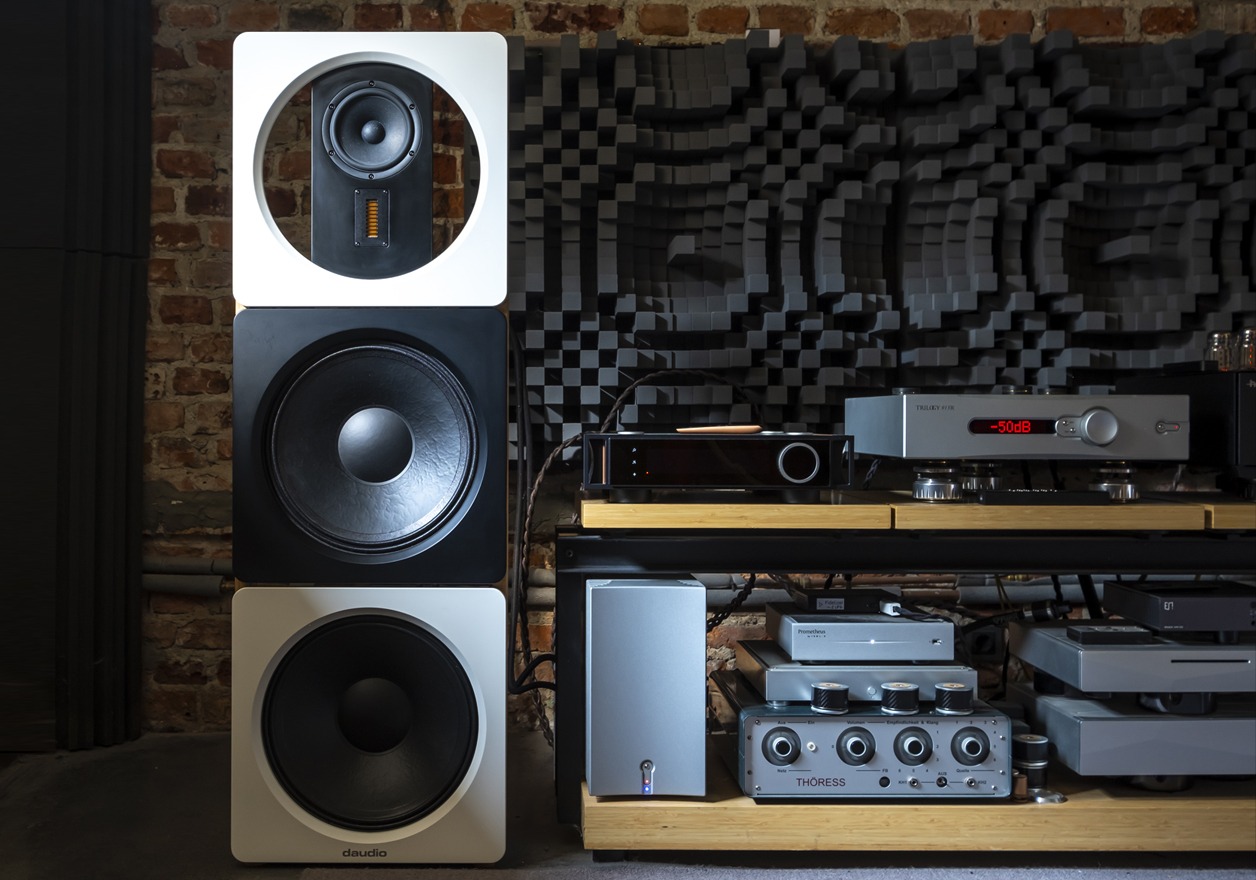
Whether one prefers a mild sedative or potent stimulant to the MOB3's already remarkably feisty demeanour is ultimately matter of taste. Since my daily music diet revolves largely around Rock, electronica and folk, after two days with the Trilogy stack I switched to the Aavik and never looked back. That said, while my reference monos couldn't match the Danish integrated on bass authority, their class A pedigree rendered the MOB3's presentation more radiant, lucid and colourful. More importantly, that sense of ease carried over into the upper registers regardless of amplification. As quickly became apparent, this speaker is no one-trick pony obsessed with bass alone but a genuinely finessed performer farther up, too. In absolute terms, my sound|kaos Vox monitors positioned close to the listening seat and aggressively toed-in still retained the upper hand in spatial precision, image outlines, depth layering and that elusive bubble-like projection that's very difficult to achieve without a widebander. Given how well these point-source minis handle dispersion, I neither expected the MOB3 to match their spatial wizardry nor felt short-changed when it didn't. Instead, I appreciated its own reality—and how convincingly it went about creating it.