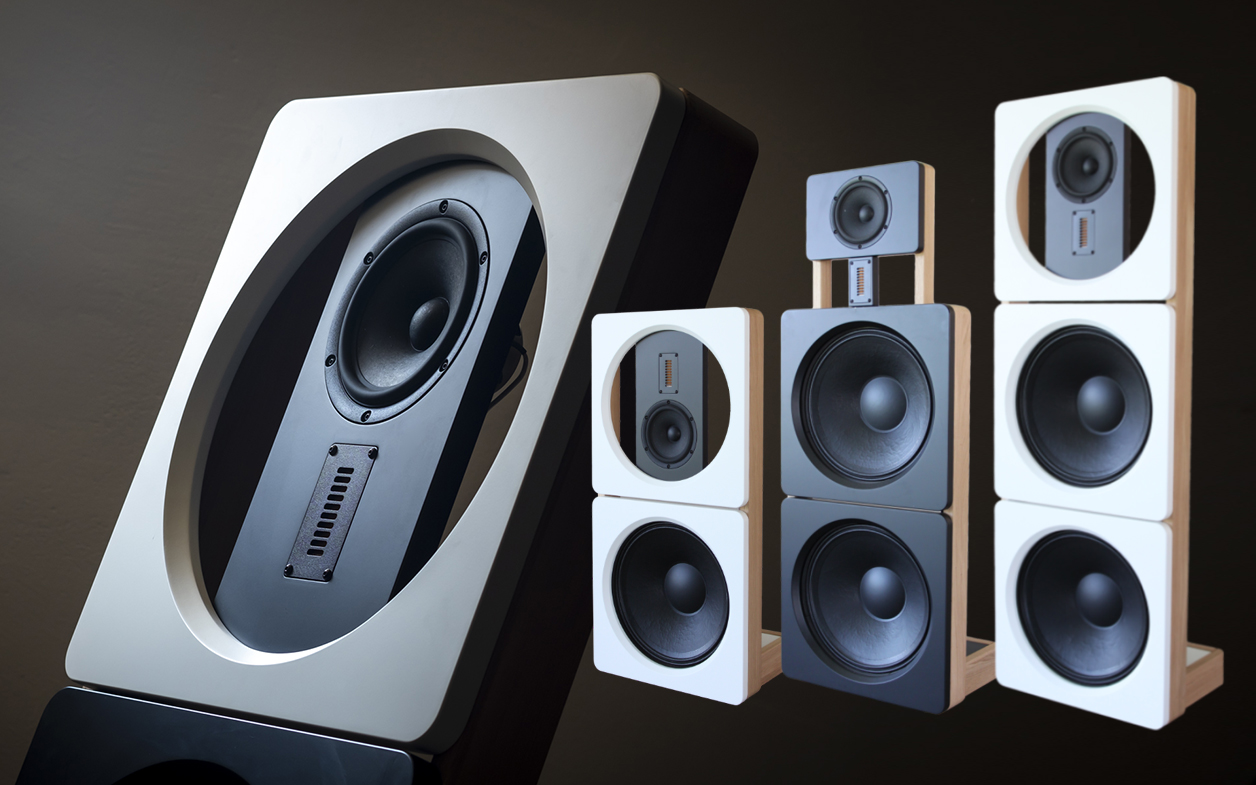
Upon visiting their website, one quickly notices that Daudio split their online presence into two parallel branches. Daudio Netherlands lists the company's High End and Reference ranges, a total of six open-baffle models aimed primarily at the domestic market. Daudio International showcases the firm's latest more affordable creations gathered under the MOB banner short for Modular Open Baffle. This more recent line-up currently consists of three designs and represents the company's most focused expression of their dipole philosophy. The MOB concept dates back to 2017 when it first presented publicly. One glance is enough to understand what these speakers are—or rather, what they are not. Conventional boxes are nowhere to be seen. By now that should come as no surprise. A conventional vented enclosure allows manufacturers to obtain respectable bass from relatively small drivers. Cabinet and port act as acoustic supports boosting LF efficiency and helping a woofer move more air than it otherwise would. Dipoles operate differently. Without enclosure assistance, front and rear radiation interact freely to reduce bass efficiency. If meaningful low-frequency output is the goal, designers compensate with large surface area. This is why full-bandwidth open-baffle speakers tend to be physically imposing. Their size isn't a styling exercise—it's a fundamental requirement of the physics involved. The MOB range makes this abundantly clear. Daudio's founders don't beat around the bush with their bass weapons of choice. Even the smallest MOB2 uses a 15-inch woofer. The larger MOB2.5 and MOB3 double that count. In short, Daudio tackle the dipole bass dilemma in the most straightforward way imaginable: if there's no box, cone area steps in to do the heavy lifting. Measuring 45×31×90cm and tipping the scale at 19kg, the MOB2 is rather wide yet reasonably short for bandwidth of 40–30'000Hz. 87dB sensitivity makes it a standard-issue load. Meanwhile the MOB2.5 and MOB3 grow 46cm taller and add respectively 6 and 9kg per speaker. Their twin woofers extend reach to 30Hz and raise sensitivity by 3dB at 2.83 V/1m. The only difference between them is cosmetic. Atop its twin bass frames, the MOB2.5 parks a smaller baffle carrying the midrange, with a tiny AMT sitting just below it. The MOB3 mounts the midrange above the tweeter on a baffle identical to those below it, resulting in a visual arrangement of three equally sized squares stacked vertically. All MOBs are three-ways. Upon contact, Hans informed me that they had a demo pair of MOB3 available and that's what came my way.
Logistics are my one reason to bitch prior to reviewing floorstanders. They usually arrive in one or two very large crates or boxes which I have to drag single-handedly across my front yard then down the stairs to a basement that leads to my listening room. A two-wheeled dolly helps but negotiating the staircase—down with the cargo and back up once the job is done—is unavoidable. Fortunately, Daudio approached this differently. The MOB speakers deliver as modular kits for home assembly and the MOB3 arrived spread across six perfectly manageable cardboard boxes. Considering the usual pain, that was a major win in my book. The twin woofers each had their own boxes, the three square baffles per speaker came separately while the side rails for both shared a carton. The remaining parts—the midranges, tweeters, bolts, tools, rubber pucks and plinths with pre-installed crossovers and cable runs—all packed together in the final box. I deeply enjoy the process of building audio gear like today's. Logistics aside, I firmly believe that a product I put together brings me more joy afterwards. Sitting down to listen to the result of one's own manual labour simply feels extra rewarding. On that score alone, the MOB3 secured its second win. Assembly proved painless and free from any issues. Once everything was unpacked and all parts laid out in front of me, I began building the frames. The procedure was straightforward: place the plinth with the crossover vertically, connect one long side beam via the largest included bolts, add the upper section, attach the second beam and finally install four rubber pucks per speaker. Done. With two naked frames upright and ready, it was time to populate the square baffles with drivers. The supplied Allen key proved perfectly adequate though to speed things up, I opted for an electric screwdriver instead. Once the transducers secured to their baffles, these modules had to mount onto the frame. Prior to the MOB3's arrival I had expected this step to be the most troublesome part but it was quite the opposite. Each baffle features four tidy latches with small dimples that slide onto the side beams and each latch requires just half a turn of the Allen key to lock firmly in place. This mechanism also ensures perfect alignment and prevents uneven gaps between individual squares once installed. The final step involved routing four cables from each crossover to the respective drivers. The wiring was cut precisely to length which made incorrect connections virtually impossible. The entire assembly took me roughly two hours whilst unpacking the components added another ~40 minutes. Most importantly, throughout the entire procedure I encountered zero issues and found the experience thoroughly enjoyable. It really wasn't difficult. Even those less comfortable with manual work should have no troubles.











Daudio's MOB3 is the kind of loudspeaker that doesn't hide what it is nor pretends to be something it's not. You see exactly what you get and paid for. On the financial note, the basic MOB3 with matte white or black baffles and Oak uprights finished in clear matte lacquer costs €8'488.02 with shipping to where I live. Crossovers fitted with fancy Alumen Z-Caps add €230, separate impedance correction PCB for OTL tube amps another €100 and my loaner had both. Baffles finished in any RAL colour increase the bill by €250 while Oak parts in matte black add €200. A maxed-out MOB3 amounts to €9'280.91, undeniably a pretty penny. Still, this speaker is manufactured in the Netherlands and the final bill reflects far more than raw parts costs. These days it has become popular to judge a product by tallying up the retail price of its components then criticizing manufacturers for their profit margins. In reality, that simplistic math ignores factors like R&D time, operational costs of running a legitimate company, online marketing, logistics and exhibiting at various audio events. From that perspective, the MOB3's asking price begins to look less mysterious and far more understandable particularly once we consider that keeping up with this product in many regards is anything but easy. Upon reading this, dipole fans only smile and nod. They already know what I'm getting at. It goes without saying that as large as it is, the MOB3 won't be everyone's cuppa. This speaker occupies a fair amount of space and considering its topology, primarily winks at dipole enthusiasts. That aside, this was the visually cleanest open-baffle product I've had the pleasure of hosting. I applaud Daudio for choosing Oak as their frame material of choice and for designing a speaker that hides virtually all bolts from view to keep the square baffles modern and minimalist. I also appreciate the fact that the crossovers cleverly tuck under the bases where they won't collect dust. For context, the PureAudioProject Trio10 reviewed back in 2017 was neither this elegant and smartly executed nor as easy on assembly. All things considered, the only practical feature missing from the MOB3 are threaded plinth bores for optional floor isolators.
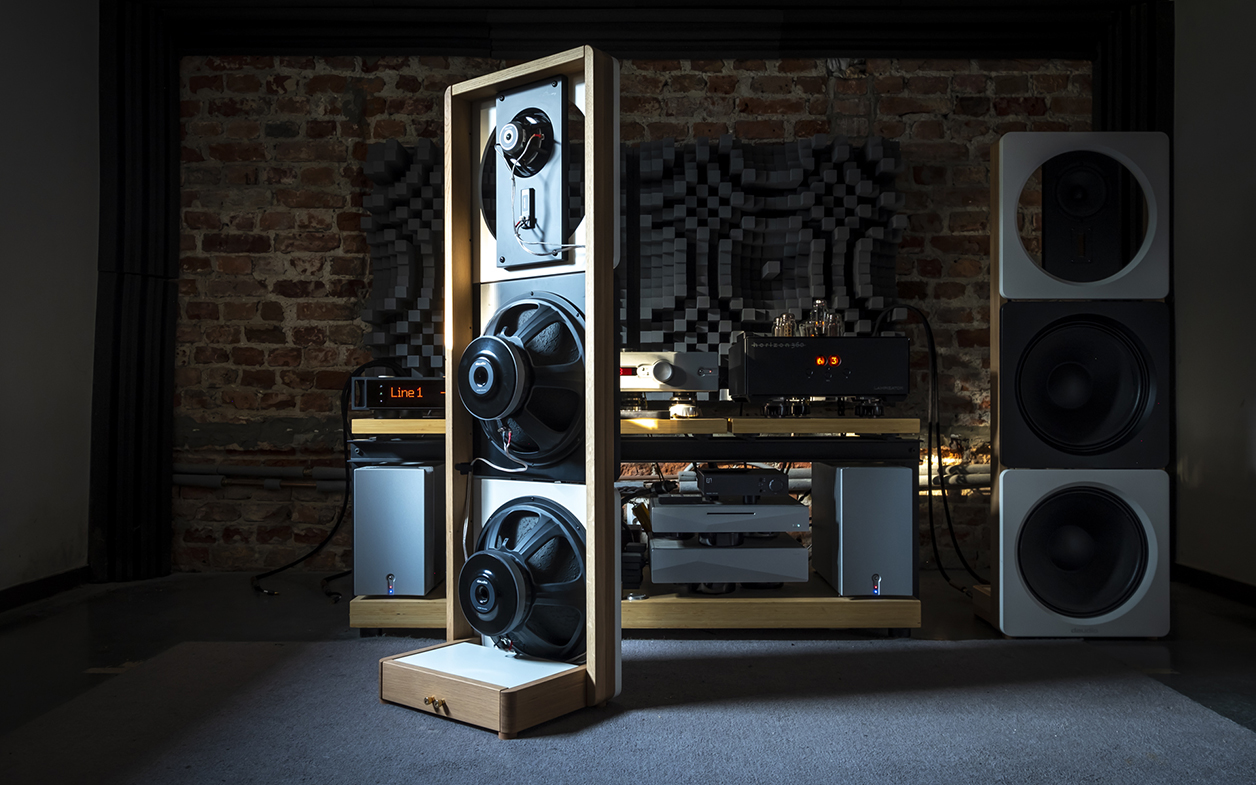
As to Daudio's driver selection, it's sensible and telling. The woofers are 15-inchers from SB Audience's professional range customized specifically for the MOB series. The midrange comes from SB Acoustics' Satori line here in its Papyrus-cone variant as used in my Premium version where Reference models swap that membrane for polypropylene. Interestingly, the very same midrange can be found in the Qualio IQ, albeit with its cone dressed in light off-white. Up top sits a Mundorf AMT as the only driver in this ensemble not a dipole. As for the crossover, Daudio's target is an acoustic 4th-order function which strikes a well-judged balance between driver integration, consistent polarity and controlled radiation. Rather than achieve this purely with complex electrical networks, the designers keep the circuits simple—preferably 2nd order—and let the acoustic driver roll-offs do the rest. It's how phase alignment falls into place more organically and results in a response that's smooth, coherent and most importantly, easy on the ear over longer sessions. In the MOB3, the 15-inch woofers cross at ~400Hz where they still behave cleanly so beyond motor distortion. The filter itself includes the expected coil and capacitor plus a series resistor to tame impedance peaks and improve phase matching with the midrange. Interestingly, while these woofers could've been pushed for higher efficiency, Daudio operate them at a more moderate 90dB which leaves enough headroom to compensate for the natural 6dB/oct dipole roll-off. The midrange operates in a very comfortable window out to roughly 4kHz which defines the upper crossover point. While the AMT is technically capable of working lower, high-passing it at 4kHz proved best. It mounts slightly recessed so that highs don't jump ahead of the midrange but align with the intent of mirroring the balance of real instruments. The system I used to evaluate the MOB3 consisted of an Innuos Statement Next-Gen, LampizatOr Horizon360 and Trilogy 915R/995R analog front end. At some point the British trio gave way to Aavik's class D I-588 and that change proved far from subtle. Positioning as the first order of business turned out to be enjoyably straightforward. Dipoles demand space behind them and the MOB3 was no exception. Placed roughly 1.3m from the front wall and gently toed-in to cross a hair behind the seat, it settled in without protest and immediately showcased the strengths typical of its kind. Set up thus, it delivered a clear orderly spatial picture without requiring obsessive fine-tuning which made for a very promising start. With three sound|kaos Vibra60 pucks added underneath each speaker, I was good to go.