 Once my shipment arrived in Galway's UPS hub, I thought about my sonic expectations. Any 'audiophile' music streamer is essentially a stripped-down computer whose processing powers now dedicate purely to playback not typical PC multitasking. Switch-mode power supplies ubiquitous for normal computers routinely upgrade to linear supplies. Special care goes to isolating incoming and outgoing streams from our router and internal CPU respectively. In trade such servers often become headless. Now access to their functionality relies on a tablet remote. Being allergic to WiFi, I prefer going fully hardwired via a maxed-out big iMac dedicated to just playback. A 4TB external SSD houses my local library. A Qobuz Sublime subscription pulls down streams from the cloud. Audirvana Studio performs all signal routing, quad integer upsampling, bypass of Apple's audio engine and suppression of background computing threads. A superb 27" retina display makes a mockery of the tiny displays of costly audiophile servers; if they even have one. This ultra-cap powered Singxer SU-6 USB bridge acts as a noise-isolating moat between iMac and DAC.
Until the DAC the signal remains squarely in the digital domain. The job of a music server thus is signal routing, noise isolation from the worldwide web and the computing hardware plus intuitive multi-level access to mixed virtual/local music libraries. That bit-perfect digital traffic is affected by OS and firmware code beyond raw processing hardware might seem irrational but experience knows otherwise. My  experience with servers well north of €10K simply hasn't prompted me to give up on my music iMac. Whilst in best-case scenarios I did hear a marginal sonic uptick for incoming loaners, it wasn't sufficient to make up for their headless nature with mandatory WiFi and inferior navigation OS. Could Gold change my opinion on an 'audiophile' streamer's digital grass being sufficiently greener, longer and healthier to abandon my domestic install around a 27" iMac with latest OS and 40GB of RAM? The last server on review which had slightly nodded in that direction was Nagra's. Whilst its temporal gestalt was more laid back to register attractiveness, its coaxial output limited PCM to the usual 192kHz, DSD to 64 whilst its proprietary fibre-optic output was useless with DACs other than Nagra's or Playback Design's. Being headless then conflicted with my hardwired needs whilst €5K for a bijou box with switching wall wart felt unnecessarily costly. Now you know my hardware and headspace conditions which Cen.Grand's Gold parachuted into. Context is useful.
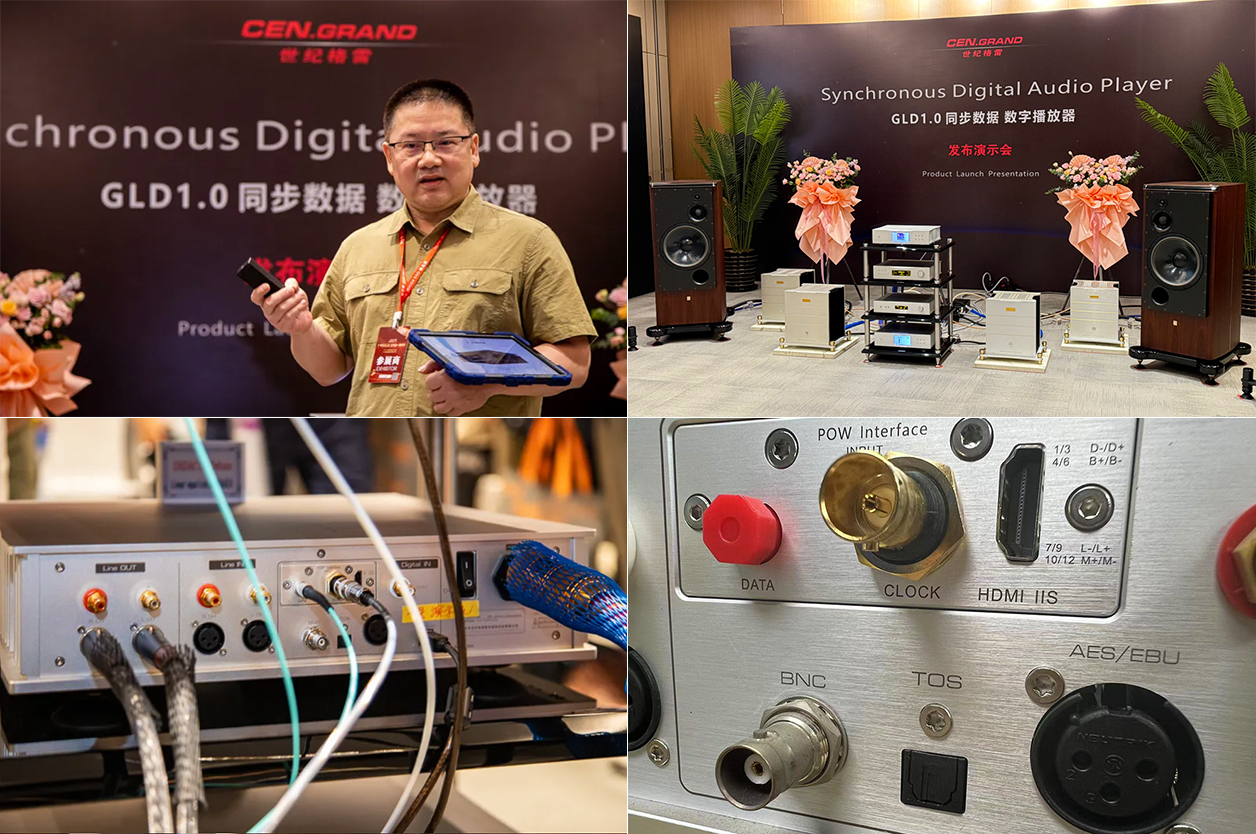 Cen.Grand at the 2025 Guangzhou Hi-End Premium Audio Exhibition with fully balanced 9i-958 monos bi-amping ATC SCM150PSL SE 15" 3-way floorstanders.









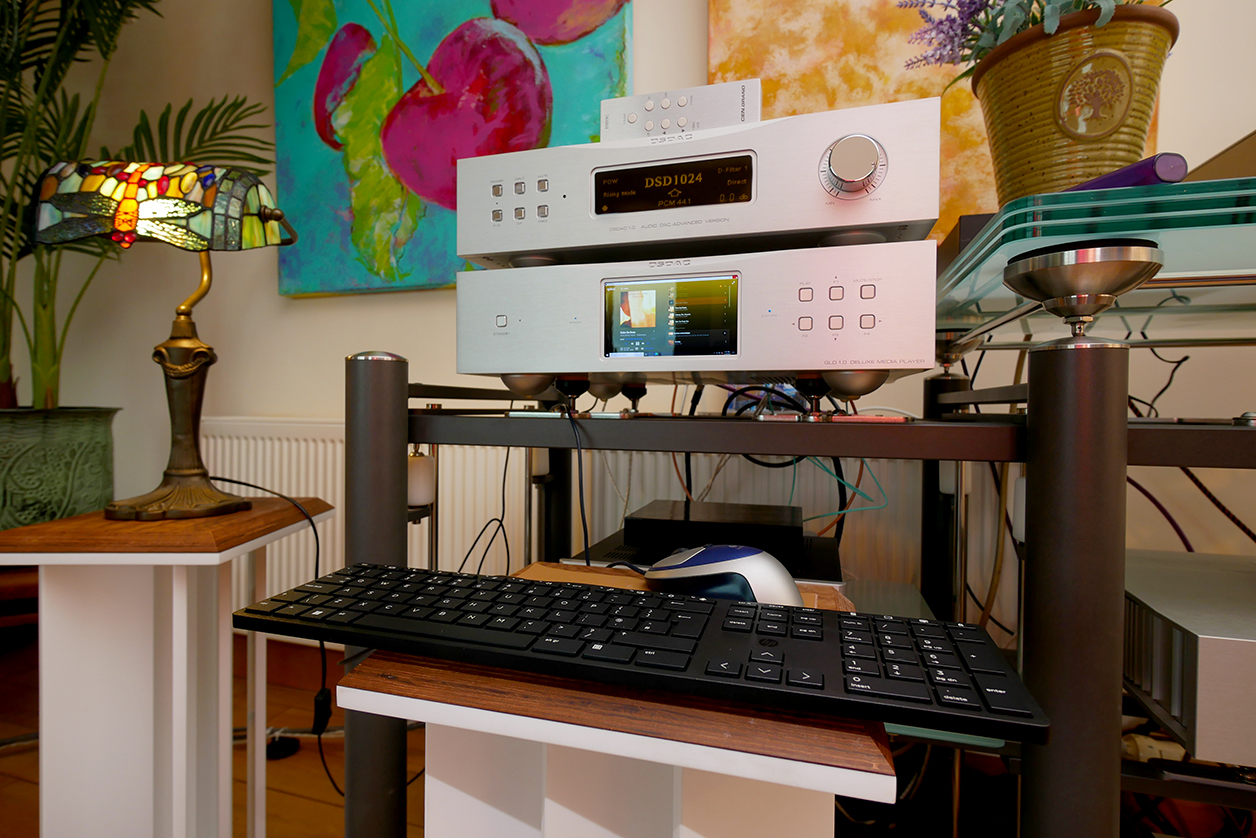
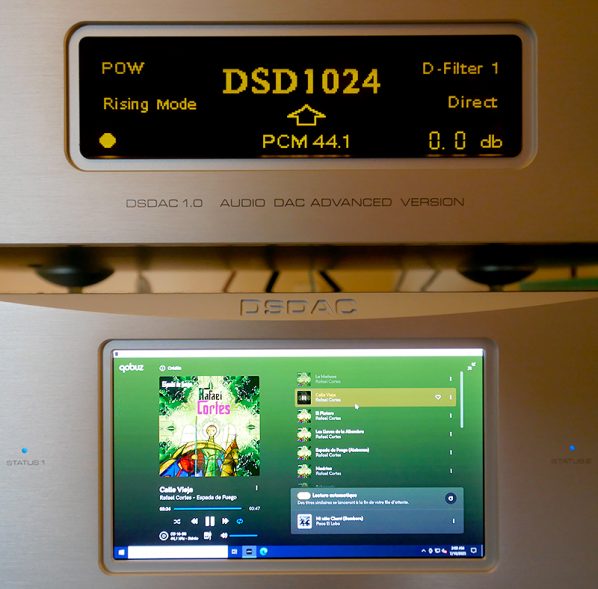 Armed with a generic keyboard, spare mouse and reading magnifiers to navigate what for a complete Windows desktop is Gold's miniature screen with an even tinier mouse pointer, I installed the Qobuz desktop app, logged in with my Sublime credentials for up to 24/192 streaming, found the DSDAC in its output device window et voilà: le son over POW, I²S/HDMI and BNC on three parallel connections.
Multiple attempts to download Audirvana's desktop app failed. Their .appxbundle installer file refused to open. Having used this French music player for years on my music iMac and Win 11/64 workstation in the office, I much prefer it over J.River. It's why I uninstalled the latter eons ago. For once Audirvana wasn't to be my friend. No matter, native Qobuz was peachy, I in the peaceful POW biz. Yes, the alternate 'prisoner of war' meaning makes this acronym a bit loaded.
Of course normal users will wield a WiFi tablet remote like a flashy light sabre. As Mr. Flintstone with his hardwired mouse and keyboard from the Stone Age, I'd default to a 27" or bigger display if Gold replaced my iMac permanently. I just had no spare screen on hand nor a Jones to buy one just for this occasion.
Whilst worshipping in front of Gold like a hard-of-seeing altar boy on his knees felt a bit Mickey Mouse, it worked. Calling Gold a Windows PC slotted into a classic hifi chassis is literal not figurative. The OS is stripped back to LTSC¹. Just so, for once I knew my way around a fancy streamer from jump street without practicing secret handshakes or new swear words. It's how I knew exactly where to turn the WiFi transmitter off and enlarge the mouse pointer. Done.
Still, I couldn't figure out how to dim the display and protect it from pixel burn as I always do with my iMac keyboard's dimmer control. As a Windows PC, we expect to be able to install our favourite apps and bolt on sundry features. My focus was on sonics and I had sound and access to my music. With three of the DSDAC's inputs live in parallel, I could compare them from the seat via lazy remote triggers. Power-on boots up an OS. It takes 20sec before the display ever turns from black to the logo, another 15 before the desktop shows up, more before it fully populates. Until then, visual confirmation that our power-button push did anything has the small right status LED turn blue immediately.
____________________________
¹ "Windows LTSC (Long-Term Servicing Channel) is a special Windows version designed for devices where stability and long-term support are crucial such as medical equipment, industrial control systems or ATMs. It prioritizes stability over frequent feature updates, offering a consistent experience for extended periods. This contrasts with the Semi-Annual Channel (SAC) versions of Windows which receive feature updates every six months."
From a parallel proof-of-life quickie, I already knew that the DSDAC's newly gained I²S input worked perfectly with my Singxer's I²S output. I could run direct comparisons between POW protocol and my usual USB path to see how much of a gap separated them. After all, POW's superiority is Gold's prime selling point and reason for its innovation patents.