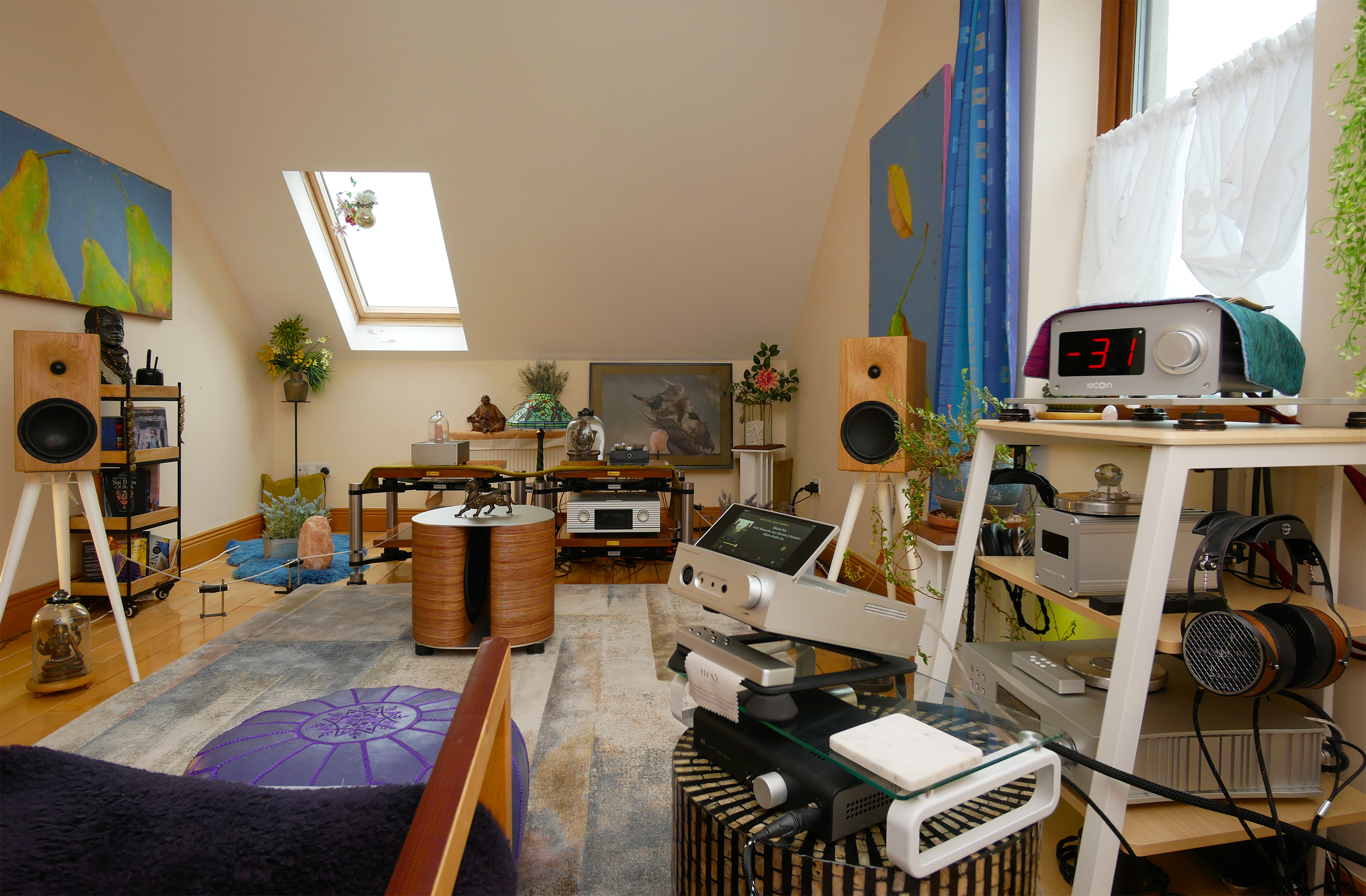
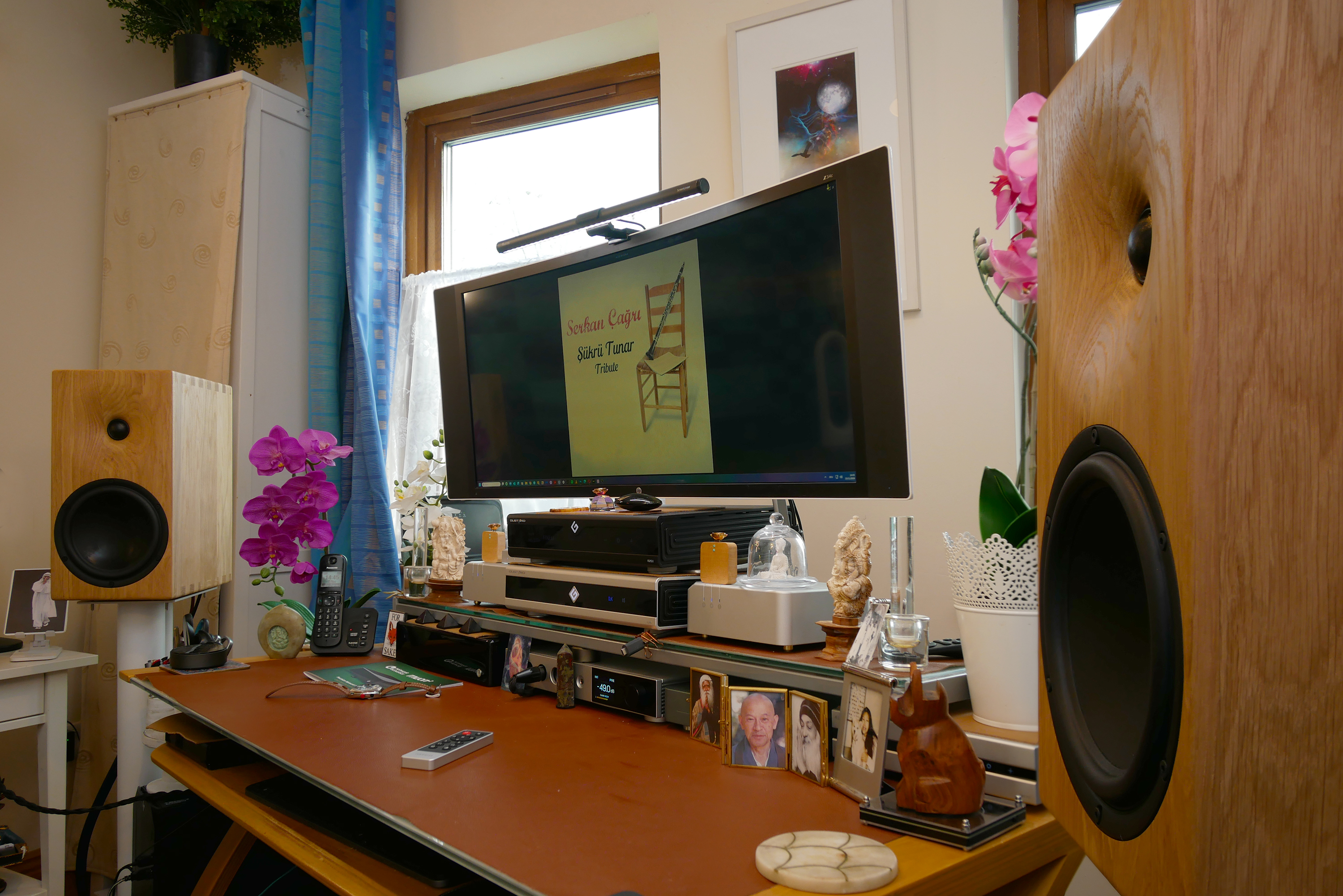
With a tip of the hat at the inverted nearfield system, this setup too has beaucoup space behind the transducers for extreme stage depth. It also seats me close if not as proximate as down the corridor for minimized room effect. A Shanling EM7 acts as 1TB microSD USB server into a CenGrand DSDAC 1.0 Deluxe 1'024 converter. Its 5V XLR output hits a Lifesaver Audio icOn 4SE autoformer volume control followed by a stablemate Gradient Box II crossover. Its high pass runs into a Kinki/Vinshine Dazzle in preamp bypass mode. That turns into a pure power amp with 23dB of voltage gain so minus the extra gain stage of the active preamp section. The low pass sees an NCx500 stereo amp from Audiophonics. Each 600W/4Ω channel drives its own 12" woofer for maximized control. Happy days at the full-range corral. Here's an open secret. If we perfect our in-room bass to the limits of audibility, all else falls in line—with less difference than otherwise. The top end is the vision polarity. It's where image specificity, focus and subjective detail appeal to our inner eyes. The low end is the feeling polarity; the musical hara in the belly. When in place without constant distress calls of boom, mode ringing or gelatinization of the higher bands, it's where emotional persuasiveness and guttural conviction live. It's where big speakers overtake little speakers; unless we dovetail a sub in seamless continuity. Now the monitor's simpler passive filter and smaller less talkative cabinet panels can have the advantage. Active adjustable LF always beats fixed passive bass. In short, a properly administered 2.1 split becomes quite the win/win. With most <100Hz bass recorded mono, the loss of stereo cover for the bottom ~2 octaves is mostly academic. At least that's my considered opinion on the matter.
By contrast to the E50-S, the residents played it warmer though their 4.3" Enviée widebander did project a bit more. With my electronic crossover temporarily bypassed to compare native F3, the Danes had a small lead in weightiness. So had their tweeters; on energy versus the more narrow-band upfiring Raal ribbon of the Swiss. Across music's lion share of the midrange, the Buchardt was a bit drier but more focused. Yet as indicated a paragraph earlier, get in-room bass sorted and those higher differences shrink; unless we suffer major nonlinearities like pebbles in a shoe. I didn't. The upshot was classic sideways trading for two equally compelling just not identical readings. But the differences were far less than the divergence of design philosophies and concepts predicted; or the price delta warranted. On energy transmission where I find good widebanders to excel, the Buchardt was really gifted. Hence my unbridled enthusiasm. Having now explored varying contexts to identify my favourite in which to conclude matters, I returned to my office. Given the next already landed gig of Network Acoustics muon² premium switch at roughly twice Buchardt's ask, elevating my desktop's resolution to the highest I had access to would be a strategic fringe benefit.











 To be sure, this final station wasn't because this Buchardt was less capable sitting farther away. All those boxes had simply ticked off already. The final task was digging deeper. For that a premium nearfield of max resolution is ideal. You hear everything before the room interferes; before reflections take over; before distance losses obscure micro detail. It also means that this type speaker is the end of the road. Naught bigger is appropriate or necessary. That the ubiquitous brake pads which transform partial signal voltage to heat—padding resistors—aren't necessary on these quite deeply inset waveguided tweeters is uncommon. It must be how Mads obtains his ideally grain-free HF resolution; from a soft not hard dome. On his, treble transients don't rise as high nor do decays linger as long as they do over my favoured pleated dipole tweeters. On lesser or overly close-mic'd productions, AMT-goosed treble dynamics can simply veer into the minorly steely; particularly on plucked strings like qanun or flamenco guitar. With treated silk processing his signal completely uncut, Mads apparently minimizes those chances whilst avoiding common resistive losses.
Not having heard the Purifi E50 version for myself, I take it on published faith that it embeds a deliberate ~3-4kHz dip for long-term listening comfort. It suggests that aural hygge was key to its tuning. The 'S' version's resolution, energy and liveliness too remain grounded in an easeful gestalt; like achieving less loss from a resistor-free tweeter whilst sticking with a textile dome. If I read it correctly, the E50-S tuning is all about still having the easy-listening cake of the Purifi model and eating it with more awareness of the recorded ingredients. Or as Mads put it, "it's clearly a more coloured presentation by choice which sets itself apart from the rest of our line. We tuned it to be midrange-centric with a lot of refinement such that it's never fatiguing. Should you measure, you'd see that the bass is a little light compared to the midrange, making it also more forgiving closer to walls which of course would lift the bass. Higher you'd see a BBC dip implementation to calm it a bit without giving the impression of a rolled-off treble." Whilst reading libertine like Cyrano de Bergerac, the listening experience is very cohesive. The magnitude of deviations is cannily set. It steers our response perception with subtlety. No neon signs. This differs from SET voicings that are described as midrange forward. Whilst their actual response shaping across the vocal range could look similar, typical dousing in high 2nd-harmonic distortion adds thickness. From it come opacity and clumping. Not with the E50-S. Transformer-coupled SET typically feel soft on top. The E50-S avoids it. Having had my own SET era compliments of Tom Willis, Jarek Waszczyszyn, Wei-fu Wu and Shigeki Yamamoto—PX25, 6C33C, 300B and 45 respectively—desire for more bandwidth, linearity and resolution eventually outgrew it. Today I'm quite allergic to playback thickness and fuzz. Here I heard none. No dropped pennies on Memory Lane. Just so, to my ears the Buchardt packed a certain turn-on factor followed by unseemly lust bumps. I was plainly susceptible to its tuning despite typically fancying more air and sheen. I also loved its wood aesthetic with tell-tale finger joints. I'd fallen hard. Which begs a valid question. Who wouldn't like the E50-S? When one is wholly in sync with a thing, it's hard to imagine someone completely outside of its sphere. Having to guess, devotees of treble- or bass-first perspectives? For the latter, the E50 with Purifi mid/woofer would seem to beckon. Flat-lined neutrality nancies? They'd have to dismiss the E50-S on religious principle, no (shudder) listening involved. Fans of gloss, sharp transients and edge-forward imaging also could want more. Meanwhile admirers of widebanders wishing for more than genre-typical lower bandwidth and superior smoothness in the lower treble should find unsuspected overlay of communicative directness. I certainly did.