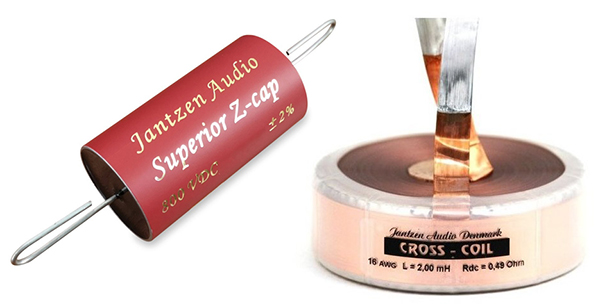
 Parts porn. "Our Jantzen cross coil was developed in conjunction with Per Skaaning of famous Danish driver design house Audio Technology. It is a high-performance foil inductor offering improved power handling and dynamic headroom. The pure copper foil insures a superior surface for electron propagation, lower distortion, higher power handling and headroom than classic wire-wound inductors. The coil wraps in clear shrink foil to protect its layers and winding integrity. With rising frequencies, electrons move to the surface in the so-called skin effect to cause power distortion. Foil coils give us the larger surface area to compensate. Jantzen's ±2%-tolerance Superior Z-Cap is a metalized polypropylene foil capacitor of special construction we call Super MPK. It runs twin layers of metalized polypropylene so a double-foil makeup. Via special winding machines and techniques, two capacitors are connected in series within one housing. This requires four times the foil of standard metalized polypropylene foil caps. Compared to them, the Superior Z-Cap is of a higher calibre where even the finest nuances become audible. Incidentally, we don't fill our caps with dielectric fluid to eliminate all risks of eventual evaporation or leakage."
"For the new 'S' tweeter, we collaborated with ScanSpeak to match our new waveguide with their renowned 28mm D2905/970000 Classic platform via several mods. This soft dome uses their patented SD-2 symmetrical drive magnet system and a German-made textile diaphragm coated by ScanSpeak for optimum linearity beyond 30kHz. Combined with an optimized rear chamber and long linear excursion, its resonant frequency is very low. One of our mods enhanced its performance at lower listening levels by enabling it to operate more 'freely'. The goal for the new waveguide/tweeter match was slightly wider dispersion and a sound that's easy to listen to yet highly resolving for a textile dome. Power handling was also important to us so despite being a rather large dome in a waveguide which naturally boosts its output, the crossover frequency was set relatively high thanks to our incredibly well-behaved mid/woofer. As a result, the tweeter does next to no work, keeping distortion incredibly low even at high SPL. For our cabinets, the wood sources from a certified local FSC supplier where for each tree harvested, a new one is planted. We also use lock joints to go beyond mere reliance on glue. Aside from real wood looking fantastic, it's far easier to fix scratches and dents than it is with veneers or glossy paints."
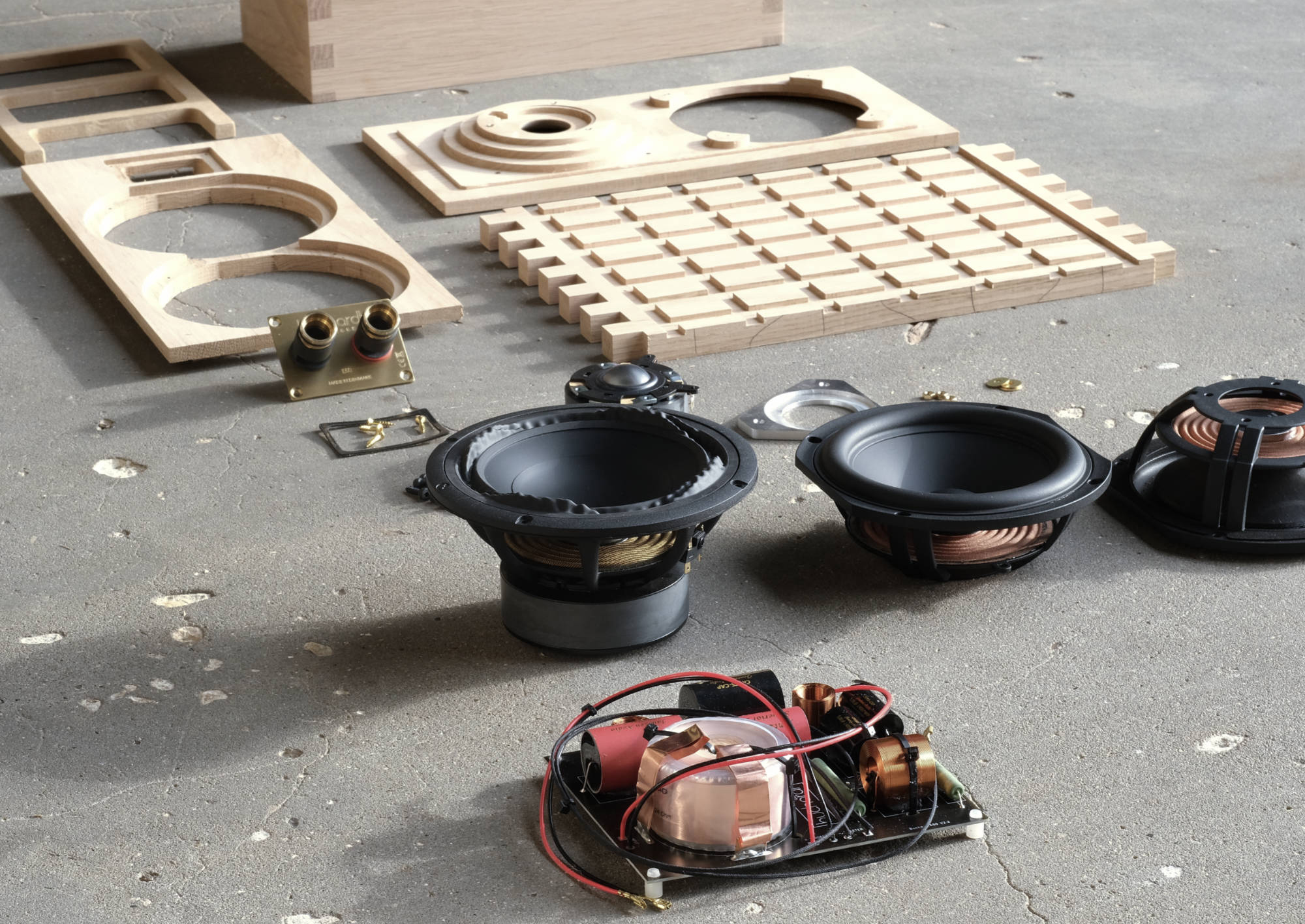 The older E50 taken apart. Note the double thickness areas where the main driver's bolts mount to the front baffle.
Hygge is a Danish/Norwegian term for a cozy mood of comfortable contentment—like a cat curled up at one's feet purring away happily. The German equivalent is Gemütlichkeit. Being typically Teutonic, of course it's got to have more than twice as many letters. Taking pleasure in the simpler things of life is a familiar concept also to the Japanese whose Haruki Murakami calls it shōkakkō. The older Zen term wabi-sabi adds the dimension of impermanence. That celebrates imperfections like wrinkles and liver spots where modern obsession with plastic surgery would deny their inevitability and relevance. Meanwhile ikigai translates to "what makes your life feel worth living"—treasured comforts like a compact quality hifi. No matter the words, it's fair to say that today's from-the-tree look without bling branding or geometric complexities more than casually nods at hygge. Given the parts and labour origins already covered, that probably renders the E50-S as Danish a speaker as it is possible to make. It's certainly worlds apart from Bang&Olufsen's ultra modernity or Børresen's wind-slippery form factors inspired by fast cars and yachts. It's also clear that Mads prefers things tidy and compact to always work extra hard on wringing more performance from smaller speakers than defaulting to what most everyone else does—going ever bigger and heavier. And perhaps that too is hygge? From there to hygiene by way of accessorizing coherence gets us at Buchardt's two options of stylish €450/pr Oak tripod or more classically austere €500/pr single-column solid-wood stands. Whilst still on wood, you can get that of the speakers au naturel, smoked or charcoal-stained.








Enter the ABR aka auxiliary bass radiator. Here our tour guide is Grzegorz Rulka of Virtual because his Cobra 2-way monitor uses six of them – per side. "A passive radiator is a cone without voice coil or magnet. It's a tuned mass/spring system. The cone is the moving mass, the air trapped in the enclosure the spring. When the active driver moves out, internal air pressure drops. The higher atmospheric outside pressure pushes the radiator in. When the active driver moves in, internal air pressure rises. That pushes the passive radiator out. It seems that the passive moves out of phase yet at the system's resonant frequency, this relationship changes. Around this frequency pressure fluctuations from the active driver combined with the inertia of the radiator's mass cause the passive to move in phase. At or below its resonant frequency, the active driver still moves but its output drops off. Now the passive moves with much larger excursion to take over a significant portion of the sound. It acts like a tuned port but instead of letting air escape, its mass and size resonate with the enclosure volume. The radiator converts internal air pressure changes into bass output. It's about synchronized motion at specific frequencies to reinforce the LF. For a long time I didn't fully understand how passive radiators work nor was I particularly interested. I could achieve excellent bass with cabinet size and ports. However, if you want small passive speakers with powerful, deep and fast bass, a port can become physically impossible. This is where radiators shine.
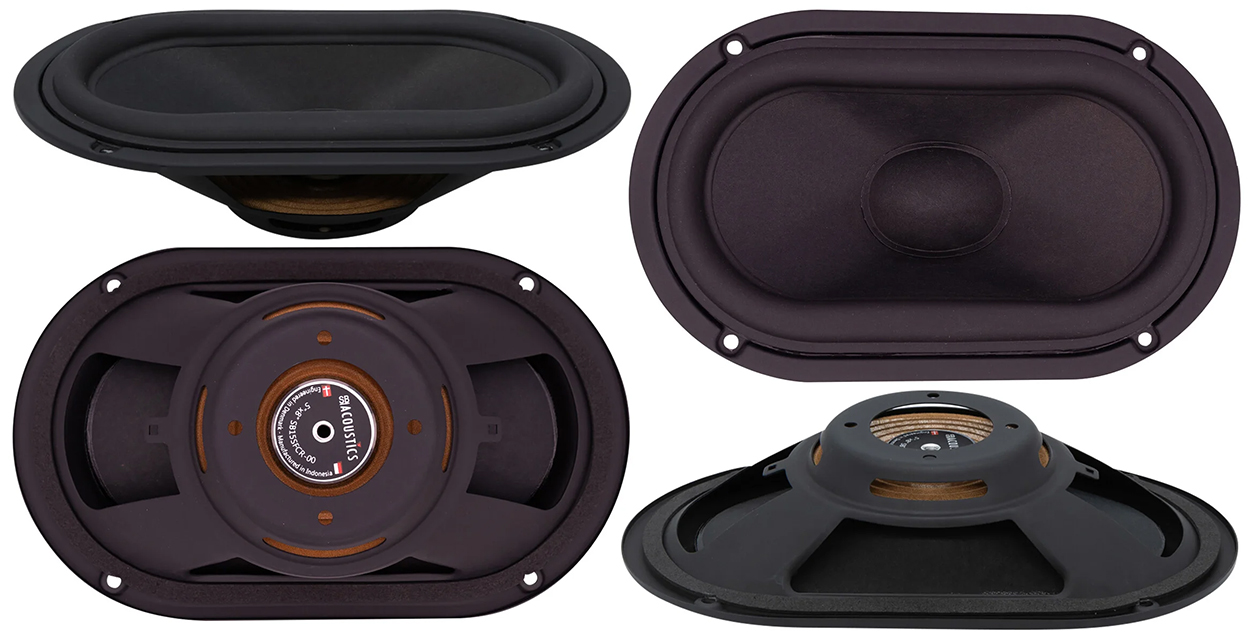 A 5×8" ABR example from SB Acoustics.
"Across their range, we essentially treat them like active woofers. They are limited since the active woofers set their max excursion. However, for scale, pressurization and sheer impact around the tuning frequency, they can be viewed like normal woofers. They almost behave like a passive subwoofer driven by the main cone's energy. It's not just about cone area (Sd) but moved air volume (Vd). My Dayton radiators have a maximum excursion of ±19mm, essentially twice what normal woofers can do. For Cobra, six radiators per side have a total Sd of ~817cm² and Vd of ~1'552cm³. Many 15" woofers have an Sd of ~830cm² but to maintain 19mm excursion, we'd need an active 15" sub. Cobra is smaller than a 15" sub. Of course an active sub would be able to do more since ultimate output of the radiators is set/limited by my two Dayton mid/woofers. Still, it's an incredible solution. Even more intriguing with multiple radiators is that the internal cabinet volume now has very little influence on the tuning frequency. Since that depends on the mass of the radiators as much as internal volume, we can simply add a bit more mass to all the radiators to shave off enclosure volume. We can make the box smaller." By that math, two 6-inch radiators compound to the cone surface of a single 8½" woofer which we were just told is a perfectly legitimate way to look at their MO below the active mid/woofer's self resonance. It makes the E50-S into a kind of 8½" 2.5-way. That's no formal tech designation, just a useful way to think about it. It's how a ~13-litre box of friendly sensitivity and high SPL capability can breach the 40Hz barrier without turning into a pipsqueak. By using two round rather than one oval radiator, the rear baffle retains a small divider brace between them as shown in the earlier photo. That keeps the wood panel stronger. This now wraps the foreplay. More when the samples drop. They'll have their work cut on in five different rigs 'n' rooms, from desktop to 2.2 television system to three 2.1 systems, all subs bypassable if neither needed nor wanted.
… to be continued…