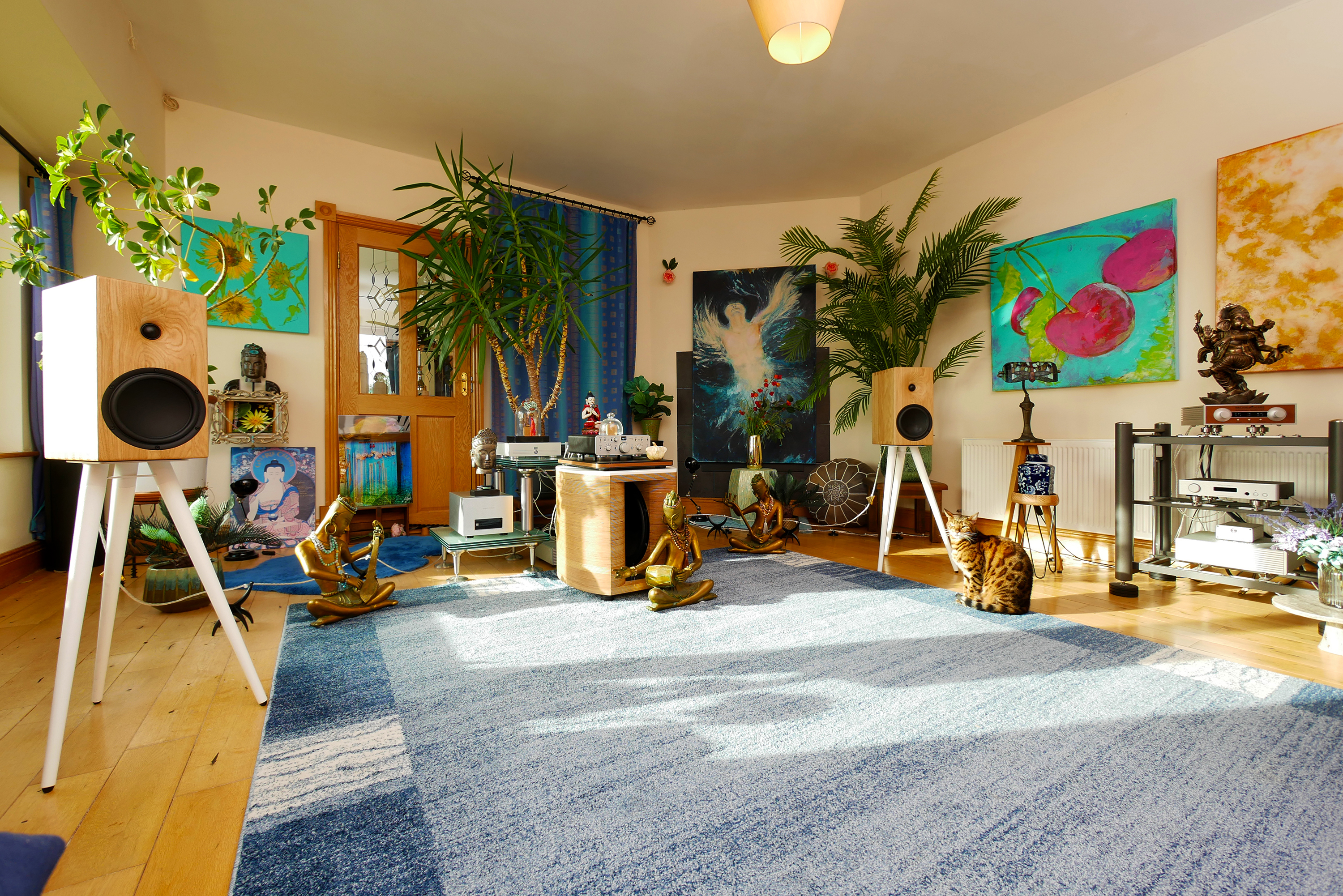
 Screw any screws the Danes probably thought as though my bigger room posed any issues. Even Chai Baba the cat basked in rare rays. No sunglasses needed when you can squint. What challenges? With a dual 15" folded dipole sub in residence, each of its AudioTechnology woofers powered by a 700-watt NC500 mono, this room is very familiar with true LF. I ran the Buchardt through my spl Crossover MkII's usual frequency division before defeating the filter and powering the sub off. It showed how even in this scenario the monitor was perfectly self-sufficient. Just because the S version is openly said to make less bass than the first E50 shouldn't imply any waif. This speaker is well fed and hung. Whilst omni dispersion below its ~580Hz baffle step of 20cm width triggered more room gain than my self-cancelling cardioid sub and open-baffle mid, it meant only minor thickening; unlike many a prior rear-ported speaker here. Of course as they always are in these front corners, two active PSI bass traps absorbing pressure below 150Hz were in on the act.
My speaker reference for this system is this Qualio IQ 3-way, a OB hybrid whose Mundorf AMT and 6" SB Acoustics Satori papyrus cone operate dipole before handing off to a 9½" rear-ported Satori woofer. Unsurprisingly, an open-backed air-motion transformer displaces more oxygen molecules front and aft than a monopole silk-dome tweeter. That acts more dynamically exuberant. In free space particularly, it also triggers lengthier decay trails. Now add an open-backed midrange with zero thru-cone reflections from box loading. It gifts IQ with a very particular gestalt. It combines liberated scale, uncorked airiness and slightly ephemeral quicksilvery spatiality. Even its no-nonsense designer refers to this mix of attributes as "esoteric".
By contrast the E50-S was more matter of fact, less outrageous on sheer scale. Yet on tone density it arguably had the edge. It's how we'd generally expect larger midrange cone surface to factor. Zu's signature 10.3" widebander is a master thereof. The usual payment are a few degrees of lower presence-region opacity. Of this the TeXtremist was categorically unguilty. Au contraire in fact. It managed the tricky tightrope act between speed and substance, energy and mass, adrenaline and comfort very well.
At this juncture I did the typical reviewer thing: check on the inner lust meter. If what we own eclipses a visitor, it doesn't even move. If things are on par but the intruder charges a lot less, the needle could be rather twitchy. If things improve whilst cost intimidates, the twitching could stop. But if things improve and cost drops, our kind could enter the redline zone of heady concupiscence. That reads far better than lechery. On said score, I remain married to the IQ. For my tastes, the E50-S didn't dethrone it though allegiances aside, I could easily swap without feeling demoted. It's a compliment in its own right. The upstairs nearfield showing was a draw against the resident 2.1 install. With those presentations far more similar than not, the Buchardt's completeness of subtracting need or desire for a sub had been a very practical advantage. I simply already own sub and crossover. That sent the needle counter clockwise again. On my desktop meanwhile, the Buchardt had left two dead bodies behind. Concupiscence indeed. Still, my available listening stations weren't exhausted yet. I had two more. Thus far I'd given the visitors plenty of front-wall clearance. Would these rear-aiming radiators respond equally happy to being far closer? The diagonal setup in my small video system would have that answer.








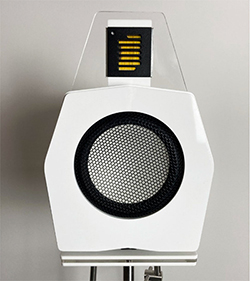 As part of my 5-year remodel from classic stereo 2.0 to 2.1, these 6.2" 2-way ModalAkustik MusikBoxx monitors were a most strategic acquisition. Not only are they my in-house ceramic reference to stand in for modern ultra-stiff cones à la Accuton and Raidho whilst sporting my beloved dipole Mundorf AMT. Their very compact sealed alignment requires a subwoofer. Published -3dB response is 78Hz; at a low 82dB sensitivity. As such one doesn't buy extra bass only to let a sub subsequently castrate it. One buys just enough mains bass to hand off cleanly to a separate LF maker without throwing away anything one already paid for. Hence twin 15" Zu Method subs anchor this foundation. As of November 2026, this was my last remaining 2.1 install without external xover. I'd already commissioned one but there it was still early days. For the Buchardt guests it simply meant no power on the subs. The full-range signal ran as usual out of GoldNote's IS-1000 Deluxe integrated. Naturally its display leader board posted rather lower volume figures with another 11dB efficiency gain on the speaker side.
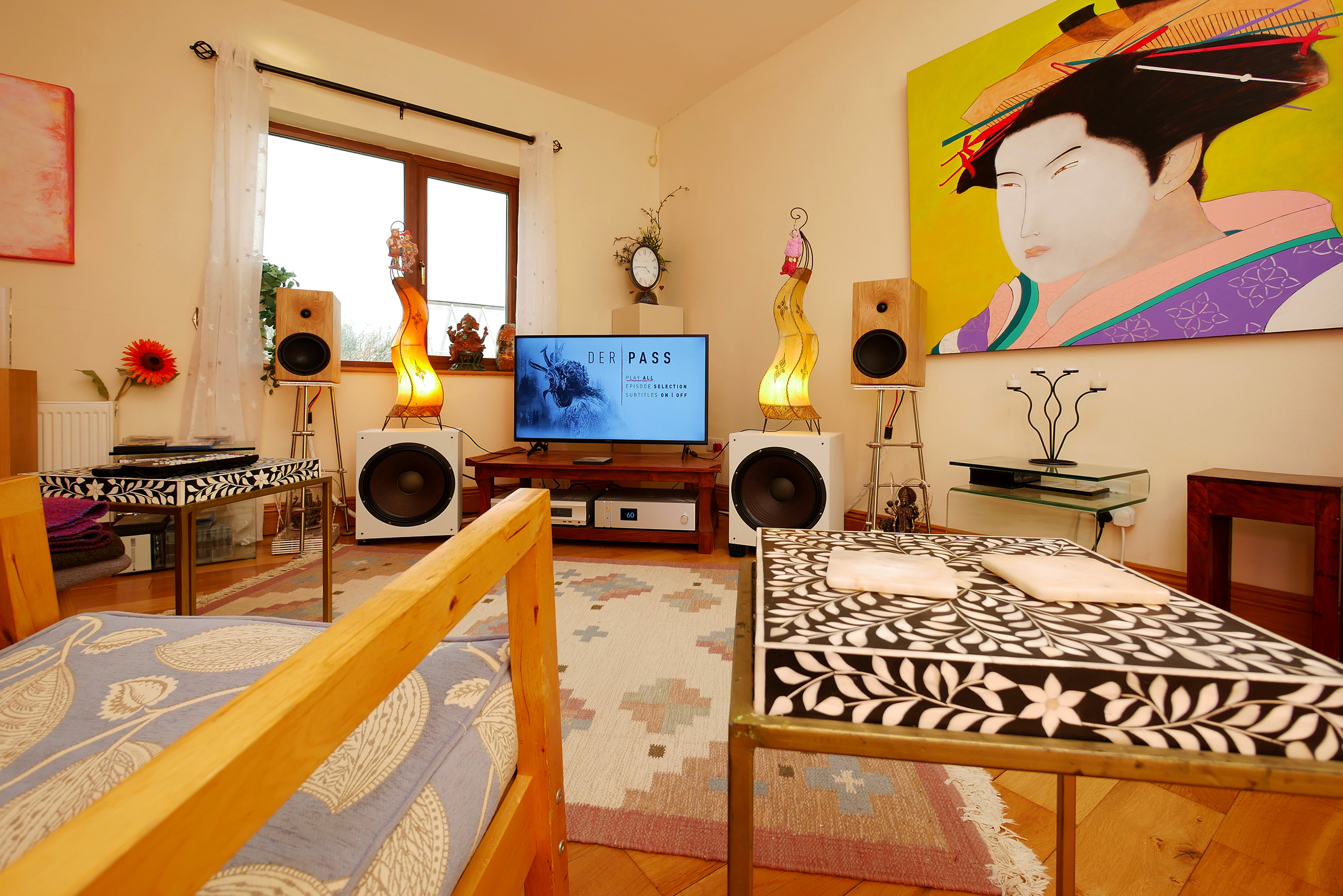
On a quick aside, nearly square rooms often do well with a diagonal setup. It also supports closer front-wall placement with less than the usual impact on soundstage depth. If you have a troublesome space to work with, do consider experimenting with layouts which angle to sundry degrees. You could be pleasantly surprised. In this setup, the E50-S radiators were within a hand's width off the front walls since my usual sealed boxes don't care and I deliberately didn't move their stands. The radiators didn't care either. I heard no ill effects. The biggest offset—for movies where unnatural LF are far more common than on music—was the sheer displacement of face-on 15ers squashing the physical impact of 7.5ers. Be it a soundtrack's deliberately subtle attempts at infrasonic dread or blasting impact mayhem, for video the 2.2 install went to deeper more tactile places. On speech intelligibility the black SB cone was as keen as the silvery slightly smaller Accuton. This A/B's real difference makers were those Eminence-based sealed woofers. They weren't primarily about extension though occasionally that factored, too. Their primary advantage was sheer shockwave physicality of larger bass artillery. That of course merely states the obvious.
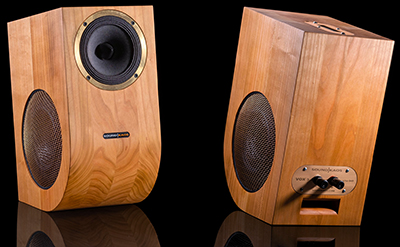 Just so, it's a fair reminder. There's a vital distinction between small and big-woofer LF. Already premium headphones can hit 25Hz. It's a tempest in a thimble compared to big-woofer speaker bass which also differs from reaching nearly as low with modern small drivers. Where articulation and pert stoppages for taut timing are top priority, small woofers can enjoy an edge. Where sheer physicality and scale are talking points, great surface area becomes a must. It could spread across paralleled smaller woofers or be one mega cone. On that score the Buchardt clearly makes small-woofer bass—of fabulous reach for its cubic volume but demoted to normalcy on raw frontal cone size. It's this line-of-sight moving mass which determines raw physicality. Woofers which fire sideways, down or backward don't register the same. Of course we don't miss what we never had. If we don't arrive from big active woofers, said distinction is mere theory. Now it won't be a qualifier tacked onto the E50-S. Now it simply impresses, period. In my case, I couldn't unknow the familiar. On this score, the 4th showing with video content least pegged my needle. But I had a 5th for pure tunes; with 2×12" folded-dipole sound|kaos sub. With an electronic analogue 120Hz frequency split, dipole LF dispersion generates a solid 25Hz without triggered <100Hz room modes—a real boon for a narrower room with higher lateral resonance. Upholding the spectrum's remainder are these €12.2K/pr sound|kaos Vox3 all-wood monitors. Like the Buchardt, in this space they don't need a sub. But figure-8 radiation linearizes the low end's in-room response. Effective acoustic treatment. Then the sub bolts on ~10 cycles where that matters; and larger extremely self-damped woofers move more air with more snap and crack to scale up. Having carefully assembled this hardware for maximum effect, the E50-S merely dropped in for the thrice-priced Swiss. Hello dedicated 2.1 configuration; for music not movies.