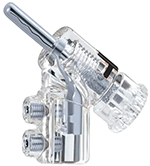
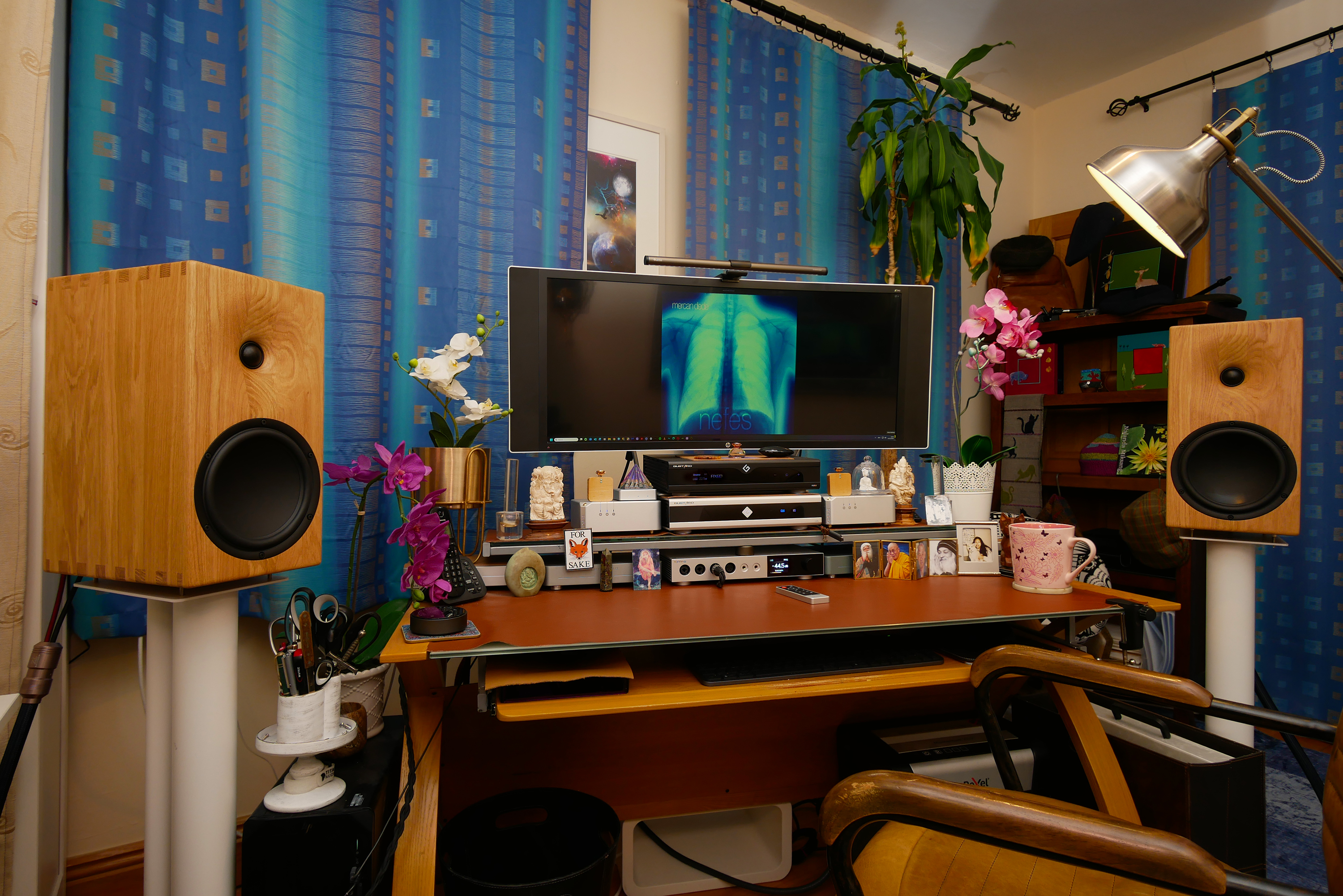
 … Irish Revenue's curious custom agent had gotten there first. Their agency's tell-tale red-on-white tape sealed the deed. But the lazy sod hadn't put the speaker he pulled out back into its protective cloth sleeve. No harm, no foul. All arrived in perfect nick. That included those enormous Argento terminals. If you're Sam Spade, you've got the right high-torque name. But if your banana be crooked like my locking angled WBT, Argento's contact sleeves sit too deep¹. You won't reach even with their inner metal barrel removed because the outer plastic barrel remains the barrier. I've got three different cable sets fitted with these German crooks. Thankfully an aggravated grave robbery in my hifi cemetery unearthed a massive set of silver Allnic cables. Standard inline 4mm. Hurray. With bananas straightened out, I was in biz, my office in sound. From my usual dipole Mundorf AMT to suddenly a dome tweeter—three of my speakers run dipole AMT, one a monopole, one a Raal ribbon—would take a few tunes to acclimate. Not so for twin-radiator bass assist. My usual office workers do the same long-throw business; V-twin force-cancelling style, one per cheek. Even their Jantzen-based filter pedigree carried over. What didn't were the figures on my Topping preamp's display. Its resistor ladder had to obviously cut more voltage than on the Polish residents to keep my remaining hair from moving. Before going sonic, about those looks. I thought them positively splendid. My hand delighted in brushing across the ultra-smooth oak and rounded edges. My model-year 1962 eyes applauded the utter absence of branding in full frontal even side view. Perhaps it's too hygge for young punks and turks? Yet if you're prepped to drop €4K on compact 2-ways, you've been 'round the busy city square. You could be ready for something more countrified and low key. Other reviewers, of other Buchardt woodies, called their looks polarizing. I must have lived in rural hinterlands far too long. I can't even relate to such divisiveness. But if these aren't you because of cosmetic conservatism, you checked out pages ago. So that's settled. They are deviously dapper; Dansk style. As I learnt soon, they're also brilliant nearfielders. With properly tall stands on either side of a work desk, their size is just right. On most desks they'd be rather too big. Resonance-generating stuff simply doesn't belong there. One could fudge with table-top decoupling mini stands. Been there, done that. Going off-desk is far cleaner all around; for work space, sonics even soundstage breadth. That too is settled then.
_____________________________
¹ From the tip of the seated banana, I measured 52mm down its barrel before it cleared the inner Argento cylinder. My lovely WBT nextGen only have 20mm before the V splits off. That's too short by more than half. Argento—hello?
Thin-walled stiff wood is an excellent energy shedder. It doesn't hold on. It lets go; rapidly. A quick hands-on demonstrates how these Buchardts do it; like an acoustic guitar. It's naught drastic, just a constant rather fine action already felt at nearfield if happy SPL. Did it help these boxes sound so unstuffy and open? 'twas a fancy thought. As a concept it obviously differs from mass damping. That aims to kill reactive material vibration with heroic builds. Magico to the metal rescue. This solid-wood behaviour is about quick release, not choking such energies unconscious. Before that reeks of jiu jitsu or juju, another belief: higher speaker sensitivities quicken dynamics. Mathematically they probably shouldn't. Recorded dynamics are fixed. If we sink enough power into given drivers, they ought to track what's recorded as it was recorded.  In practice though, it routinely seems that more efficient conversion of signal voltage into acoustic output is accompanied by livelier more responsive dynamic contrast. Whatever the real math at work, the E50-S certainly felt aspirated. Expressive not stuck up. Engaged not bored. Microdynamically informative not hard-to-read small print. Running through Mercan Dede's Nefes, this hand-on-the-pulse feel extended to the low freqs which our composer/DJ loves to season with. They were adroit, articulate and finely formed. That meant decidedly not underdamped or woolly as radiator skeptics could suspect. Whilst well-developed bass can introduce warmth if its textures are looser and/or its amplitude lays on heavier, it's not how these Danes tune. Though most admirably extended at a proximity where just a slight forward lean had me touch both speakers with straight arms, they weren't bassy, bloomy or bottom-up. If my music were a talkie's soundtrack, I'd next call out brilliant dialogue intelligibility. In the name of realism, many modern actors mumble against location din and musical ambiance set too loud. Now it's child's play to realize when we drop words; entire verbal exchanges even. Subtitles to the rescue. On my desk, it was nearly as easy now to notice the exact opposite; on instrumental music with no missing-word markers. To press the point, we might say that Buchardt's midband resolution was such that my tunes suddenly came with their own subtitles. It seemed a function of both high separation and articulation plus that micro-astute tracking of individual lines and their small inflections and accents. It made easy sense of complex arrangements. Superior legibility. That's a different form of res than bright HF. It's true vocal veracity. Wordless instruments across this midband behave exactly the same. This inside-out obviousness opens up musical structures. We experience intersecting harmonies, melodies and rhythms—simultaneous yet discrete. It makes their coincidence spontaneously comprehensible. That's more delightful. To go fancy, we might call that deeper acoustical seeing; superior sonic glasses. In the same mode, we could invoke organic full resolution because the E50-S's easeful intelligibility shuns the crutch of treble spotlighting or over-honed transients. Given what typically associates with it, these wordings are my attempt to avoid 'hi-rez'. It is that; but not in the usual more primitive meaning.










Contrasting my resident refines meaning. With its extreme-stroke carbon-fibre Dayton Epique mid/woofer built like an inefficient miniature subwoofer and matching horizontally opposed radiators, Virtual's Viper plays it bassy, warm, chunky and thickish. Its open-backed pleated tweeter bolts on high top-down dynamics and some airiness and sparkle onto an otherwise darker richer gestalt. That focuses more on macro gestures and textural substance than micro motions and twitchy reflexes. The Danish soft-dome tweeter was less dynamic than the dipole AMT yet phenomenally pure in its own right. My usual treble-chaser cuts spotted no lacking reach, just minorly shorter decay trails. Yet the overall resolution of the E50-S was demonstrably higher. Unusually I experienced this as an inner radiance from the midrange out, not any tweeter-first illumination like sunlight streaming through a cabriolet's open roof. This effect also didn't feel like the typical small unfiltered widebander lift which contingent on recording can inject freshness; or shoutiness instead. The minor response liberties designed into this speaker which support its 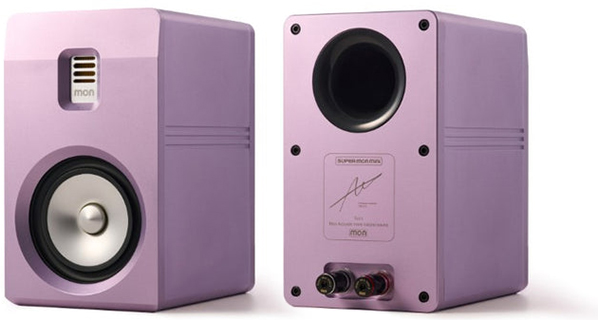 undeniably insightful magnification powers—more on that later—had zero sharpness. Even some of my overcooked Arab Pop evinced no sizzling oil residue or deep-fried edging all whilst being fronted by lucid low-feedback GaN-based class D. At €5'412/pr in my white 3D-printed finish sold workshop-direct, Virtual's smaller Viper sits high on my value meter. The Buchardt simply sits higher still. Both speakers reflect conscious voicing decisions. Neither is a generic paint-by-numbers effort. The Pole is the equivalent of classic class A muscle amp expectations—big, bold, smooth, warm, potent. The Dane is closer to a premium modern switching amp like AGD's where clarity, transparency and speed carry the day. On my desktop, the E50-S was love at first listen.
Moving into my other nearfield system meant more crooked bananas. So I went straight again with the same thick leashes. Here the amplifier is a €259 Aiyima B07 Pro. It duly capsized under the cables' weight until I added a 2kg damper plate; see two images below. Think very small TI-based 450kHz 100w/8Ω chip amp with upgraded 48V/10A outboard laptop switching brick. A Simon Lee i5 integrated precedes it via its pre-out. That injects some class A discrete preamp substance. If you're blasé, the Aiyima reads far too declassé. If you actually listened, your tune would change. Blasé moi. My usual Dynaudio 18S sub of opposed so force-cancelling sealed 9½" woofers proved quickly unnecessary. It could remain off. Hence my usual high-pass for these tiny speakers bypassed, too.
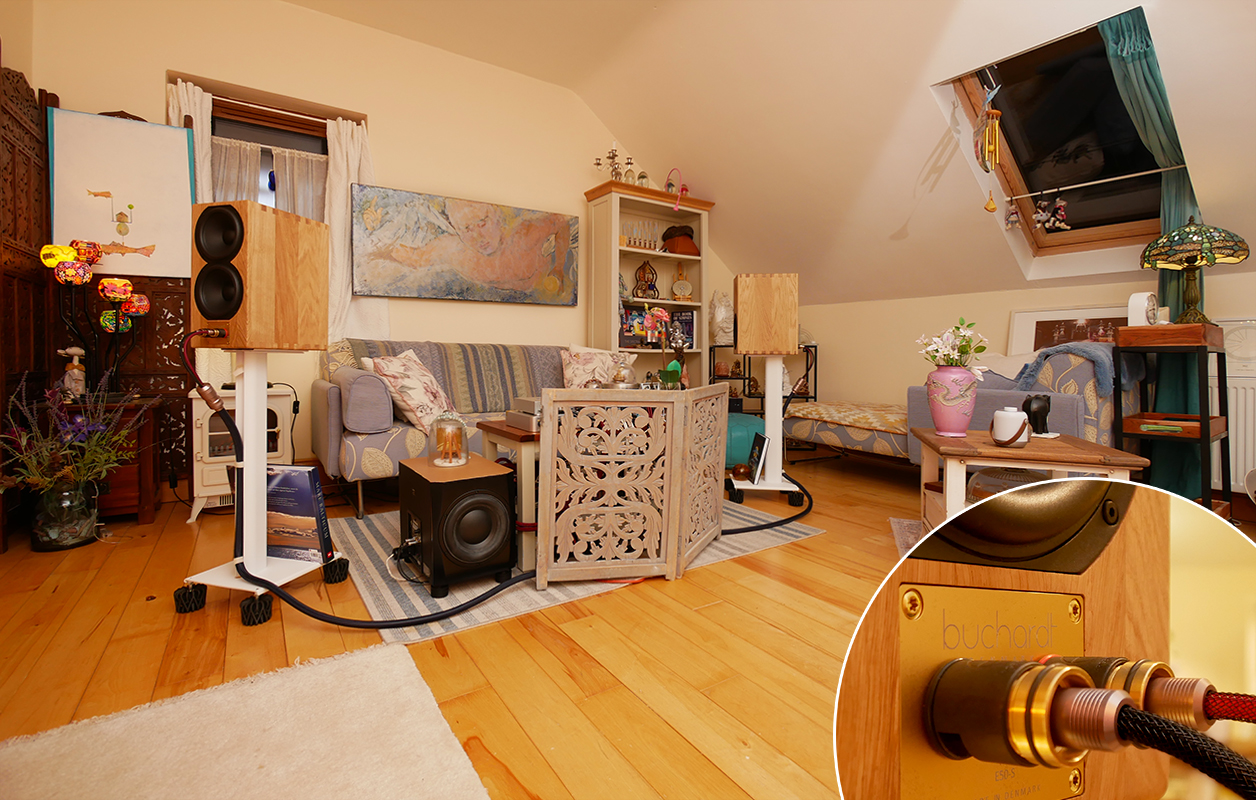 With straight bananas, having their plugs nearly swallowed up by these extra-long barrels is no issue.
I call this my inverted nearfield setup. I sit against the wall. The speaker backs face loads of free space. That removes most the room from the equation. Steeply toed-in wide spacing at very close proximity generates superlative staging. The sound isn't distant. Rather, it's as though my face pressed into the translucent skin of the overall soundstage bubble. It's quasi immersive and most similar to headfi—just times ten and ejected from the skull prison. I also call it my bonsai system. That's because the five tabletop components—microSD server, I²S CD transport, DAC, preamp and power amp—are all half width or less. My usual speakers here are the above lilac MonAcoustic SuperMon Mini. They identify as aluminium-clad isobarically twinned 4" widebanders with micro 15kHz AMT. I actively high-pass them at 120Hz an octave above their native cut-off. The sub low-passes on the same 4th-order Linkwitz-Riley slope for a mirror-imaged phase-consistent transition. With the Buchardt's broader bandwidth, that filter scheme wasn't needed. I ran it like most all buyers will; unfiltered; full range. Whilst Mads' 7½" cone wasn't quite as intensely resolved as my far smaller 4" Markaudio Alpair, it came surprisingly close. The main difference? My residents render space even more lit up. It's even cleaner and stiller. That cranks contrast to the max; what I call suchness. Buchardt space as the fill between images was a bit darker for slightly softer contrast. Unexpectedly close too were its bass textures vs my usual sub's. They were just a tad paunchier; not quite as wirily damped. Even where ultimate reach went, on most music the sub's small advantage didn't factor. In short, virtually matching performance from two not three parts; and no active crossover functions involved.
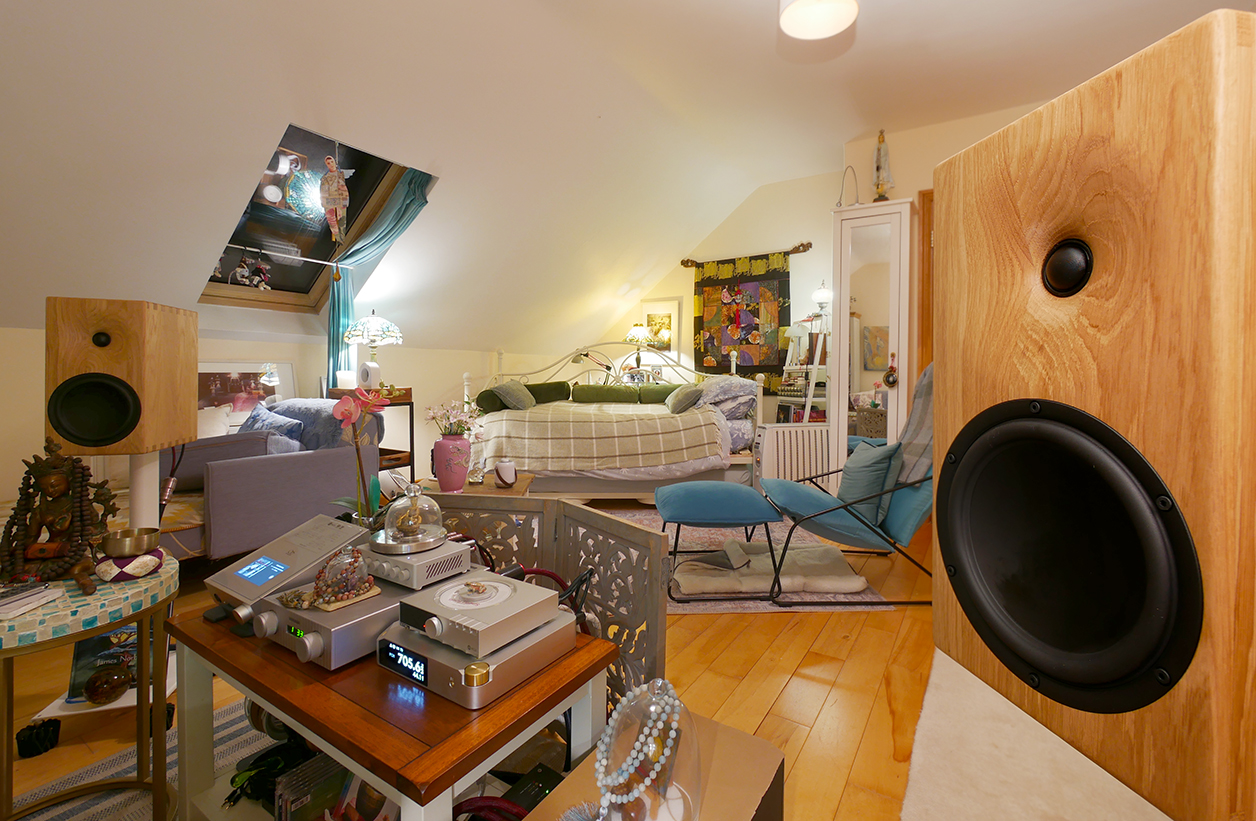
Let this register. In nearfield conditions, bass control and extension came close enough to my 500-watt Dynaudio sub to decommission it. Staging focus and energetic liveliness proved nearly on par with a highly specialized radically smaller unfiltered widebander sans inner suspension called spider. A spider is a typically corrugated impregnated cloth which centers the voice coil whilst actively resisting the outgoing stroke. The music signal pushes, the spider breaks. It's a lossy proposition. Just so, this sensitivity-groomed TeXtreme® mid/woofer from SB Acoustics clearly was a top-performance and hi-tech specimen, its resistor-free custom soft dome a seamlessly continuous mate. In my two close-proximity installs, the E50-S absolutely ruled. Personal perfection. Major lust bumps. Time to turn the screws in my main system?