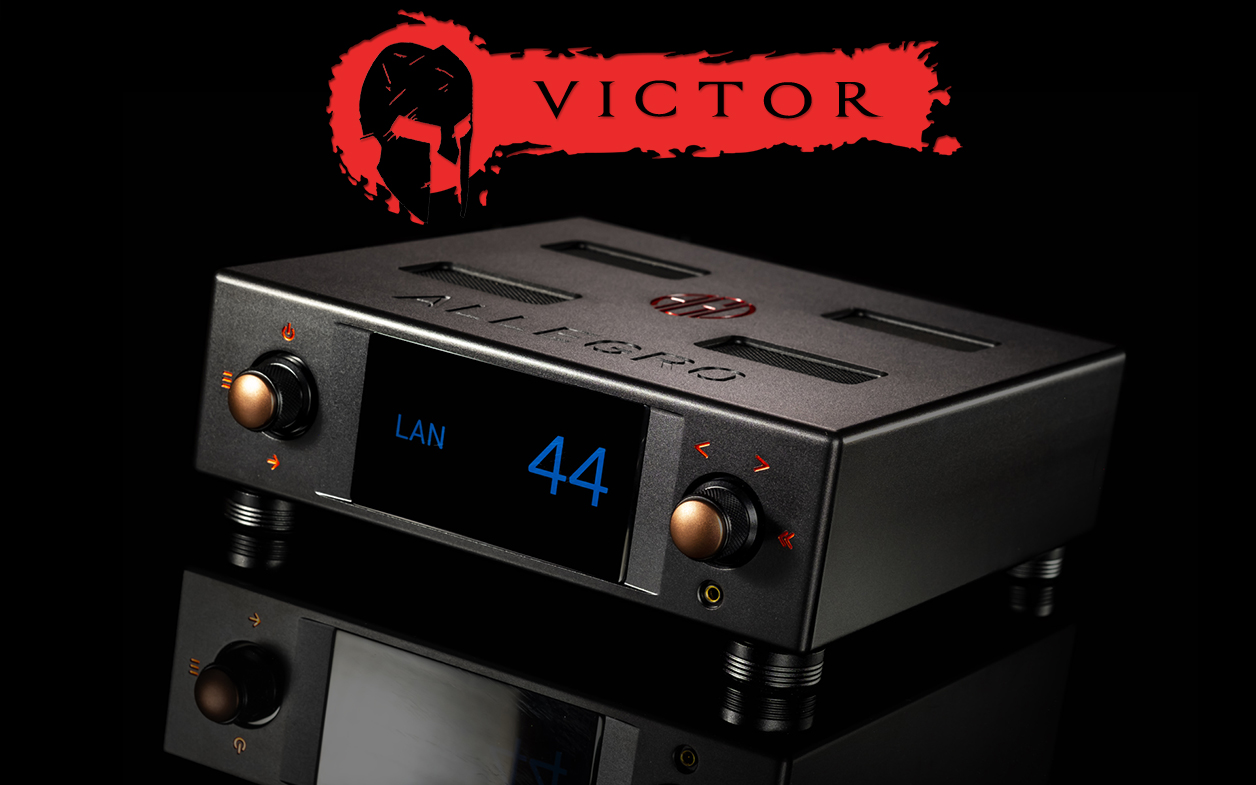
The last time I experienced a comparable degree of insight, immersion, elasticity, expressiveness, tactility and sheer delicacy was when the FirstWatt SIT-4—one of only two amplifiers I consider the finest pieces of hardware I ever had the privilege to host—spent time in my system. I'm not suggesting that in a direct A/B, the SIT-4 and Allegro would sound alike. Rather, despite different sonic identities and a two-year gap between reviews, both evoked a remarkably similar intensity and emotional response. Every now and then, with the right recording, they had that exceedingly rare ability to strike exactly the right nerve and leave me listening with moist eyes. To be clear, such moments are exceptionally elusive therefore memorable. I neither anticipate nor avoid them; they simply happen when they do. I've learnt to treat them as perhaps the most reliable indicator that the component on my workbench is something truly special. It's only fair to admit that I initially did underestimate Allegro. I didn't expect the concept to be this capable. Looking back, I suspect much of its profound impact stemmed from the fact that it never placed its explosive qualities on a pedestal. Exceptionally muscular, fearless and authoritative though it undoubtedly is, it never flaunted these traits. Instead it behaved as though perfectly aware that such abilities were present yet deliberately drawing my attention to qualities which class D amplifiers are still rarely celebrated for. In doing so, Allegro quietly but unequivocally challenged long-held preconceptions and did so with remarkable confidence and complete conviction.
In that regard, Allegro dismantled the usual stereotypes much like several other outstanding designs of its kind did which I hosted earlier. That in itself wasn't my true revelation yet. The next genuinely intriguing moment arrived when I set the Boenicke W11 SE+ aside and partnered the AGD with my sound|kaos Vox monitors. These compact Swiss loudspeakers happily make music with virtually any amplifier yet unusual as they are, refuse to reveal their full potential unless driven by my Trilogy 995R monos biased in pure class A—or an amplifier of similar topological pedigree. Allegro changed that equation. The little Swiss monitors sounded positively wicked while simultaneously revealing just how spectacular Alberto Guerra's latest creation is in spatial terms. Particularly striking was the way it rendered images with finely sketched outlines and an almost uncanny sense of physical presence, a quality I had previously considered to be one of my LampizatOr tube DAC's defining strengths. The sound from this pairing was as remarkably intense in colour, zesty, elastic and vivacious as it was quick, spatially outrageous, direct, instantaneous and precise. Although some upper-bass bloom and body naturally disappeared in the process, I greatly appreciated the iron grip Allegro exercised over the Vox below the waistline; how effortlessly they manifested their true bottom end. More importantly, nothing about this struck me as artificial or contrived. Instead it exhibited remarkable correctness, balance, order and natural coherence. Perhaps more than anything else, that caught me off guard. Neither had I seen coming that an amplifier this resolving and quick-footed could render images so present, tangible, substantial and close to the seat. Having lived with these Vox for ~7 years, I hadn't expected a class D amplifier to unlock this level of performance. Instead I had anticipated a sound that would be predominantly mechanical, explicit, well illuminated and decidedly big-bore but certainly not this artful, sensual and alive. I also appreciated just how silent these rather sensitive monitors were when fronted by Allegro in the absence of music. Here this amplifier was indeed squeaky clean.











My above confession paints the picture of Allegro when I used it as intended so an all-in-one device. Still, I couldn't resist to eventually front it with my own DAC then streamer. While the resulting shifts in overall balance and the accompanying list of sonic gains were readily apparent, detailing them feels largely redundant. Allegro already accomplished such an extraordinary amount as a self-contained design, explaining how its performance can still scale when partnered with standalone components of grossly higher ask misses the point. Anyone contemplating such an exercise no longer evaluates an all-in-one component but considers an altogether different proposition. In fact, I'm willing to bet that most listeners exposed to a system built around this AiO and my sound|kaos Vox monitors wouldn't even contemplate adding more boxes for a very long time. That said, I'm sure that many seasoned audiophiles will instinctively dismiss the Allegro. To them, an all-in-one component—however accomplished, however costly—simply cannot compete with dedicated separates. The inconvenient truth is that this one very much can. It also suggests what the industry's performance peak may look like in a decade from now. The difference is that Alberto Guerra has arrived there well ahead of schedule already. Beautifully voiced and visually understated, his latest design drives home the point that genuine high-end can dress up as a single inconspicuous box that takes up very little rack space and needs only a pair of speakers to accomplish things it frankly shouldn't. Currently I know of no competing AiO that performs at this level. The award merely acknowledges that reality. Those intent on building a minimalist system capable of extraordinary things should take note.
Publisher's comment: During an email exchange with the designer, I learnt a few more things which are pertinent to Dawid's review. "Our headphone amp is a fully differential class A design without global negative feedback, a ±7.5V linear supply and voltage gain of ~22dB. Output power is 175mWpc/300Ω in pure class A or 1wpc/32Ω current-limited into class AB above 190mW. At 7VrmA, a 300Ω load of 100-105dB/Vrms produces ~117-122dB far beyond sane listening levels. For a 32Ω planar of lower 95dB/Vrms sensitivity, 6Vrms still generates ~110dB. At realistic levels, say 90dB average, the load will draw single-digit milliwatts and sit deep inside class A regardless of impedance. The 1wpc/32Ω spec provides headroom which anyone sane will be very careful to use for any extended time. The output impedance is 0.4Ω nominal well below the 1/8th-of-load guideline for every headphone impedance past 16Ω. Hence the driver's own impedance curve won't produce audible response deviations due to attenuation issues. We decided to address the requirements for our headfi amp with a dedicated circuit. We chose pure class A with zero global negative feedback. This decision was based on the small output power requirements and sound quality. Using a dedicated resistor attenuation method to take the power directly from the speaker outputs was an option but would have required additional power-rated relays to impact the size and reliability of the finished product. Ultimately we decided on a dedicated power stage but we do have scores of hardcore headfiers who use our Audion/Tempo amps with headphones via dedicated network adapters, some even directly. There are a few Asian fora reviews on it. They all use electrostatic headphones and are super happy. To waste no energy and have the lowest possible interaction between our headphone circuit and other parts of the system for the lowest residual noise when a headphone connects, the main power supply and class D GaN stages turn off completely; and vice versa. While we won't share intrinsic tech info of our designs, I can comment that the adaptive deadtime circuit in our products is typically from 10-25ns, varying with operating conditions and power. Deadtime isn't the only concern when talking about how any class D output stage sounds. Many more elements need to be considered. One can have very small deadtime—zero of course is physically impossible—yet terrible ringing due to parasitic elements of the layout. Marketing claims for smallest deadtime can be confusing. One may need to check how such figures are obtained. It may involve an unwelcome increase in switching losses, some shoot-thru issue hence more heat and stress on the parts. Is the industry's continued use of silicon over GaN technical preference or inertia? Again, I won't comment on our competition but simply say that we pioneered GaN tech on our class D platform so may know a few things others haven't caught on to yet. Learning is a process of trial and failure. That takes time and money. Sometimes it's better to play a game one knows."
About two core approaches to class D circuits, "because of our professional rules and ethical standards, we won't comment on any competitor's products, brand, marketing strategy or technical choices. However, because this type question arises often, I recently decided to share what Claude the Anthropic AI model replies when asked questions we get in certain audiophile fora, from customers even dealers. Here is the answer Claude shared on a public forum. So, re-affirming our no-comment position on the work of competitors, "the two companies address the same problem—distortion in a class D output stage—from opposite ends. Purifi correct the distortion; AGD try to avoid it in the first place. The conceptual breakthrough behind Eigentakt/Purifi was Bruno Putzeys and Lars Risbo identifying a source of distortion that most class D designers had underestimated: hysteresis in the output inductor (they call it iron distortion). The ferromagnetic core has a memory effect. The flux at a given point on the B-H curve depends on the path taken to reach it. This nonlinearity is heard as a grainy sonic texture. Their fix wasn't an exotic perfectly linear core when no such material really exists. Instead the principle is what they call EigenTakt ErrorCorrection (EEC), a "full-output feedback" architecture. It's a correction circuit which encloses the entire power stage including the output demodulation filter inside a loop. That is run at extreme gain of >75dB across the audio band, corresponding to roughly a 110MHz gain/bandwidth product. When the filter inductor produces a hysteretic artifact, the loop suppresses it with >75dB of compensation. Notably Purifi achieve this with ordinary silicon Mosfets at conventional switching frequencies. As one summary put it, their secret sauce is the very high loop gain and carefully designed stable feedback network. The payoff is THD+N around 0.0002% or lower, sometimes below the test analyzer's own residual around -140dB. Alberto Guerra who worked on the team which developed GaN tech at International Rectifier builds around gallium-nitride Mosfets in both his output stage and power supply. GaN switches far faster than silicon. This lets AGD run an unusually high carrier frequency. Where many quality amplifiers operate at 200-400kHz, AGD's run at ~800kHz, making PWM comparison much more precise. More broadly, GaN's speed reduces distortion and enables a very simple output filter. Guerra also leans heavily on supporting elements. He argues that roughly 50% of any amplifier's performance comes from its power supply, extremely short signal paths (millimetres not centimetres) and careful high-frequency PCB layout. Purifi accept that the output stage and its inductor will distort so wrap enormous carefully stabilized negative feedback around it all to erase that distortion. It's a correction philosophy with feedback as the hero. AGD instead try to generate a cleaner waveform at the source through very fast GaN switching and a robust supply, relying on comparatively less aggressive global feedback. It's a prevention philosophy that sits closer to the low-feedback tradition some audiophiles prefer. That difference is exactly why Purifi tend to post the lower raw THD+N numbers. Maximizing loop gain is the most direct route to minimizing measured distortion and Purifi push that harder than almost anyone. AGD's pitch is less about winning on the measurement charts and more about the character of fast switching plus minimal feedback. One caveat: AGD don't publish the same exhaustive THD+N-vs-power-and-frequency data that Purifi do so a precise head-to-head distortion figure for AGD is harder to pin down than the marketing-level comparison suggests."