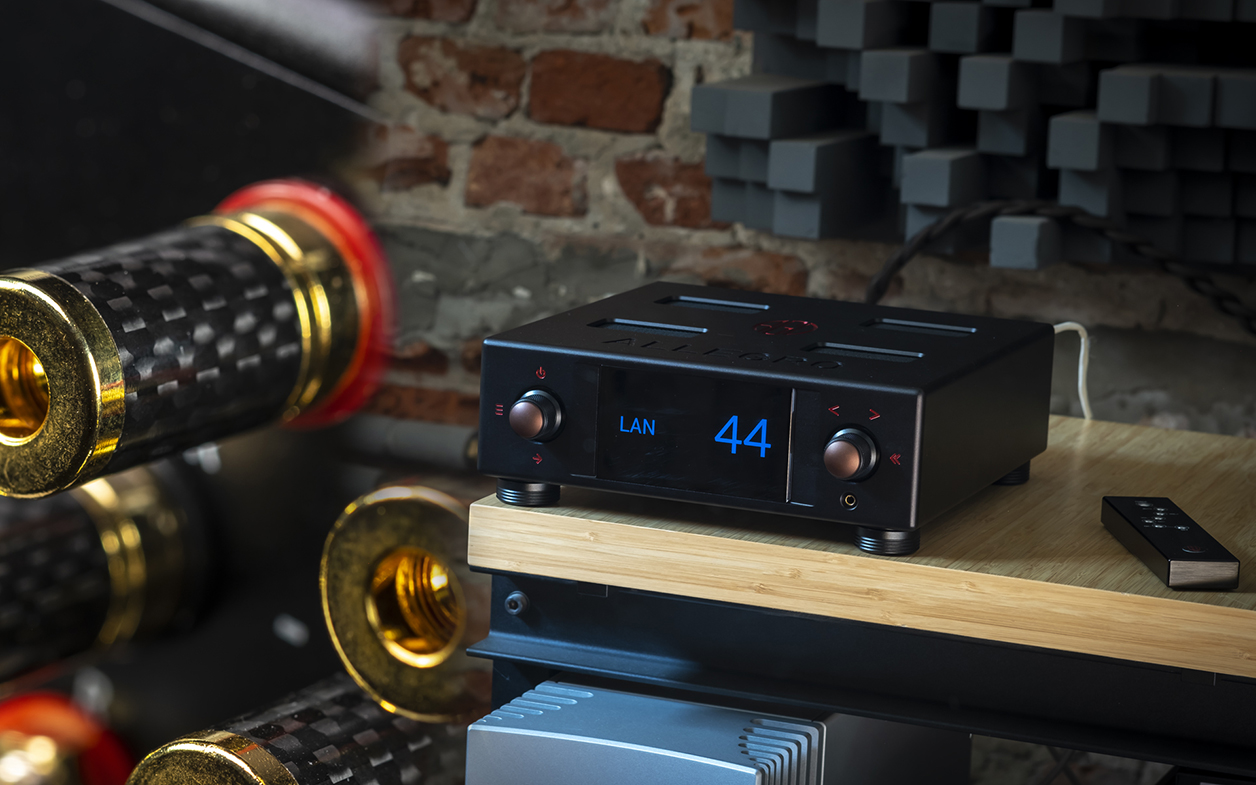
Although Allegro packs features about which much could undoubtedly be said in isolation, I decided to review it as I suspect most buyers would use it: as all-in-one. Accordingly it replaced virtually my entire reference system save for power distribution, speaker cables and the two speakers that serve as my daily drivers. In doing so, AGD's newcomer effectively found itself squaring off against a roughly 9 x (!) dearer front end¹ comprised of an Innuos Statement Next-Gen server/streamer, LampizatOr Horizon360 DAC and Trilogy 915R/995R pre/power trio. Making the necessary comparisons proved surprisingly painless. All I had to do was mute the Trilogy 915R preamp, swap speaker cables, unmute Allegro and select it as the active playback device in my Innuos app. Hardly a chore when I once again appreciated being able to control both streaming platforms from the very same smartphone app without any downtime or reconfiguration. Whenever Allegro took centre stage, the Innuos assumed mere NAS duties. Before delving into Allegro's sonic performance, one practical aspect is worth mentioning. A quick glance at the rear panel reveals how tight it gets around the speaker terminals. With these posts in close proximity to the IEC inlet, Bluetooth antenna and analog outputs, Allegro prefers speaker cables with banana/BFA plugs. Spades and bare wire will work fine but installing either requires a bit more fiddling because there's very little room to work with. Some may view this as a minor drawback. Then again, given how much hardware Alberto squeezed into such a compact enclosure, criticizing Allegro for it feels somewhat unfair. Ditto its lack of XLR outs despite its balanced architecture. In a product this compact, such compromises are virtually inevitable but in the grand scheme of things, hardly dealbreakers.
_____________
¹ In harsh currency, that meant €135'000 more – Ed.
Considering what Allegro packs under its hood, certain expectations arise about its likely sound. Its GaN output stage and R2R DAC struck me as two principal contributors so let's begin by examining what each of these technologies typically brings to the table. Elsewhere I described R2R converters as inherently biased toward musical naturalness rather than forensic analysis. Instead of prioritizing sheer speed, edge definition and microscopic detail retrieval, they tend to communicate tonal richness, elasticity, dynamic ease, tactile presence and that difficult-to-define organic quality which lends instruments and vocals convincing substance without making them overly warm, thick or sluggish. Their presentation is often denser and more colourful than many delta-sigma designs yet still highly resolving, expressive and structurally complex. In my experience, this particular combination makes R2R DACs compelling and ace companions for electronics and loudspeakers primed for quick, fit and nuanced sound. Previous encounters with AGD's finest amplifiers painted a remarkably consistent picture of the brand's sonic priorities. Their presentation invariably leaned towards openness, speed, dynamic eagerness, generous spatial scale and pinpoint clarity yet never at the expense of tonal sophistication. While this sort of voicing often risks becoming dry, coarse, lightweight or overly etched, Alberto's designs had repeatedly avoided these pitfalls with ease. Instead they combined athletic reflexes, explosive dynamics and unwavering control with uncommon smoothness, liquidity and textural complexity. They illuminated recordings rather than dissect them, sounding energetic and highly revealing without ever becoming nervous, fatiguing or emotionally detached. Equally important, their LF authority remained as substantial as it was disciplined. It prevented all of that openness and immediacy from drifting into lean, ethereal, hyper-explicit territory. To my ears, this ability to reconcile seemingly opposing qualities has become AGD's defining house sound: inherently sporty yet unmistakably elegant.










Now combine a discrete R2R DAC with AGD's signature GaN gain stage and it should be fairly clear where Allegro's sonic footprint was headed. Alberto Guerra deserves credit for pairing these two remarkably complementary technologies. Although I had a fairly accurate idea on how Allegro ought to behave, the end result still largely caught me off guard. Hindsight thinks that it knows why. Much as enthusiasts appreciate a well-executed AiO, few of us place such products on the same pedestal as carefully assembled separates costing several times more. We tend to view any AiO as a sensible convenient solution designed to satisfy rather than astonish—products that trade hardcore performance for versatility and practicality. Allegro had no interest in that stereotype. Quite the opposite. It repeatedly challenged my expectations of what a compact one-box component should be capable of and in terms of sheer sonic performance, proved legitimately startling. Alberto's previous designs had consistently expressed speed, sunlit tonal hues, outrageous dynamics, excellent drive and control, generous insight, directness and seemingly inexhaustible energy. They mirrored the vivid, spacious, punctual, brilliantly illuminated and fresh style which brands like Goldmund, Enleum and Kinki Studio routinely achieve with lateral Exicon Mosfets in class AB. Right from the outset however, Allegro surprised with its broad tonal palette, high colour intensity and unmistakably fruity disposition. Think of a delicious dish that is light on your stomach yet exceptionally complex in flavour, packed with nutrients, brilliantly seasoned and artfully balanced between sweetness, acidity and just the right amount of spice. In that analogy, my primary system represents a meal of comparable sophistication albeit decidedly heartier, unapologetically fattier and one that keeps your digestive system busy far longer.
This food metaphor extends well beyond matters of tone or taste. It proved equally relevant in the bass. With my notoriously demanding Boenicke W11 SE+ speakers, my Trilogy 995R monos whose 8Ω damping factor remains in the low double digits produce bass that is bloomier, softer around the edges, less disciplined and not quite as punctual. It was no surprise that Allegro told a rather different story. Although AGD don't disclose its output impedance, how Allegro controlled the Swiss floorstanders strongly suggested a damping factor well into triple digits. Class D amplifiers have long been known for abundant power into low output impedance, a combination that translates to exceptional woofer control. Compact though it may be, Allegro is every inch a workhorse built to tame demanding loads with complete authority and unquestionable ease. While I quickly realized that my assumptions regarding Allegro's successful fusion of R2R virtues and gallium-nitride amplification were correct, the biggest surprise lay elsewhere. As accomplished as it was in balancing athleticism with tonal sophistication, this inconspicuous machine also exhibited remarkable finesse, refinement and precision in how it rendered spatial cues and the upper reaches. The longer I listened, the more evident this elusive and genuinely rare level of sophistication became. I had expected Allegro to hold its own in these areas. What I hadn't anticipated was how profoundly it would exceed my expectations.