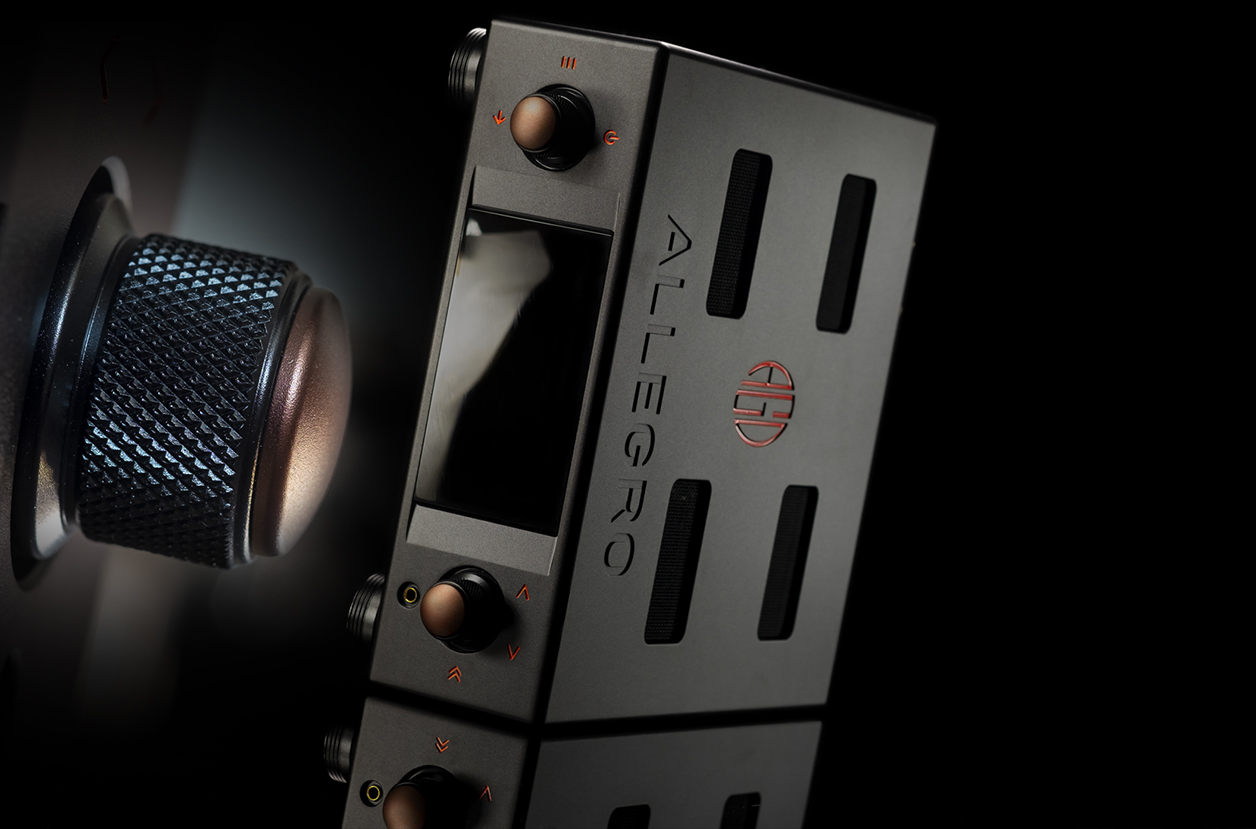
In the impeccable metal, Allegro is an adorably compact square-shaped device that occupies surprisingly little space. It also barely gets warm even after extended sessions, making it an exceptionally domesticated piece of hardware. From a practical standpoint, this is exactly the kind of component for listeners who want a single box to do it all, albeit at a very high level. Generously segmented with ventilation perforations across top and underside, this case is machined from a single billet of aluminium while access to the internals is from below. Normally I'd have no reservations about removing the bottom plate. This time discretion prevailed. My review sample would continue on to another reviewer immediately after my assignment so I decided not to chance opening it. The fascia is as clean and purposeful as the rest. The knurled rotary encoder on the left complete with integrated push function handles standby on/off, input selection and menu navigation. Its right counterpart just above the 4.4mm balanced headfi port governs volume and confirms menu selections. Whenever the headphone jack detects a load, Allegro automatically places its entire GaN power stage and main power supply in standby, leaving only dedicated class A headphone circuitry fed by ultra-low-noise voltage regulators in play¹. Sandwiched between the two controls inside a shallow recess sits a generously sized OLED display that reports the selected input and volume level. Personally I had no issue with its deliberately limited data. The Innuos app on my smartphone already supplies everything else I might want to know, from sample rate and file format to metadata and album art. As such I never found myself wishing for Allegro's display to duplicate such intel.
____________________
¹ This begs a question. Some linear speaker amplifiers tap their main output stage through a voltage divider to adjust gain and impedance for headphone use. Allegro dedicates a separate class A circuit to headphones. Not having come across an ambitious headfi amp with class D outputs whilst learning that this implementation of excellent S/NR and residual noise specs doesn't harness its GaN stage either has me wonder whether somehow, switching outputs and headphones aren't compatible? Ed.
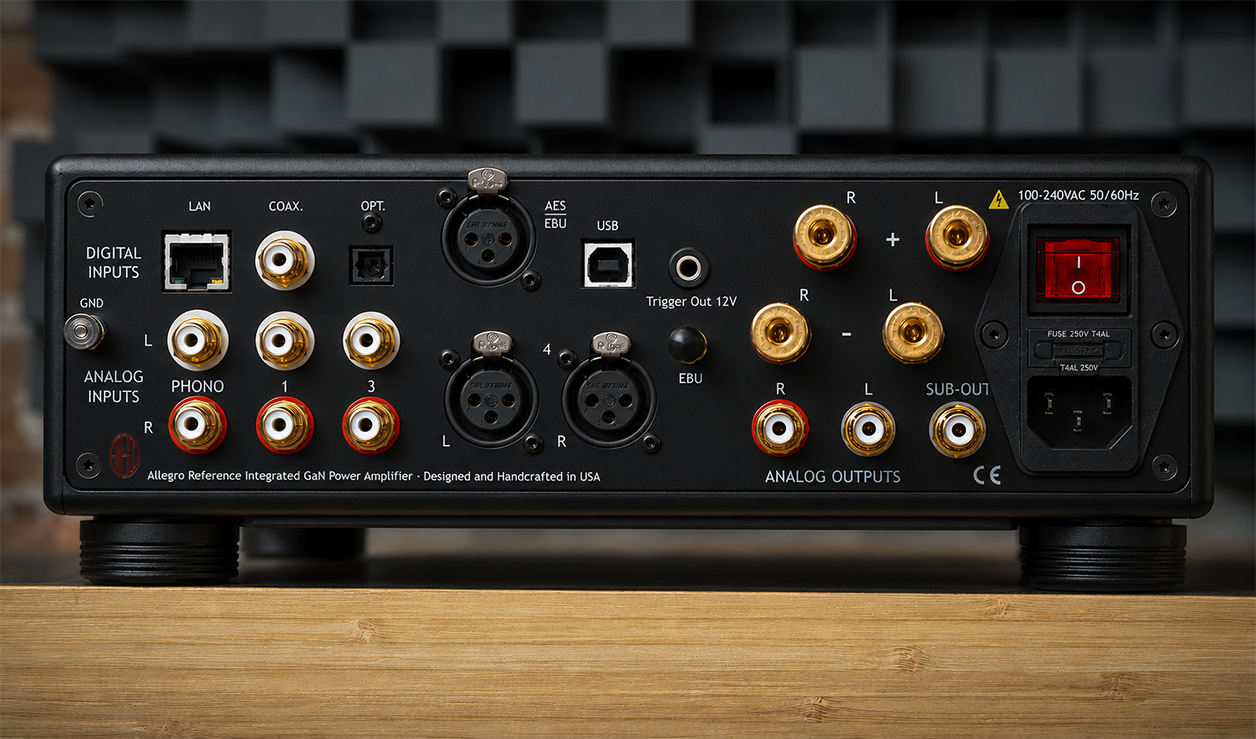
To call Allegro's business end busy would be an understatement. From left to right it accommodates five digital inputs in the form of LAN, coaxial and optical S/PDIF, AES/EBU and USB followed by a 12V trigger output and Bluetooth antenna. Next come the grounding post and RCA phono input followed by two RCA line-level inputs and one on XLR, all direct-coupled and with a <50Ω output impedance. The analog section concludes with a stereo pre-out and mono sub-out all on RCA, the latter low-passed at 80Hz/1st-order. Completing the picture are a pair of handsome binding posts, fused IEC inlet and primary power rocker. The UI is intuitive, straightforward and easy to navigate. Here we can adjust channel balance and MC loading, invert absolute phase, select between MM and MC, set display brightness, engage home-theatre bypass, configure date and clock, pair the remote and inspect system information. And just to state the obvious should my photos fail to do justice: Allegro is very well put together. Long-time HiFiKnights readers may recall my AGD Andante review where I noted Alberto's preference for proprietary digital solutions and industrial-grade parts. Back then the volume control comprised an 8-bit ladder with sixteen industrial relays while D/A conversion was entrusted to four industrial R2R chips. The analog output stage in turn relied on a dedicated buffer based on THAT Corp.'s professional audio chipset. Although Allegro's DAC architecture has since evolved into a fully discrete implementation, the underlying philosophy of keeping as much design in-house as feasible appears very much intact.










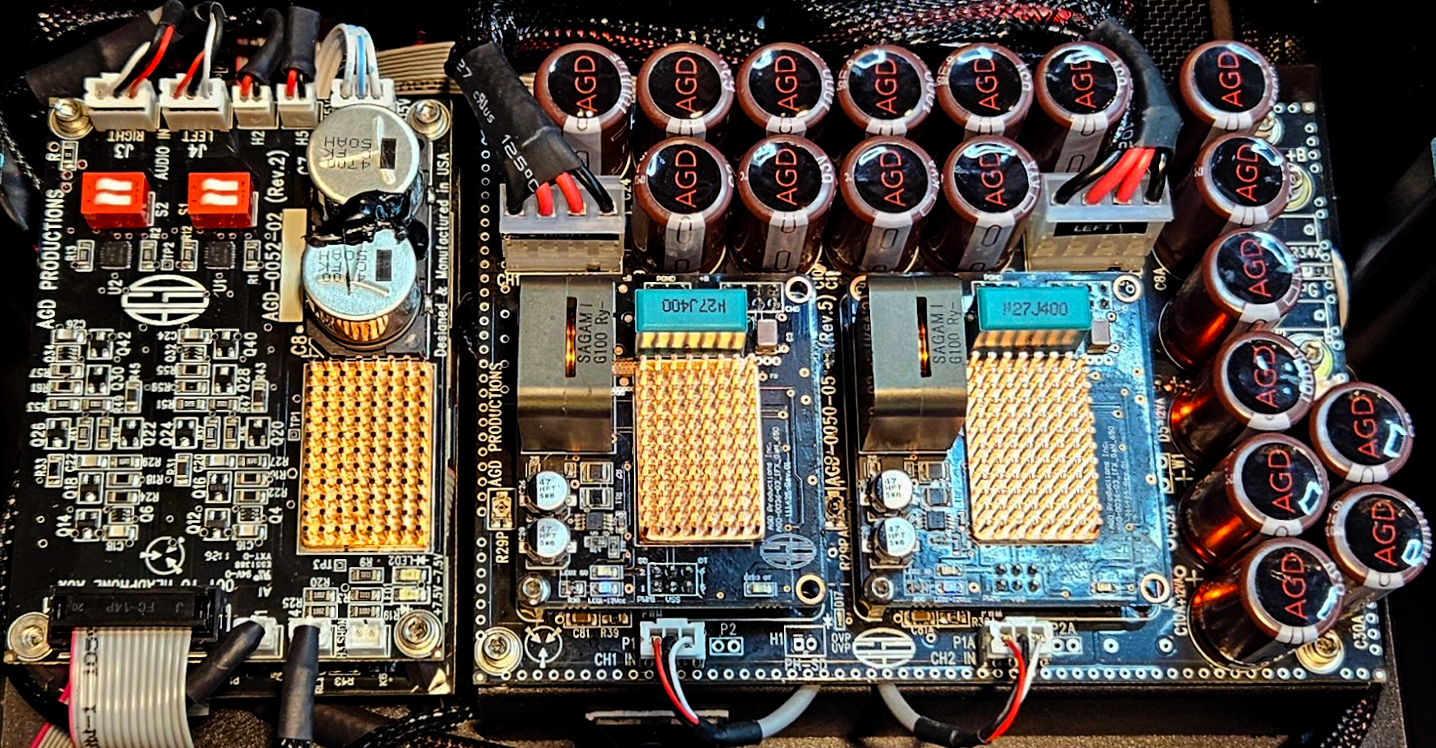 While I didn't inspect Allegro's internals [right image subsequently supplied by AGD for this syndication, click on image for a full-size version – Ed.], Alberto was more than happy to fill in blanks. His R2R DAC is a fully discrete design developed in-house. Ditto the streaming platform around a quad-core ARM single-board computer equipped with 512MB RAM and 4GB onboard memory to further underscore Alberto's determination to engineer as much as possible himself rather than rely on readily available 3rd-party solutions. Power comes from a proprietary 600W switching supply based entirely on GaN tech. This isn't a one-off solution for Allegro but AGD's newest platform of the latest Forté and Gran Vivace MkIV models. In short, Allegro isn't a technological outlier within the portfolio but another beneficiary of its latest hardware intended to become the company's new standard across the range.
One technical aspect worth highlighting concerns AGD's output stage. Beginning with the MkII generation introduced in 2022, every amplifier in this portfolio saw its switching frequency double from roughly 400kHz to ~800kHz. According to Alberto, that increase reflects new 600V GaN parts, a revised GaN output stage, improvements to the PCB layout and several other upgraded critical parts. At the heart of this architecture sits AGD's proprietary GaN module built around dual depletion-mode gallium-nitride FETs with exceptionally low input and output capacitance. Configured as a cascode half-bridge, these devices minimize path length between switching elements to reduce parasitic effects and preserve switching integrity at very high frequencies.
Although the jump from 400kHz to 800kHz may appear as little more than an engineering footnote, it carries tangible benefits. Moving the PWM carrier ever farther from the audible band allows for a less intrusive output filter with improved phase behaviour, flatter response into complex loads and easier suppression of ultrasonic switching residue. While none of it guarantees better sound automatically, it does give the designer considerably more freedom to make a class D amplifier behave like one that isn't. In other words, a higher switching frequency won't rewrite the rulebook but significantly relaxes several compromises traditionally associated with the topology.
Naturally, nothing is free. Operating at 800kHz raises the bar on switching losses, PCB layout, EMI management and overall circuit complexity. Alberto regards his operating point as the practical sweet spot whose measurable gains remain worthwhile without incurring disproportionate thermal penalties. The challenge isn't merely faster switching but to do so cleanly with precise timing, minimal dead time between the devices and no spikes or delays that inevitably mean distortion. Achieving this required considerably more than just fast gallium-nitride parts. Allegro's 800kHz architecture is the result of an entire gain platform developed as a cohesive whole. Its GaN outputs, PWM controller and 600W GaN-based power supply were engineered to complement each other, not operate as isolated building blocks. As so often in high-performance audio, no single decision deserves all credit. Instead, Allegro's amplifier section is best understood as a carefully balanced ecosystem whose individual elements only reveal their full potential when working together. Enough theory. Let's see what all of it sounds like.