Country of Origin

 This review published on HifiKnights.com July 2026. By request of the manufacturer and permission of the author, it is herewith syndicated to reach a broader audience. – Ed.
Reviewer: Dawid Grzyb
Transport: Innuos Statement, fidata HFAS1-S10U
DAC: LampizatOr Horizon360 w. Stradi 5U4G + Psvane Art TIII 4x KT88 / 2x 6SN7
USB components: iFi audio Mercury3.0
Network: Fidelizer EtherStream, Linksys WRT160N
Preamplifier: Trilogy 915R, Thöress DFP
Amplifier: Trilogy 995R, FirstWatt F7, Enleum AMP-23R
Speakers: Boenicke Audio W11 SE+, sound|kaos Vox 3afw
Headphones: HifiMan Susvara
Interconnects: LessLoss Entropic Process C-MARC, Boenicke Audio IC3 CG
Speaker cables: Boenicke Audio S3, LessLoss C-MARC
Speaker signal conditioning: LessLoss Firewall for Loudspeakers, Boenicke ComDev
Anti-vibration conditioning: 12x Carbide Audio Carbide Base under DAC, preamp and speakers
Power delivery: Gigawatt PC-3 SE EVO+/LC-3 EVO, LessLoss C-MARC, LessLoss Entropic Process C-MARC, Boenicke Audio Power Gate, ISOL-8 Prometheus
Equipment rack: Franc Audio Accessories Wood Block Rack 1+3
Review component retail: $14'999

In a class of its own. During the first episode of our recent YouTube endeavour 7th Moon hosted by Srajan and I, we casually mentioned several hifi brands. Today one of them takes centre stage. At one point Srajan asks me. Which brand known primarily for class D has made the biggest impact on me over the years? Without hesitation I answer Alberto Guerra of AGD Productions. This exchange wasn't scripted. Neither of us had the slightest idea where our conversation would lead, what topics might emerge once our webcams rolled. Looking back, AGD's mentions during that podcast were no accident. Truth told, Alberto's work had been on my radar for years already. At HifiKnights alone, his portfolio by now enjoys rather extensive coverage of the Andante and Alto DAC/pre designs, Tempo stereo amplifier and Audion Vivace monos, the latter awarded with our rare Victor badge. That was no coincidence either. Whenever an AGD component landed in my system, it reminded me. Judging an amp by its operating class alone has become increasingly futile. As someone who spent countless hours with genuinely accomplished amplifiers in class A or AB, I can without reservation say that Alberto Guerra's finest belong in exactly such company. His amplifiers never struck me as excellent for class D. They were excellent, period. In my experience they occupy the uppermost tier of contemporary amplification regardless of topology. That's perhaps the highest compliment I can pay them. With that out of the way, let's briefly rewind to the recent High-End Vienna show. That event proved instrumental in kicking off today's review. Although Alberto Guerra didn't exhibit at the main Austria Center Vienna, he was very much present a five-minute stroll away at HiFiDeluxe hosted by the Arcotel Kaiserwasser hotel. On its fifth floor, AGD shared an exhibit with Bayz Audio whose Courante 2.0 speakers were entrusted with showcasing several of Alberto's creations. One of them was his latest and by far most ambitious, the all-in-one affair called Allegro.
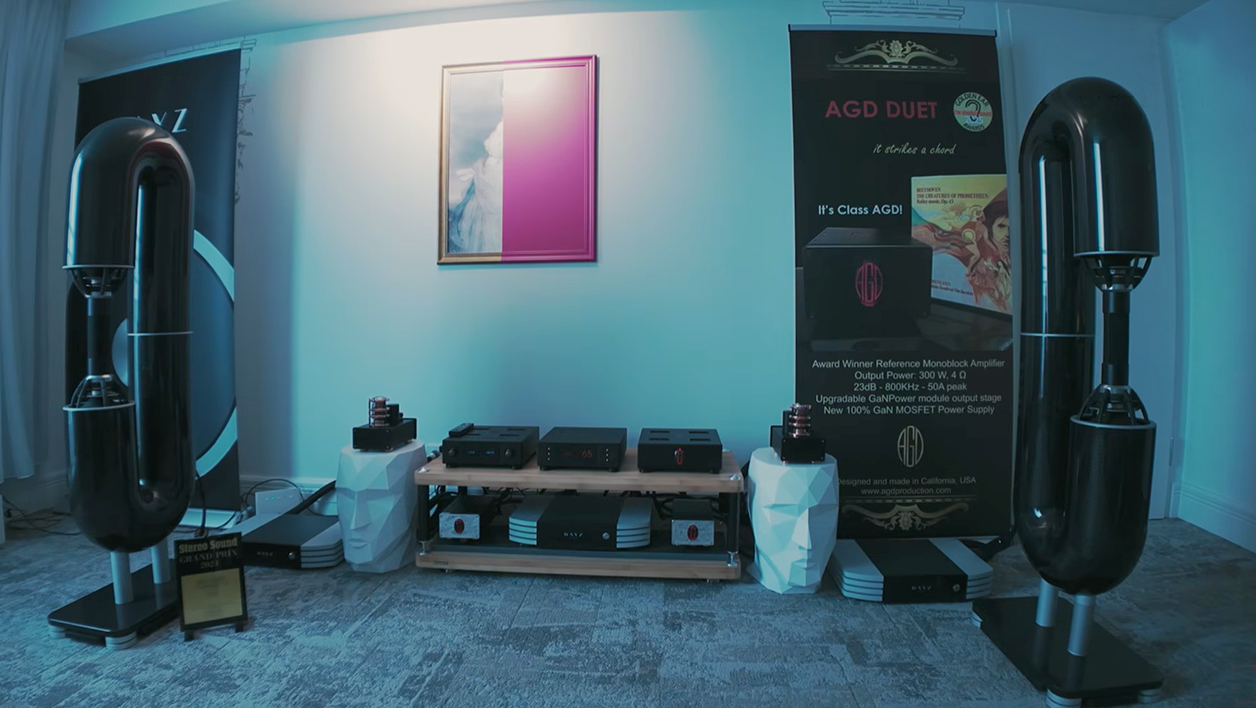 Click on screenshot to see Grzegorz Rulka's YouTube video of this alternate 2026 show.
There I spent far too little time to form any meaningful conclusion about the above system's sonic prowess. Besides, Zoltan Bayz's speakers are omnis. They present music quite unlike conventional front-firing speakers. Anyone without familiarity of their breed needs a moment to recalibrate expectations particularly for imaging and spatial cues. As such, any off-the-cuff sonic remarks would be premature at best. On a personal note, that show finally gave Alberto and I opportunity to shake hands in the flesh. Although our acquaintance dates back to early 2020, with numerous conversations and correspondence exchanged since, our paths never physically crossed before. It was long overdue and as it turned out, the start of Allegro's journey to my room. Roughly two weeks later, a large package bearing AGD's logo landed at my door and the game was afoot. The cargo arrived in a rather substantial carton housing a flight case seemingly fit to withstand an artillery assault. I expected no less though. Over the years this level of packaging has become one of AGD's trademarks. Once latches released, the case revealed a dense foam interior precisely cut for its contents. The main attraction was accompanied by a microfiber cloth, a pair of woollen gloves, a user guide tucked inside a red envelope, a nicely appointed power cord and a handsome aluminium remote that offers everything one might expect: power, mute, volume adjustment, input selection and a confirmation command for menu navigation. Functional, tactile and reassuringly solid, it mirrors the philosophy of the product it accompanies. In fact, the entire unboxing experience felt carefully considered beyond merely adequate. Nothing struck me as an afterthought and as so often with AGD, Alberto Guerra's attention to detail was evident long before the amplifier itself connected to my mains.









Having already designed separate DAC/preamplifiers and power amps, one might reasonably expect a fully analogue integrated next to combine both disciplines under one hood. Instead, Alberto skipped that stop altogether and ventured straight into all-in-one turf. Allegro is an integrated amplifier but one generously seasoned with a DAC, headphone socket, network streamer and full-fledged phono stage which together make for a bona-fide command centre capable of handling virtually any modern source. In other words, it does all, perhaps even things some prospective owners won't need. Take me for example. Vinyl has never been part of my routine. As a predominantly digital listener, I'd inevitably pay for a phono stage only for it to remain permanently idle. That observation felt particularly relevant before Allegro's arrival. This is no modular platform where individual sections can be specified or omitted at time of purchase. In an ideal world, such an ambitious product would allow buyers to configure their needs, not ask everyone to finance the same feature set. Then again, reality is rarely straightforward. Would modularity have compromised Allegro's remarkably compact enclosure or significantly increased its already substantial ask of $14'999 ex VAT and import fees? Maybe Alberto's objective from the outset was an uncompromising centre piece equally comfortable in digital and analogue environs, thus inherently future-proof? Whatever his rationale, my initial reservations gradually faded once Allegro commenced daily service. As I would soon discover, genuinely high performance has a curious way of making theoretical objections increasingly academic. More on that anon. For now I'll play devil's advocate. Should I ever decide to venture into vinyl—and I can't entirely rule it out—Allegro would already have me covered. Better still, it could finally provide incentive to do exactly that. Even before delving into sonic merits, one thing was apparent already: Allegro is the sort of product one builds a system around rather than upgrades from eventually. At this early stage I can already confess that it also belongs to the exceedingly rare breed of components that qualify as endgame purchase. Truly!

Allegro occupies a mere 28×28×9cm footprint and parks 10kg on a scale. Those figures alone hardly prepare one for just how much hardware Alberto managed to cram into such modest real estate. Via its USB input, Allegro accepts PCM up to 32-bit/768kHz and native DSD all the way to 512. There's effectively no commercially available high-resolution format beyond its reach. The built-in streamer supports the DLNA/UPnP standard and already syncs with Qobuz Direct and Audirvana. Spotify, Tidal and Roon certification are on their way. Bluetooth transmits only when selected and otherwise remains off. Analogue enthusiasts aren't left out, either. Allegro's phono stage caters to both MM/MC cartridges, with the former seeing the customary 47kΩ input impedance, the latter 420Ω. The remaining figures are equally reassuring: S/NR of at least 85/75dB for MM/MC, RIAA equalization within a razor-thin ±0.1dB margin, frequency response within the same ±0.1dB tolerance across the audible bandwidth, harmonic distortion below 0.05%. As expected for AGD, the power section is where engineering credentials get particularly impressive. Allegro is specified to deliver 125wpc into 8Ω, exactly twice that into 4Ω for a textbook indication of a stout power supply and output stage happy to source current on demand. That impression is reinforced by peak current capability beyond 50 amperes, enough to wonder whether Alberto inadvertently designed a small welder while distortion remains below 0.005% at 10W/1kHz. Frequency response doesn't roll off until 80kHz/-3dB whereas dynamic range exceeding 120dB rounds out a spec sheet that leaves very little to be desired. A-weighted output noise remains below 45µV and factory gain is set to what for an integrated is a low 23dB [many integrateds with active line stage pack ~35dB – Ed.]. Allegro appears fully equipped to remain unfazed by demanding loads.